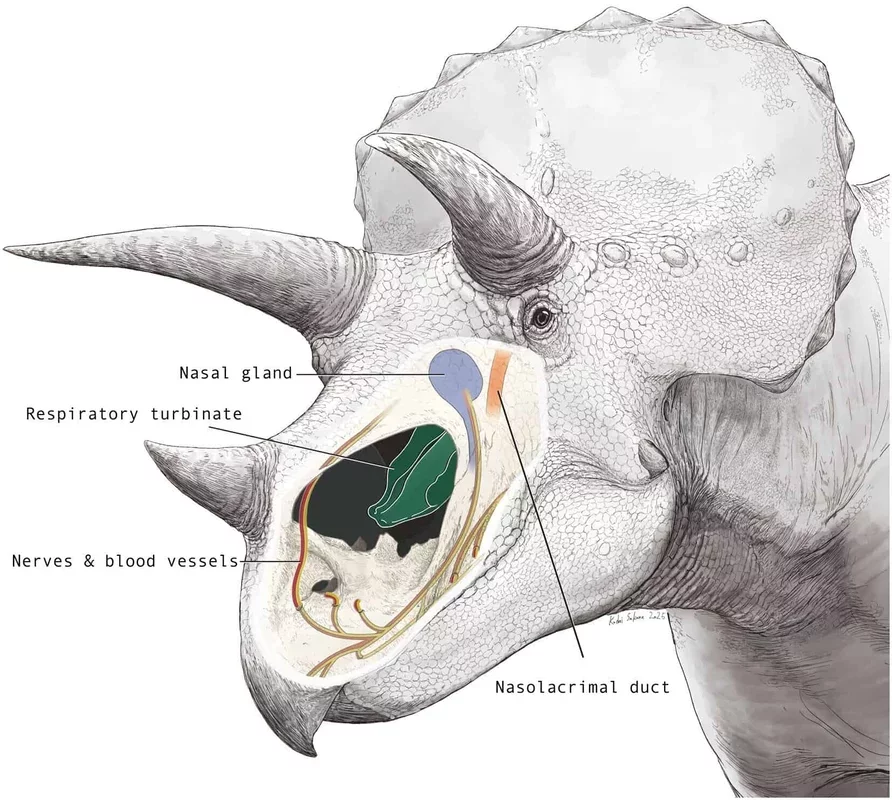
The remarkable anatomy of the Triceratops has sparked new insights into how this iconic dinosaur managed its internal temperature. Renowned for its impressive three-horned head, the internal structure of its skull has remained largely enigmatic until now. Paleontologists have long pondered how such a massive head could maintain a cool brain within its bony encasement.
Recent research from the University of Tokyo provides an intriguing answer, revealing a complex network of nerves and blood vessels within the dinosaur's large nose, functioning as a sophisticated cooling system. "Triceratops had an unusual arrangement of nerves in their noses," explains Seishiro Tada, a researcher at the University of Tokyo Museum. Unlike most reptiles, where nerves and blood vessels reach the nostrils from the jaw, in Triceratops, the structure of the skull necessitated a different route, utilizing the nasal branch instead.
This anatomical adaptation indicates that the dinosaur's snout was not merely a sensory organ but a crucial element for regulating temperature, reflecting a significant evolutionary shift in its facial structure.
An Evolutionary Transformation
To investigate the fossilized remains, researchers employed high-resolution micro-computed tomography (µCT) to examine the premaxilla, the bone at the tip of the upper jaw, from a specimen sourced from the Hell Creek Formation. This innovative approach allowed them to uncover the intricate internal pathways where nerves and blood vessels once traversed the bone.
The findings were unexpected. While most reptiles have two primary nerve pathways for sensory input in the snout, Triceratops faced a unique challenge. Its specialized beak and enlarged nasal region obstructed the conventional route for the jaw nerve, prompting evolution to create an alternative pathway. The lateral nasal nerve expanded its function, taking over sensory duties for the beak's tip.
"This adaptation in Triceratops was essential for supporting its large nose," Tada noted, reflecting on the process of reconstructing the dinosaur's skull using 3D-printed components.
This represents a remarkable reorganization of the cranial nervous system, seemingly unparalleled among reptiles.
Cooling Mechanisms for Ancient Giants
The study further explores the reasons behind the enormous noses of these creatures, linking it to thermoregulation. Large animals like Triceratops generate significant body heat, making it vital to efficiently dissipate this heat. With its massive, heavily insulated head, protecting the brain from overheating was critical.
Researchers identified distinct ridges on the nasal bones of related horned dinosaurs that resemble the attachment points for respiratory turbinates found in modern birds. These structures enhance air surface area for effective heat exchange and moisture retention, akin to a vehicle's radiator.
"While we cannot definitively confirm the presence of respiratory turbinates in Triceratops, similarities with birds suggest a likelihood," Tada remarked, highlighting the rarity of such features in non-avian dinosaurs.
Completing the Puzzle
The research team also inferred the likely position of the nasal gland and the path of the nasolacrimal duct, which appears to have followed a groove on the outside of the lacrimal bone, contrasting with the structure seen in crocodiles.
Utilizing the Extant Phylogenetic Bracket approach, paleontologists draw parallels between fossils and their closest living relatives, such as birds and crocodiles, to hypothesize about soft tissue structures. By identifying osteological correlates--bumps, grooves, and holes on the bones--scientists can reconstruct aspects of the fossil record that are otherwise missing.
This research marks a significant advancement in understanding the anatomy of one of the most well-known dinosaur families. "Horned dinosaurs were the last group to have their cranial soft tissues examined in this detail, completing a vital piece of the dinosaur puzzle," Tada concluded.
The findings have been published in The Anatomical Record.