Far beyond the orbit of Neptune, a fascinating group of icy bodies known as trans-Neptunian objects (TNOs) orbits the Sun. Among them, Pluto is the most recognized, being one of the few with a confirmed thin atmosphere. However, for most TNOs, the extremely low temperatures combined with weak gravitational forces typically lead scientists to assume these distant entities are airless.
A Unique Stellar Event Provides Insight
Recently, astronomers seized a unique opportunity to challenge this assumption with a TNO designated (612533) 2002 XV93. This object, measuring approximately 500 km in diameter, is significantly smaller than Pluto, which has a diameter of 2,377 km.
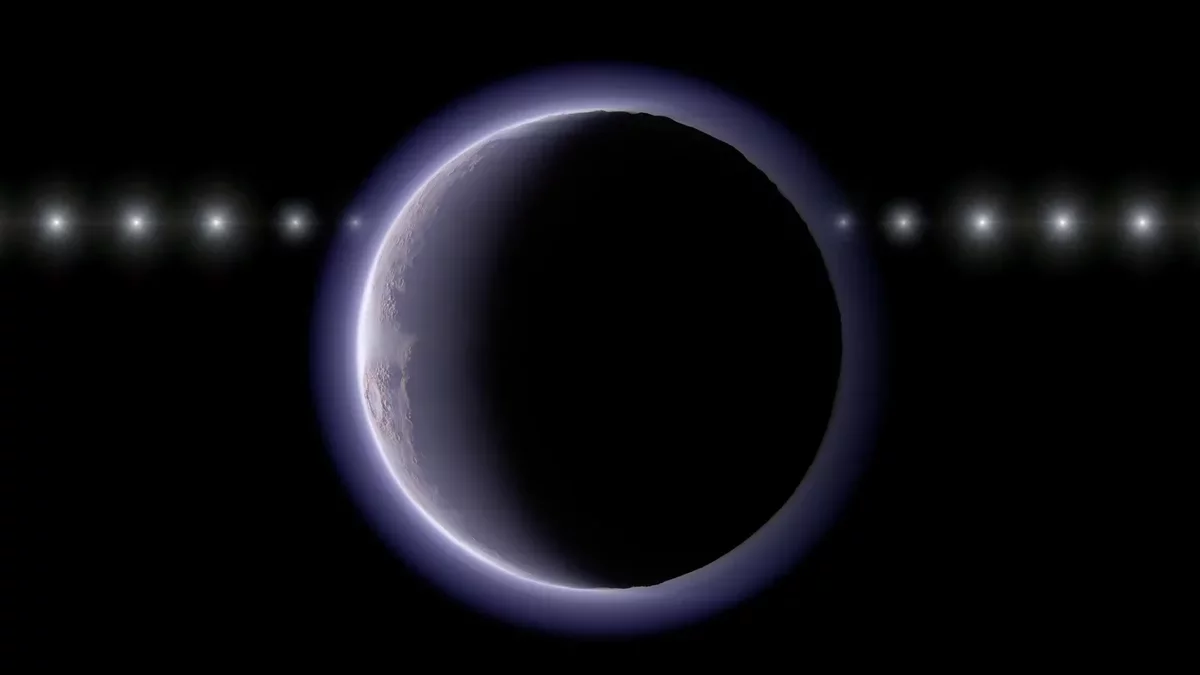
On January 10, 2024, 2002 XV93 passed directly in front of a distant star as seen from Japan. This event, known as a stellar occultation, allows researchers to analyze distant celestial bodies in detail. If an object lacks an atmosphere, the light from the star should abruptly disappear. Conversely, if an atmosphere exists, the starlight will gradually dim as it filters through the gas.
Evidence of a Thin Atmosphere Emerges
A research team led by Ko Arimatsu at the NAOJ Ishigakijima Astronomical Observatory conducted observations from various locations across Japan. Their findings revealed a dimming pattern consistent with light passing through a thin atmosphere, suggesting that 2002 XV93 is indeed enveloped by a gaseous layer.
Transient and Enigmatic Origins
Further investigations indicate that this atmosphere is likely short-lived, predicted to dissipate in less than 1,000 years unless it is replenished. This implies that the atmosphere must have formed or been renewed quite recently.
Data from the James Webb Space Telescope adds another layer to the story. Observations show no signs of frozen gases on the surface that could gradually vaporize to sustain an atmosphere. This absence leads scientists to explore other possibilities, such as internal materials being expelled to the surface, releasing gas, or a comet impact delivering sufficient material to temporarily create an atmosphere.
Ongoing observations will be crucial to uncovering the correct scenario and enhancing our understanding of how such a small, distant object can maintain an atmosphere, even if only for a brief period.