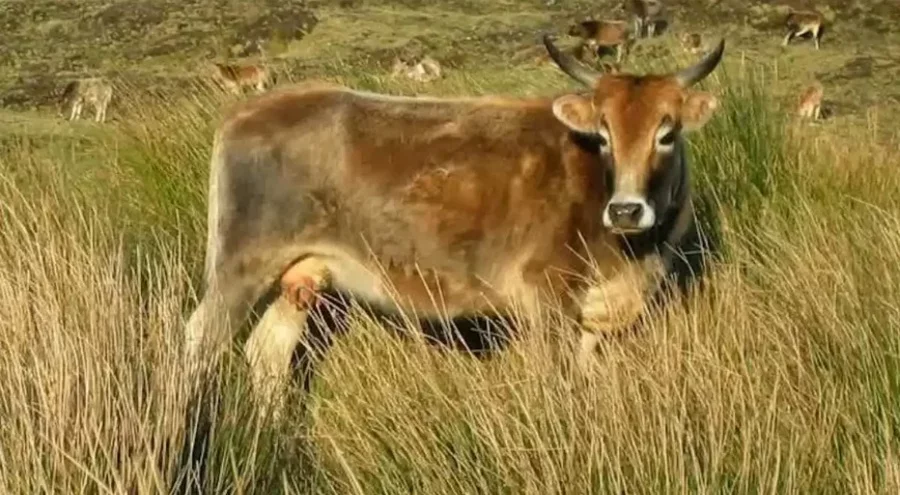
In 1871, a determined farmer disembarked on a volcanic island in the southern Indian Ocean. After seven months of unsuccessful attempts to cultivate crops and raise livestock, he left behind a small group of five or six cows, deeming them a burden as the settlement failed. However, these resilient animals had different aspirations.
Amsterdam Island, a tiny French territory nestled between Madagascar and Antarctica, is characterized by its harsh, windswept climate and isolation--far from an ideal habitat for humans or domesticated animals. Remarkably, over the following decades, this small band of cattle transformed into a thriving herd of 2,000, representing one of the rare truly feral cattle populations on Earth.
This phenomenon puzzled biologists, as small founding groups typically struggle due to inbreeding and environmental challenges. Yet, these cows not only survived for over a century but also significantly altered the island's ecosystem until their culling in 2010.
A recent genetic investigation published in Molecular Biology and Evolution aimed to uncover the secrets behind this extraordinary adaptation.
Optimal Conditions for Cattle
Researchers sought to validate the island's intriguing history. DNA analysis from preserved remains confirmed that the population experienced a significant genetic bottleneck approximately 22 generations ago, aligning with the timeline of the original five founders.
Typically, such a severe bottleneck leads to extinction. However, these cows exhibited unique genetic traits: a blend of European taurine and resilient Indian Ocean Zebu. This genetic "pre-adaptation" equipped them for survival in the island's challenging environment long before they arrived.
According to Laurence Flori, a co-author of the study from France's National Research Institute for Agriculture, Food and Environment, "Our genomic results suggest that mutations already present in the genome of these founding animals played a role in the Amsterdam Island cattle population's rapid adaptation to life in the wild within a few generations."
In essence, these cattle were inherently suited for a wet, resource-scarce habitat.
A Herd Thriving in Isolation
This research addresses a long-standing question in invasion biology: how do small, inbred groups flourish in new environments? The answer often lies in evolution, but chance also plays a significant role.
Once the initial challenges were overcome, the herd expanded rapidly. Despite their inbreeding, their genetic patterns indicated a population that accelerated towards growth rather than heading towards extinction.
Moreover, their behaviors evolved. Observers noted that their actions began to resemble those of wild bovids rather than domesticated cattle.
Stable groups formed among females and young males, while adult males congregated separately. During breeding seasons, mixed herds appeared, and the animals exhibited increased aggression and a diverse range of coat colors--traits commonly found in feral mammals but rarely documented in cattle.
Recent genetic analyses reveal that many of the strongest indicators of natural selection involve genes associated with the nervous system and behavior, suggesting that temperament and stress response were crucial for their survival without human intervention.
The Controversial Decision to Eradicate
Another debate revolves around the size of the cattle. Previous studies suggested they shrank rapidly, illustrating the "island rule" where large mammals on islands tend to evolve smaller sizes. However, newer genomic findings propose that their smaller stature may have been inherited from their ancestral breeds, with little evidence for strong selection towards dwarfism.
Regardless of their size, the cattle became a significant ecological challenge. Their grazing and trampling severely impacted native vegetation and posed a threat to the endangered Amsterdam albatross. In response to the ecological crisis, conservation authorities fenced the area and ultimately eradicated the entire herd by 2010.
This action, while necessary for the island's avian inhabitants, came at a considerable scientific cost. The eradication occurred without systematic biological sampling, effectively ending a rare, real-time study on how mammals adapt to wild conditions.
The story of the Amsterdam Island cattle illustrates how swiftly nature can alter the fate of a few abandoned animals. Given the right conditions, a small group of cows can evolve into a remarkable case study in evolution.
Yet, human decisions can just as quickly bring such natural experiments to a halt.