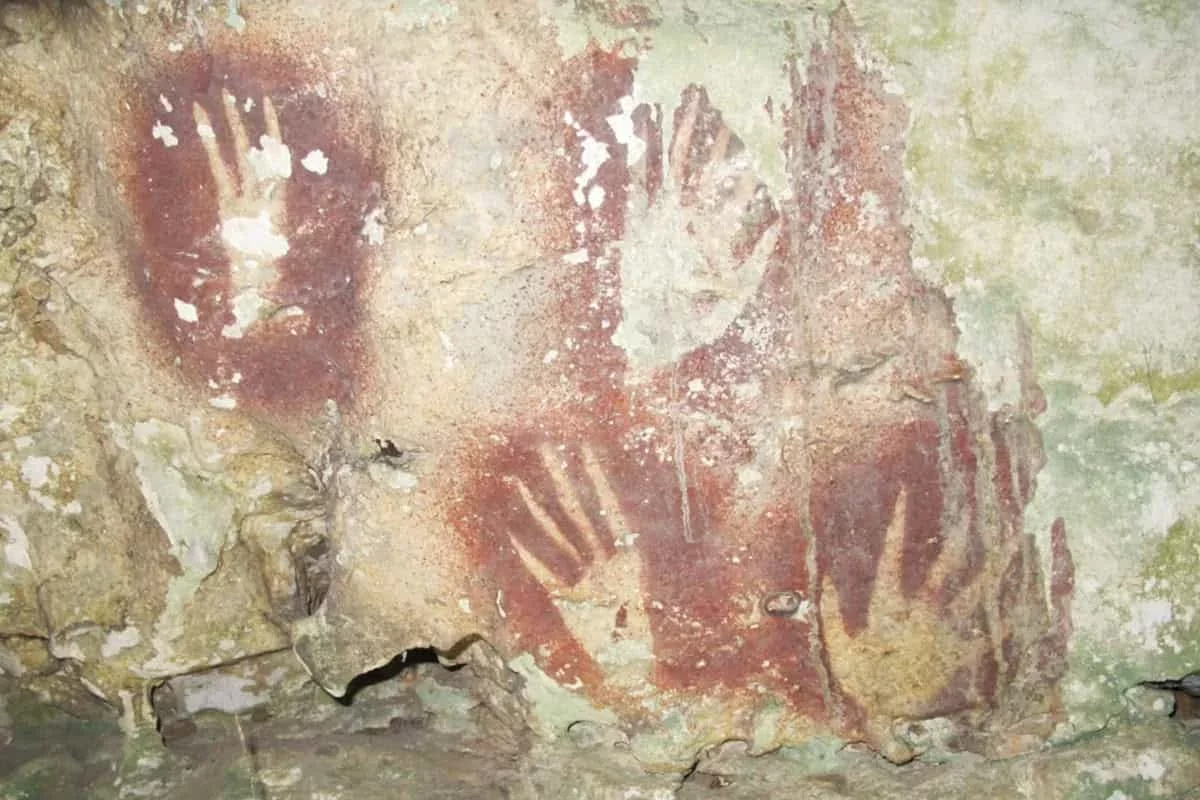
A remarkable discovery has been made on the Indonesian island of Muna, where a hand stencil created by Homo sapiens over 67,000 years ago has been identified as the oldest known piece of art. This ancient artwork, found in a limestone cave, showcases a human hand pressed against the wall, with red pigment sprayed over it, leaving a striking silhouette that has endured through millennia.
For years, the narrative surrounding the origins of art has centered on Europe, with famous sites like Chauvet and Altamira often highlighted. However, this new finding from Sulawesi is set to redefine our understanding, as it predates the earliest known European cave art by thousands of years.
The Technique Behind the Discovery
Determining the age of cave art is notoriously challenging. Traditional radiocarbon dating cannot be applied to mineral pigments like ochre, which lack organic carbon. Instead, researchers utilized Uranium-series dating, a method that functions like an atomic clock embedded in the rock. Water carrying trace amounts of uranium seeps through limestone, and as it evaporates, it leaves behind mineral deposits. By analyzing the uranium-thorium ratio in these layers, scientists can estimate when they formed.
In this case, the calcite layer over the hand stencil provided a minimum age of 67,800 years, making this finding particularly extraordinary, as noted by archaeologist Adam Brumm from Griffith University.
This discovery surpasses a previous record held by a cave painting of a warty pig in Sulawesi, dated to 51,200 years ago, by over 15,000 years.
Artistic Intent and Cultural Significance
The handprint's design is intriguing, with slender, claw-like fingers, suggesting that the artist may have intentionally manipulated the stencil to create this effect. This unique "narrowed finger" motif has been observed in other caves in the region, indicating a cultural continuity that spans thousands of years. Maxime Aubert, a co-author of the study, posits that these stencils could symbolize group identity, marking individuals as part of a specific cultural lineage.
The location of this artwork is also significant, as Muna Island lies within Wallacea, a region that necessitated early humans to navigate open oceans to reach Australia. This implies that the creators of this ancient art were part of a broader population of modern humans who undertook remarkable maritime journeys.
In conclusion, this discovery not only enriches our understanding of prehistoric art but also highlights the complex symbolic traditions of early humans. The hand stencil, alongside other later artworks, reveals a long history of cultural expression in the region, suggesting that art is a universal aspect of the human experience.