In a world where real-time translation through artificial intelligence (AI) has become ubiquitous--from live speech translation in video calls to auto-dubbing on social media platforms--the relevance of learning a new language is being questioned. Major tech companies like OpenAI, Meta, and Google are leading the charge, offering near-instantaneous translation capabilities that continue to evolve.
This technological advancement prompts a critical inquiry: If machines can translate languages more swiftly and accurately than humans, is it still beneficial to invest time in mastering a new language?
Historically, humans have leveraged tools to enhance cognitive functions--writing has eased memory burdens, while calculators have simplified mathematical tasks. AI follows this tradition, serving as a supportive tool that can expand learning and accessibility in significant ways.
However, the distinction between using a tool to augment capabilities and relying on it to forgo engagement entirely is crucial. This becomes especially relevant when considering not just the skills being replaced, but the cognitive and cultural connections that language learning fosters.
The Value of Effort in Language Acquisition
Effort is integral to knowledge acquisition. Psychologists refer to "desirable difficulties," challenges that may seem counterproductive but actually enhance long-term retention and understanding. Engaging with grammar, searching for appropriate vocabulary, and constructing meaning across languages stimulate brain networks that bolster memory, attention, and cognitive flexibility.
Active mental engagement contributes to what researchers call cognitive resilience--the brain's ability to maintain function as it ages. Managing multiple languages demands the brain to resolve competition, monitor context, and adapt dynamically. These are significant challenges that passive use of translation tools cannot replicate.
Insights from Multilingualism Research
Research on multilingualism often simplifies findings into a "bilingual advantage," obscuring a more nuanced reality. Some studies indicate benefits in areas such as attention and working memory, while others find no significant differences. Recent studies demonstrate that multilingual experience correlates with enhanced performance in specific cognitive tasks, particularly in visuospatial working memory among older adults.
Moreover, multilingualism has been linked to later onset of Alzheimer's disease and improved aging outcomes, although the underlying mechanisms remain a topic of debate.
The Limitations of AI Translation
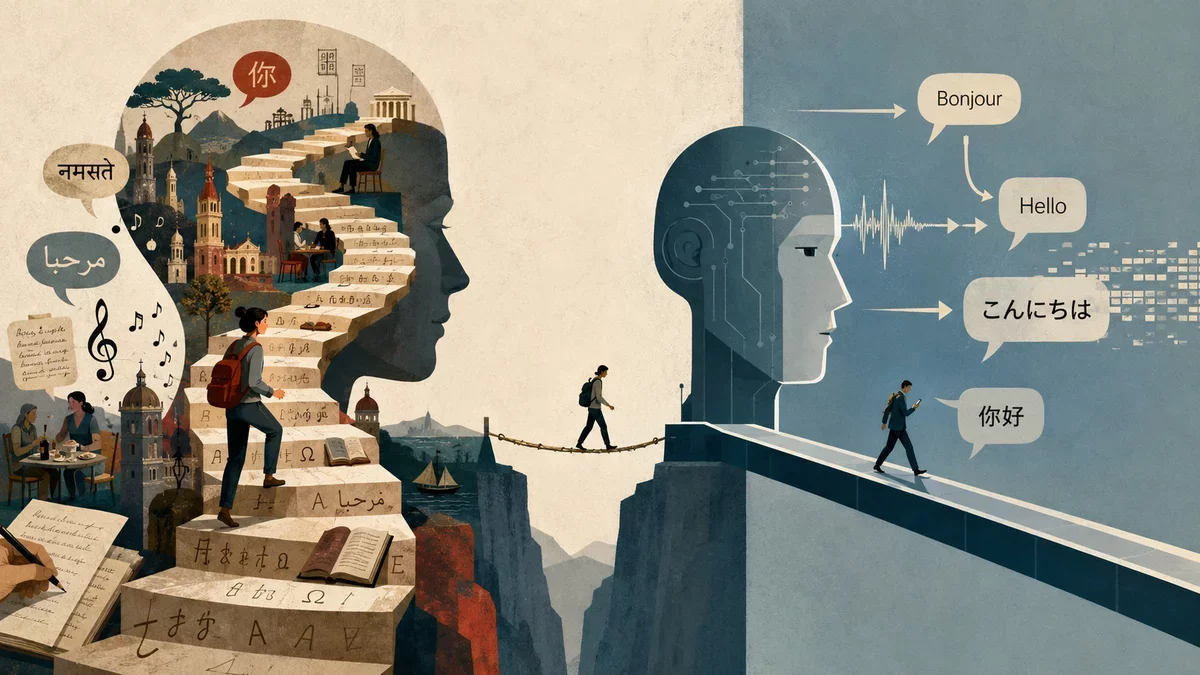
While AI translation excels in speed and accessibility, it lacks the ability to grasp cultural nuances, humor, and emotionally embedded meanings. AI captures the literal aspects of language but often misses the social context that enriches communication. For instance, a heartfelt proposal delivered in a foreign language carries emotional weight that automated translation cannot convey.
Ultimately, learning a language is about understanding diverse perspectives, values, and the intricate ways meaning is shaped by culture and history. This depth of cultural literacy emerges from personal interaction and experience, which cannot be fully replaced by AI.
As AI continues to transform language learning, it will enhance personalized instruction and reduce barriers, but the cognitive and cultural engagement derived from learning a language remains irreplaceable. This engagement fosters a deeper connection with how others perceive the world and enriches personal expression.