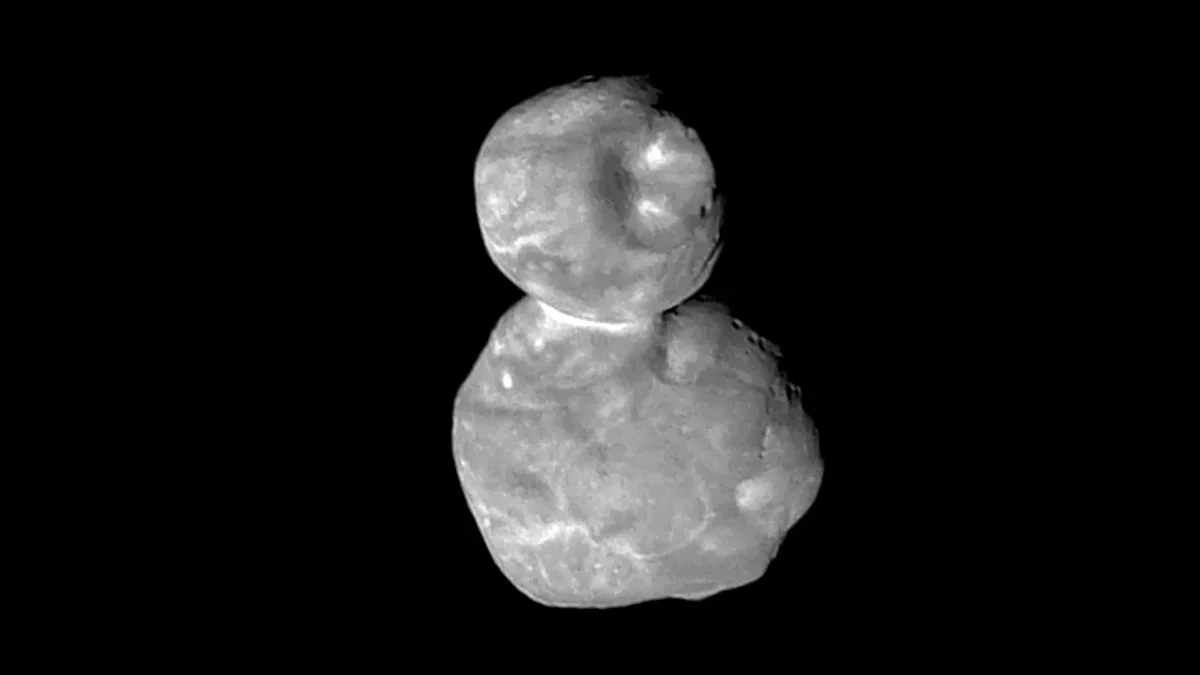
Beyond the asteroid belt that separates Mars and Jupiter lies the enigmatic Kuiper Belt, a remote region past Neptune filled with frozen remnants from the solar system's formative years. These ancient objects, known as planetesimals, serve as the building blocks of planetary formation. Intriguingly, around 10 percent of these planetesimals are identified as contact binaries, featuring two connected lobes that resemble snowmen. Until recently, the natural formation of such shapes remained a mystery.
Innovative Simulation Unveils Gravitational Collapse Mechanism
Jackson Barnes, a graduate student at Michigan State University (MSU), has pioneered a groundbreaking computer simulation that successfully generates these double-lobed structures through gravitational collapse. His research findings were published in the Monthly Notices of the Royal Astronomical Society.
Previous models simplified collisions by treating the colliding bodies as fluid masses, which hindered the accurate recreation of the unique two-part shape characteristic of contact binaries. Utilizing the advanced computing resources at MSU's Institute for Cyber-Enabled Research (ICER), Barnes developed a more sophisticated simulation environment. His model allows forming objects to maintain their structural integrity, enabling them to settle against each other rather than merging into a singular sphere.
Earlier theories suggested that rare cosmic events or unusual conditions could explain the presence of contact binaries. However, such scenarios fail to account for their relative abundance. "If we consider that 10 percent of planetesimal objects are contact binaries, the formation process must not be rare," stated Earth and Environmental Science Professor Seth Jacobson, the senior author of the study. "Gravitational collapse aligns well with our observations."
Insights from NASA's New Horizons Mission
Contact binaries gained significant attention when NASA's New Horizons spacecraft provided detailed images of one in January 2019. This discovery prompted scientists to investigate additional Kuiper Belt objects, revealing that approximately one in ten planetesimals exhibit this distinctive shape. In the sparsely populated Kuiper Belt, these distant bodies drift with minimal collisions, allowing their delicate structures to endure.
The Kuiper Belt is a remnant of the early Milky Way, a time when the galaxy was a swirling disc of gas and dust. This primordial material still exists in the region, including dwarf planets like Pluto, comets, and countless planetesimals.
Understanding Planetesimal Formation and Coalescence
Planetesimals emerged as some of the first substantial objects from the rotating disc of dust surrounding the young Sun. Much like snowflakes coalescing to form a snowball, tiny particles were drawn together by gravitational forces into larger aggregates. As these rotating clouds collapsed, they occasionally divided into two separate bodies that began orbiting each other. Astronomers frequently observe such binary planetesimals within the Kuiper Belt. Barnes' simulation illustrates how the pair gradually spirals inward, gently coming into contact and fusing while preserving their rounded shapes, thus creating the recognizable snowman form.
Longevity of Contact Binaries
Once fused, these objects can remain intact for billions of years. Barnes notes that their long-term stability arises from the low likelihood of further impacts in the remote Kuiper Belt, where collisions are infrequent. Without disruptive events, the two lobes remain connected, and many binary objects show minimal cratering.
Although the role of gravitational collapse in forming contact binaries was previously suspected, earlier models lacked the necessary detail for thorough testing. Barnes' research marks a significant advancement in this area, allowing for a legitimate examination of this hypothesis. "This paper is exciting because it enables us to test this idea in a meaningful way," Barnes expressed. The team is also working on enhanced simulations to explore more complex systems involving multiple connected objects. As NASA's future missions continue to probe the solar system's distant regions, both Jacobson and Barnes anticipate the discovery of even more snowman-shaped worlds.