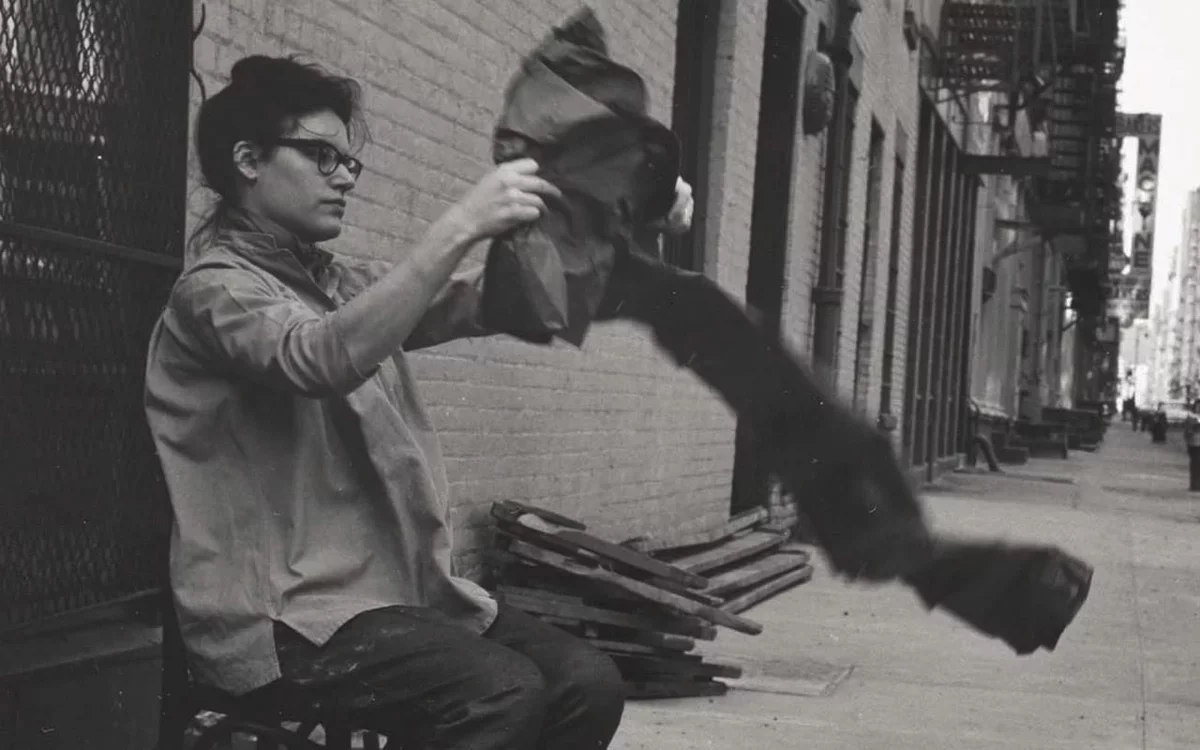
In October 1962, Alison Knowles transformed the mundane act of salad preparation into an innovative art form with her performance piece, Proposition #2: Make a Salad. This groundbreaking event took place at London's Institute of Contemporary Arts during the vibrant Festival of Misfits, organized by poet and art dealer Victor Musgrave. During the performance, Knowles and her collaborators mixed fresh ingredients in a pickle barrel on stage, serving the dish to an audience of around 100, exemplifying her talent for turning everyday activities into communal and transcendent experiences. Such radical undertakings would characterize Knowles's remarkable six-decade career.
The recently released book, Performing Chance: The Art of Alison Knowles In/Out of Fluxus by Nicole L. Woods, marks the first comprehensive exploration of Knowles's work. Despite being the only female founding member of the avant-garde Fluxus movement, Knowles's contributions have often been overlooked. Woods notes that Knowles's art, which is frequently ephemeral and multidisciplinary, has led to her being described as a "mystery." The artist's humble approach and subtlety in her work further contribute to her enigmatic presence.
Woods's book delves into the first two decades of Knowles's artistic journey, spanning from 1958 to 1975. Each chapter focuses on specific artworks, tracing Knowles's evolution as an artist. A pivotal moment occurred at Syracuse University, where Knowles, after being sidelined by Josef Albers for not adhering closely to traditional methods, decided to abandon painting. This decision paved the way for her explorations in performance, installation, poetry, and other experimental forms.
The text provides an insightful analysis of Knowles's works, drawing connections between her pieces and broader art historical contexts. For instance, Woods highlights parallels between Knowles's Journal of the Identical Lunch (1971) and early Cubist collage, as well as the socio-political undertones in her Poem Drop Event (also 1971), which resonated with the antiwar movement. However, some interpretations may risk overshadowing the spontaneity and joy inherent in Knowles's creations.
Woods aims to balance Knowles's art with her personal life, yet the book offers limited insights into the latter. The complexities of Knowles's relationships, particularly with her husband and fellow Fluxus artist Dick Higgins, are touched upon but not explored in depth. The text hints at the challenges Knowles faced in managing her career and family life, but fails to provide a fuller picture of her experiences beyond her artistic endeavors.
Despite these shortcomings, Woods's expertise shines through, as she has spent nearly two decades studying Knowles and conducting interviews. The book ultimately serves as a valuable resource for understanding Knowles's artistic innovations and her impact on contemporary art.
Performing Chance: The Art of Alison Knowles In/Out of Fluxus is now available from the University of Chicago Press, inviting readers to discover the profound legacy of this pioneering artist.