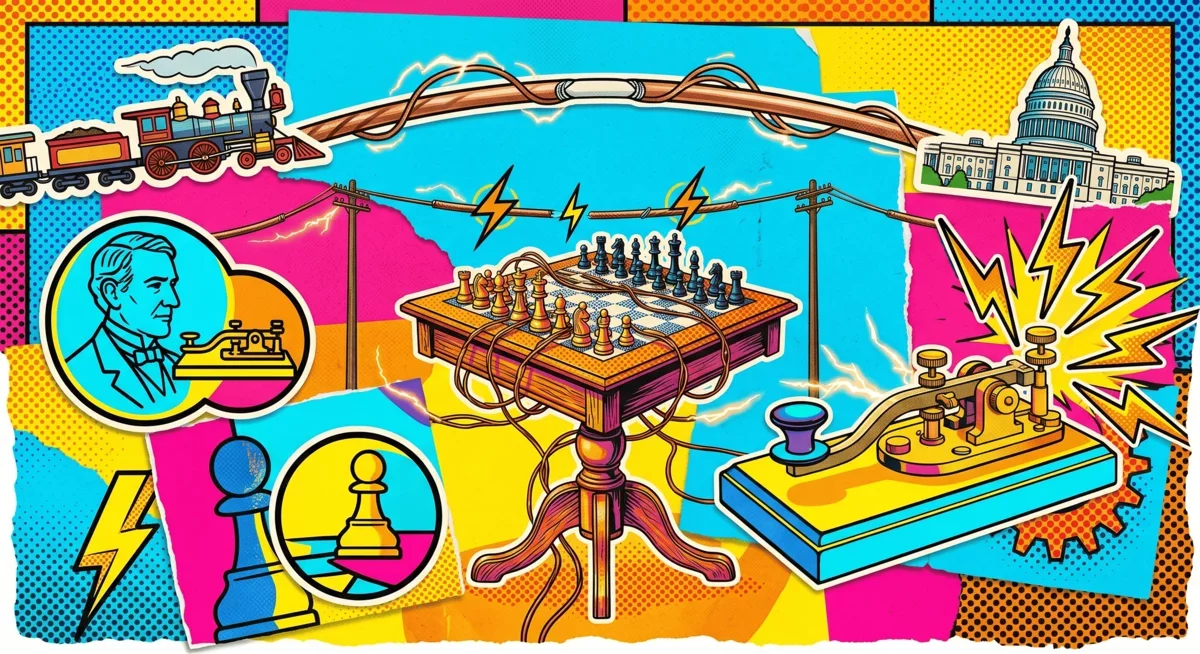
On a chilly November afternoon in 1844, chess enthusiasts in Washington initiated a game in the traditional manner, moving a pawn to the center. However, their opponents were not nearby but located 60 kilometers away in Baltimore, with each move transmitted through telegraph wires.
Long before the advent of online gaming and massive e-sports tournaments, chess became one of the first games to embrace electric communication. This innovation not only facilitated gameplay but also introduced the concept of people connecting, competing, and watching each other in real-time across long distances.
Historian Simone Müller-Pohl highlights that this "cable chess" phenomenon emerged at the intersection of several 19th-century interests, including sports, science, and the burgeoning middle class's ambitions. It represented a thrilling new frontier where distance could be bridged.
World's First E-Sport
Modern chess has its roots in a game dating back approximately 1,500 years, originally known as chaturanga, which emerged in India. This early version was designed to simulate military strategies, reflecting the four divisions of the Indian army.
After making its way to Persia and then Europe, chess evolved into a game primarily enjoyed by the elite. The societal shifts of the 19th century democratized the game, allowing a burgeoning middle class to engage in it.
In the 1840s, chess clubs began to form, and formal tournaments were organized. Newspapers started featuring chess columns, and publishers produced magazines and theoretical works to standardize the game. Müller-Pohl notes that in cities like Paris and London, intellectuals regularly gathered to play.
Correspondence chess had gained popularity through postal services, albeit slowly. However, with Samuel Morse's invention of the telegraph, communication became instantaneous. The first telegraph line in the U.S. was established in May 1844, transmitting Morse's famous message.
Chess and Marketing
The first telegraph chess game began almost serendipitously when Morse's associate Alfred Vail challenged the Washington Chess Club to a match. Utilizing a numbering system for the chessboard, moves were sent as rapid signals, resulting in a seamless transmission of all 686 moves across the telegraph.
The excitement surrounding these games captivated many, including members of Congress, and Morse leveraged this interest to promote the telegraph's potential.
Britain Seized the Idea and Made It Even Bigger
While America pioneered telegraph chess, Britain transformed it into a spectacle. In 1845, British inventor Charles Wheatstone organized a match between chess master Howard Staunton and a rival, transmitting moves over a distance of nearly 90 miles. This event showcased the telegraph's capabilities and attracted significant public interest.
As telegraph chess spread globally, it fostered connections across oceans, with matches played over newly laid submarine cables by the 1890s.
A Global Board for Peace
This innovative medium brought people closer together, with some optimists believing it could reduce conflict through instant communication. Müller-Pohl notes that telegraphy effectively turned the world into a chessboard, allowing for strategic interactions without hostility.
As technology evolved, chess adapted alongside it, transitioning from telegraph to telephone, radio, and eventually to the internet, where it thrives today as a recognized e-sport. This evolution demonstrates how human creativity continually seeks to connect and engage through play, reflecting a timeless impulse to combine innovation with leisure.