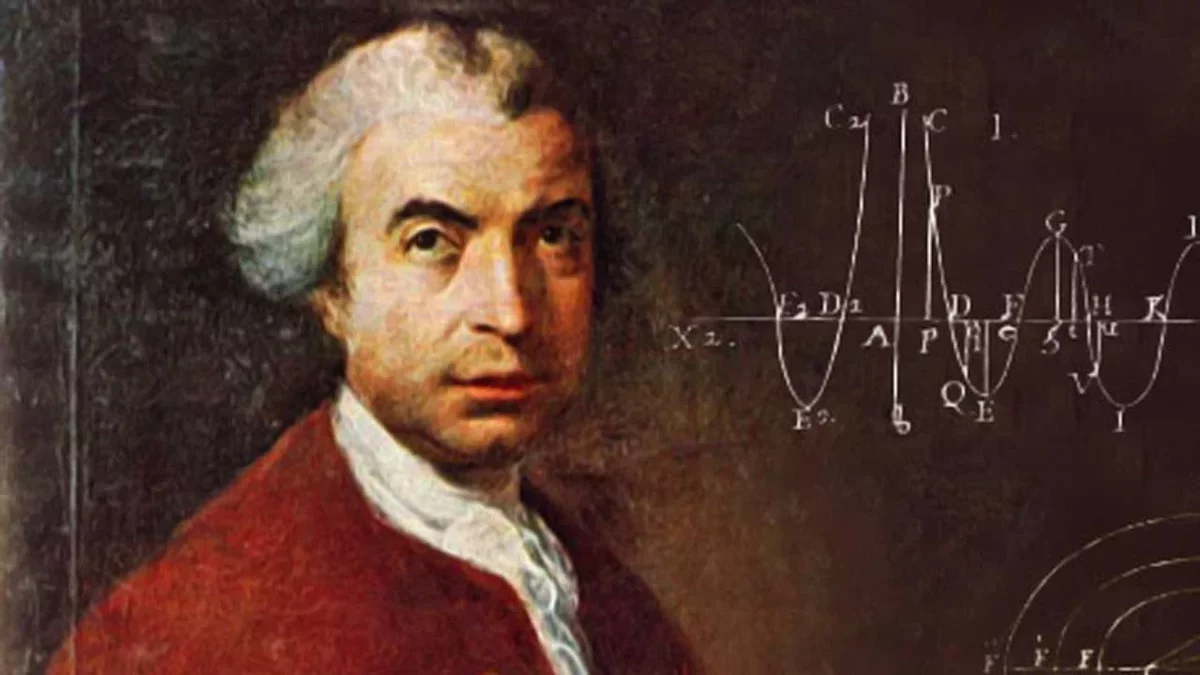
During the 18th century, the scientific community was captivated by the deterministic views of Newtonian physics, perceiving the universe as a predictable mechanism. However, Father Roger Joseph Boscovich, a distinguished polymath from Dubrovnik, Croatia, challenged this notion with a groundbreaking hypothesis: matter is not continuous but composed of discrete, point-like particles that interact through unseen forces.
This revolutionary perspective laid the groundwork for a dynamic, quantized universe--one that predated the principles of atomic physics and quantum mechanics by nearly two centuries. Boscovich's insights essentially foreshadowed a form of quantum theory.
The Polymath of Dubrovnik
Born on May 18, 1711, Boscovich epitomized the Renaissance spirit, excelling as a physicist, mathematician, astronomer, philosopher, poet, diplomat, and Jesuit priest. His educational journey began at a local Jesuit college, later advancing to the Collegium Romanum in Rome, where he became a mathematics instructor by 1740 and was ordained in 1744. His contributions spanned various fields, including classical mechanics and natural philosophy, where he formulated theories that would influence future scientific advancements.
The Radical Idea
Boscovich's innovative thinking emerged in a time dominated by Newton's theories, which portrayed matter as solid, massy particles governed by straightforward forces. In his seminal work, Theoria Philosophiae Naturalis, published in 1758, he proposed that matter consists of dimensionless particles governed by fundamental laws of force.
His famous "Boscovich force curve" illustrated how the force between particles varies with distance:
- At short distances: The force is repulsive, preventing matter from collapsing.
- At medium distances: The force becomes attractive, maintaining structural integrity.
- At long distances: The force aligns with gravitational principles.
This interplay of forces established stable equilibrium points, hinting at atomic stability long before the technological means to validate such ideas existed.
A Precursor to Quantum Theory?
Boscovich's perspective on matter as discrete points anticipated the discrete units in quantum mechanics, such as photons and electrons. His conceptualization of forces acting across space predated the field theories later developed by scientists like Michael Faraday and James Clerk Maxwell. Faraday acknowledged his inspiration from Boscovich in formulating electric field concepts.
Moreover, Boscovich recognized the limitations of human reason when exploring the atomic realm, proposing a philosophical precursor to the uncertainty principle later articulated by Heisenberg. His insights into forces and their interactions have been acknowledged as foundational to modern physics.
Faith and the Fabric of Reality
For Boscovich, science and faith were intertwined. As a Jesuit, he viewed the universe's order as a reflection of divine reason, arguing that the laws of nature expressed God's rationality. He believed that the universe is a harmonious system describable by mathematical laws, suggesting an intelligent order behind natural phenomena.
Rediscovering a Titan
Despite his early influence on atomic theorists, Boscovich's legacy faded after the suppression of the Jesuit order in 1773. It wasn't until the 20th century that his contributions were fully recognized, with scientists like Werner Heisenberg praising his pioneering ideas. Boscovich's exploration of forces and particle interactions significantly shaped our understanding of the universe, illustrating that the cosmos is not merely a machine but a dynamic interplay of forces.
Through his visionary work, Ruđer Boscović has laid the groundwork for future scientific revolutions, reminding us that sometimes, to envision the future, we must first reflect on the past.