For decades, scientists have been intrigued by the potential behavior of superfluids at even lower temperatures. This long-standing question has remained elusive for nearly half a century.
A Superfluid That Halts
Recent findings published in Nature by a research team led by physicists Cory Dean from Columbia University and Jia Li from the University of Texas at Austin reveal an astonishing phenomenon. They observed a superfluid, which is known for its perpetual motion, abruptly cease movement. "This is the first instance where we've witnessed a superfluid transition into what seems to be a supersolid," Dean stated. This transformation is akin to water freezing into ice, yet it occurs within the quantum realm.
Understanding Supersolids
A traditional solid is characterized by atoms arranged in a fixed, repeating crystal lattice. Conversely, a supersolid represents the quantum interpretation of this concept. It is expected to maintain a structured, solid-like formation while also exhibiting properties typically associated with liquids, such as frictionless flow. This unique combination positions supersolids as one of the most fascinating states of matter proposed in physics.
Until this study, no experiment had clearly demonstrated a superfluid naturally evolving into a supersolid. This includes helium and all other known forms of matter. Previous laboratory experiments have simulated supersolid behavior through meticulously controlled environments established by atomic, molecular, and optical (AMO) physicists. These setups utilized lasers and optical elements to create a periodic trap, compelling particles into a repetitive configuration, similar to how Jello assumes shape in an ice cube tray.
Exploring Graphene for Insights
The quest for a naturally occurring supersolid has been one of the most debated enigmas in condensed matter physics. Dean's team opted for a novel approach by utilizing graphene, a naturally occurring material composed of a single layer of carbon atoms. The team included Li, who conducted the research during his postdoctoral fellowship at Columbia, along with Yihang Zeng, a former PhD student now serving as an assistant professor at Purdue University.
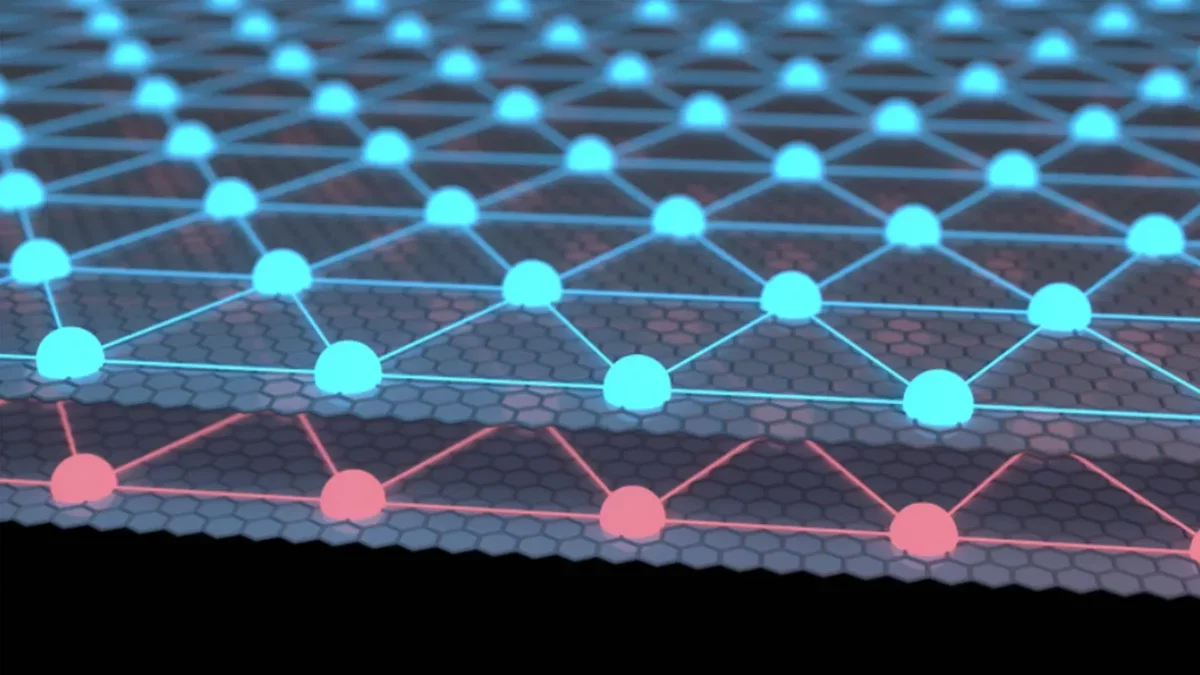
Graphene can accommodate particles known as excitons. These quasiparticles arise when two atom-thin graphene sheets are stacked and adjusted so that one layer has excess electrons while the other has surplus holes (the absence of electrons). Due to their opposite charges, electrons and holes can bond to form excitons. In the presence of a strong magnetic field, these excitons can collectively behave like a superfluid.
Unexpected Phase Transition in a 2D Material
Two-dimensional materials like graphene serve as excellent platforms for investigating quantum phenomena due to their adjustable properties. Researchers can manipulate variables such as temperature, electromagnetic fields, and even the spacing between layers. As Dean's team fine-tuned these parameters, they discovered an unforeseen correlation between exciton density and temperature.
When excitons were densely packed, they moved freely as a superfluid. However, as density decreased, the flow halted completely, and the system transitioned into an insulating state. Increasing the temperature reinstated the superfluid behavior. This sequence challenges longstanding assumptions regarding superfluidity.
"Superfluidity is typically viewed as the low-temperature ground state," Li noted. "The observation of an insulating phase transitioning into a superfluid is unprecedented. This strongly implies that the low-temperature phase represents a highly unusual exciton solid."
Is This Truly a Supersolid?
Whether this state can be classified as a supersolid remains an open question. "We are left to speculate somewhat, as our ability to investigate insulators is somewhat limited," Dean explained, noting their expertise lies in transport measurements, which insulators do not facilitate. "For now, we are examining the boundaries surrounding this insulating state while developing new tools for direct measurement."
Future Directions for Supersolids
The research team is now exploring other layered materials that might exhibit similar quantum phases. In bilayer graphene, the excitonic superfluid and potential supersolid emerge only under strong magnetic fields. Other materials might be more challenging to fabricate in the necessary configurations but could allow excitons to remain stable at elevated temperatures without requiring a magnetic field.
Mastering the control of superfluids in two-dimensional materials could have profound implications. Compared to helium, for instance, excitons are thousands of times lighter, enabling the formation of exotic quantum states at significantly higher temperatures. While the intricacies of supersolids are still being unraveled, these findings provide compelling evidence that 2D materials will be crucial in understanding this enigmatic quantum phase.