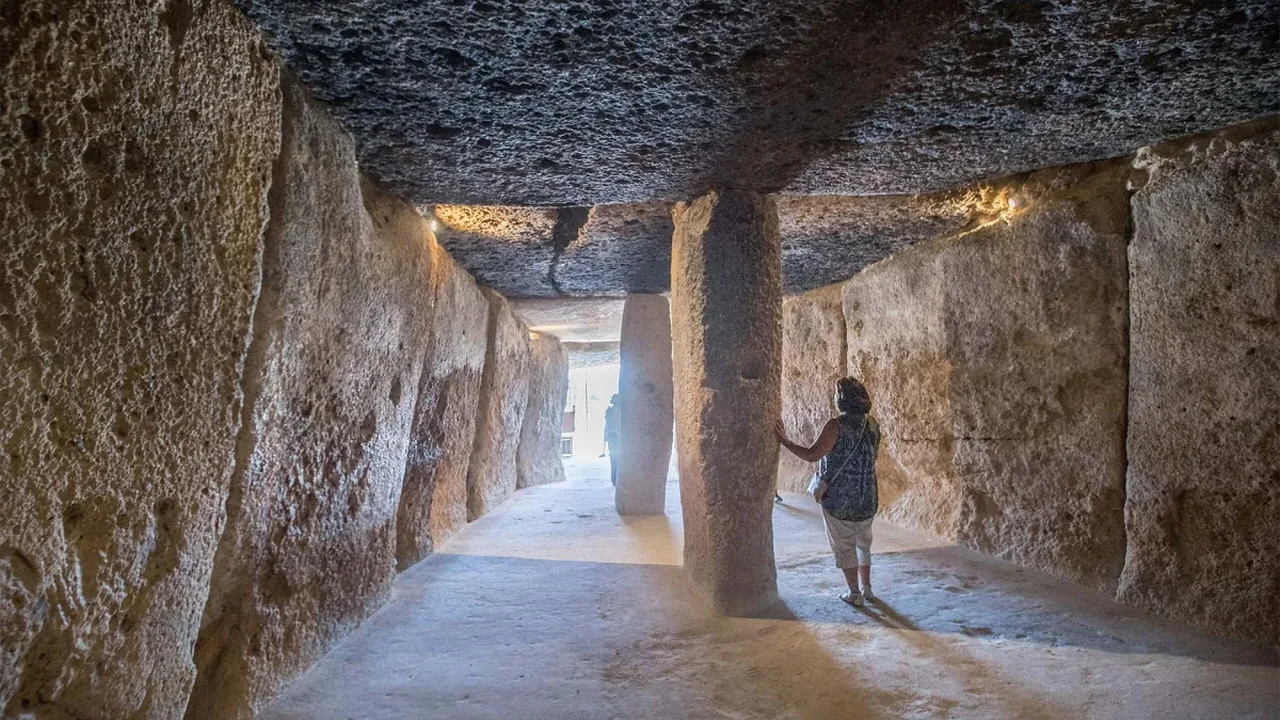
Near Antequera in southern Spain, the Menga Dolmen continues to stand as one of Europe's most remarkable prehistoric structures. Built during the Neolithic era, this stone chamber is nearly 6,000 years old and predates both Stonehenge's iconic stone phase and the Great Pyramid of Giza by more than a millennium.
Ancient engineering, modern insight
Researchers studying the monument in 2024 used laser scans, geological mapping, excavation records, and historical documentation to reconstruct how it was built. Their findings suggest that the builders worked with extraordinary precision, shaping and placing enormous stones without modern machinery.
The largest roof slab weighs about 150 tonnes, while the monument's 32 structural stones together total an estimated 1,140 tonnes. Rather than relying on brute force alone, the builders appear to have combined knowledge of geology, friction, angles, and geometry to create a stable design that has endured for millennia.
How the monument was assembled
Evidence points to a quarry source at Cerro de la Cruz, about one kilometer away and uphill from the site. The stones were likely moved on wooden sledges over prepared trackways, then lowered into a deep foundation cut into bedrock. Some uprights were set as much as 3.2 meters below the final floor level, giving the structure exceptional stability.
Each block was positioned with a slight incline so it could lock tightly with the next one. After the walls and pillars were in place, the capstones were added to form the roof. Builders then removed the inner bedrock, leaving a chamber protected by an earthen mound that also helped shield the softer stone from weather and moisture.
The monument's placement was equally deliberate. It sits on stable ground near the quarry and its axis points toward La Peña de los Enamorados, a striking mountain landmark. Its deep foundations and interlocking layout may also have helped it withstand seismic activity in the region.
A place that remained meaningful
Menga's story did not end with the Neolithic communities that created it. Centuries later, the site was still being used and reinterpreted, showing how enduring monuments can remain part of cultural memory across eras.
Today, the dolmen stands as a powerful reminder that early societies possessed advanced practical knowledge and long-term architectural vision. Its survival suggests that the future of archaeology will continue to uncover sophisticated engineering in the ancient world.