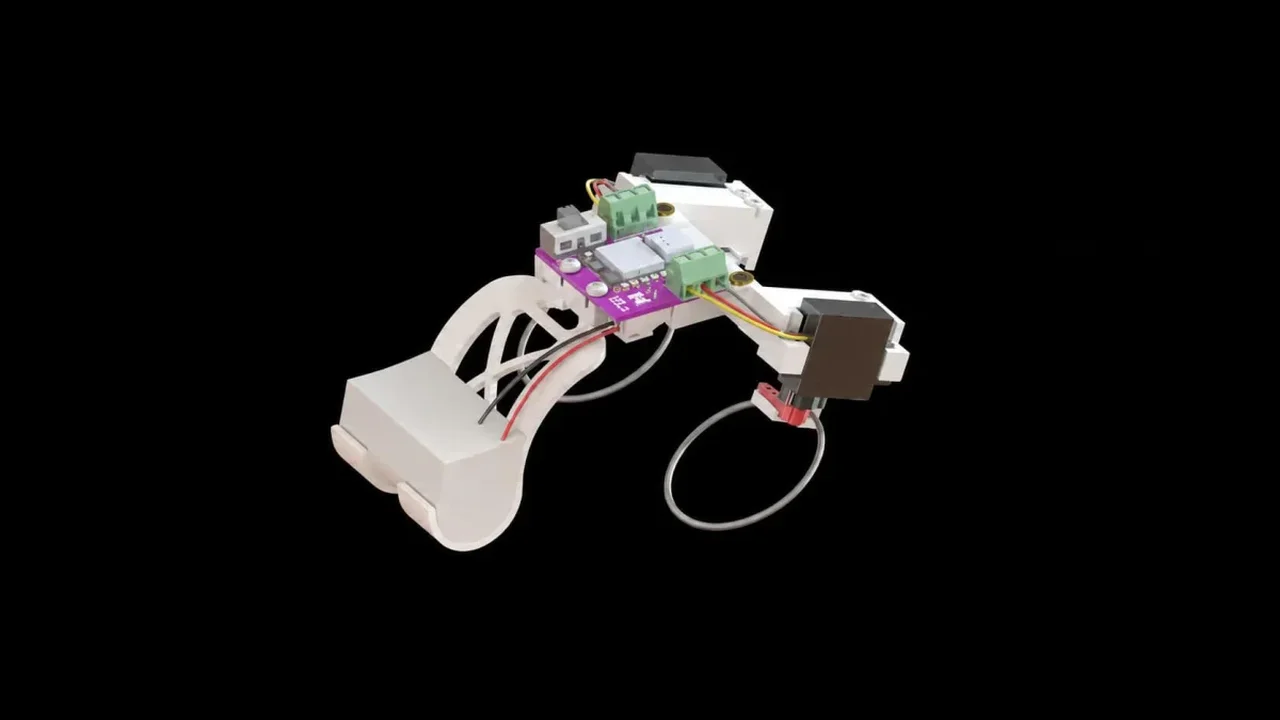
A research team from the University of Michigan and UCLA has developed a compact robot that uses flexible elastic rods to create energetic frog-like movements. Measuring around 11 centimeters long, the untethered machine can hop, turn, climb small steps, flip and move through water.
Energy stored in flexible limbs
Instead of relying on large motors, the robot gradually twists two curved elastic rods positioned at its rear. As the rods bend, they accumulate elastic energy. Once they reach a precisely engineered threshold, the structure rapidly shifts shape and releases that energy in a powerful push.
This controlled movement, known as snap-through instability, allows a relatively small motor to generate a sudden burst of motion. The approach mirrors natural systems that store energy before releasing it quickly, such as a drawn bow or a jumping animal's legs.
Designed for real-world surfaces
Weighing 98.2 grams and carrying its own battery, the prototype was tested on wood, fabric, acrylic, leather, grass and sand. Across all surfaces, it moved faster than comparable designs using rigid legs, with especially promising results on uneven terrain.
Researchers also demonstrated steering by operating the rear limbs at different speeds. The robot navigated obstacles, climbed and descended miniature stairs, and used light sensors to travel toward a light source. These capabilities highlight how mechanical design can reduce the demand for complex motors and continuous high-power control.
The findings, published in Science Advances, suggest that the same principles could potentially be adapted for even smaller robots. By combining lightweight electronics with responsive materials, future machines may gain more mobility without increasing their size or energy needs.
Elastic-powered robotics could help shape a new generation of agile, efficient devices designed to explore varied environments on land and in water.