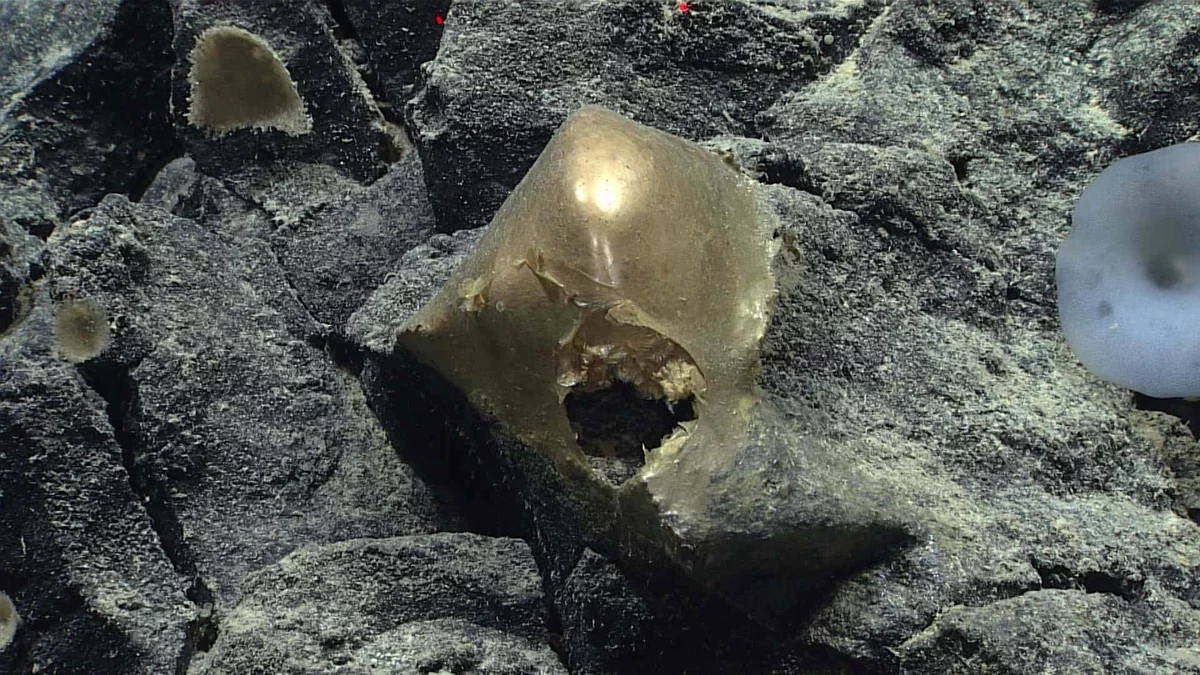
Deep within the Gulf of Alaska, at a staggering depth of approximately 3,300 meters (2 miles), a remotely operated vehicle stumbled upon a peculiar golden dome affixed to a rocky surface. Initially observed on August 30, 2023, during NOAA's Seascape Alaska 5 expedition, this enigmatic object sparked curiosity, resembling an egg from the Alien movie franchise.
For over two years, the true nature of this golden orb remained a mystery. However, researchers from the NOAA and the Smithsonian National Museum of Natural History have recently identified it as the remnant base of a giant deep-sea anemone known as Relicanthus daphneae. This fascinating creature, rarely seen, is characterized by its long, pinkish tentacles that can glide through the dark depths like living ribbons.
The orb, it turns out, is a leftover cuticle--a secreted outer layer left behind by the anemone after it died, moved, or possibly reproduced in a manner not yet fully understood. The discovery was made during an expedition where the remotely operated vehicle, Deep Discoverer, was deployed to explore a volcanic feature southwest of Walker Seamount.
The Golden Enigma
Upon its discovery, the object captivated the imaginations of scientists who initially speculated that it might be an egg case or a type of sponge. The team collected the orb, sending it to the Smithsonian for thorough analysis involving microscopy, DNA extraction, and genome sequencing.
Allen Collins, a zoologist at NOAA Fisheries, noted that while he expected a straightforward analysis, this case required extensive collaboration among experts in various fields. The orb's lack of typical animal features under the microscope, such as a mouth or gut, added to the intrigue.
Identifying Clues
Researchers identified the orb's surface as densely packed with spirocysts, a type of stinging cell unique to cnidarians, which include sea anemones and corals. This finding narrowed the search significantly. Furthermore, a previous specimen collected in 2021 shared similarities with the golden orb, reinforcing the connection to Relicanthus daphneae.
Through advanced DNA sequencing techniques, the team confirmed that both specimens contained nearly identical mitochondrial genomes, solidifying the orb's identity as a remnant of this extraordinary anemone.
A Habitat for Life
Interestingly, the orb had also become a microhabitat, hosting a diverse community of microbes. These organisms, some of which are essential for nitrogen processing, contributed to a miniature ecosystem on the seafloor, showcasing the orb's role in the deep-sea environment.
This remarkable discovery highlights the vast unexplored regions of our oceans. The golden orb, with its unique properties and ecological significance, serves as a reminder of the mysteries that still lie beneath the waves. As scientists continue to explore and understand these depths, they unlock valuable insights into the ocean's resources and its potential to sustain life on Earth.