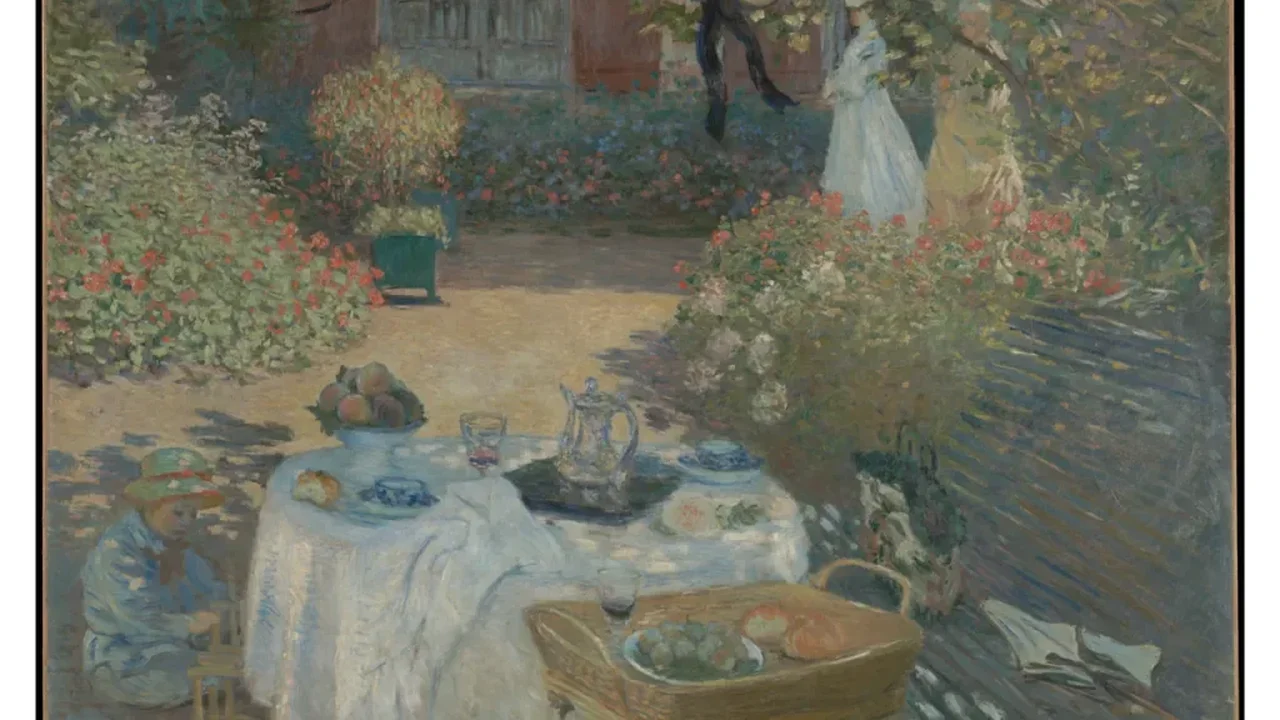
A new technical study of Claude Monet's The Luncheon is reshaping how art historians understand one of the artist's major early garden scenes. Research conducted by the Center for Research and Restoration of the Museums of France has revealed extensive changes beneath the 1873 canvas, including figures and objects that Monet later painted over.
Created during Monet's years in Argenteuil, the work now presents a quiet garden after a meal, with his son Jean and Camille Monet positioned at the edges of the scene. Beneath this familiar composition, however, researchers identified an earlier and more populated version of the painting.
A Composition Reworked Over Time
Scientific examinations found that Monet repeatedly adjusted the table, trolley and still-life elements before arriving at the final arrangement. Infrared analysis also indicated that two women were originally seated on the bench, later replaced by a basket and a folded parasol. Jean's position was revised as well, shifting from a figure turned away from the viewer to a more direct three-quarter pose.
Among the most intriguing discoveries is a painted-over bearded man wearing a hat at the left side of the canvas. Curators at the Musée d'Orsay note that the figure may be a self-portrait of Monet, although the identification remains a hypothesis pending further research. If confirmed, it would represent a rare example of the artist placing himself within one of his own compositions.
Rethinking Monet's Creative Process
The findings challenge the popular view of Monet as an artist working only through spontaneous observation. Instead, The Luncheon points to a highly deliberate process of revisions, spatial experiments and evolving visual choices.
The research also complements recent examinations of The Magpie and Women in the Garden, which revealed earlier compositional decisions and practical repairs. Restoration of The Luncheon, planned from late 2027, is expected to offer further insight into its layered history.
As conservation science advances, it can help audiences encounter familiar masterpieces not as fixed images, but as evolving records of artistic imagination and decision-making.