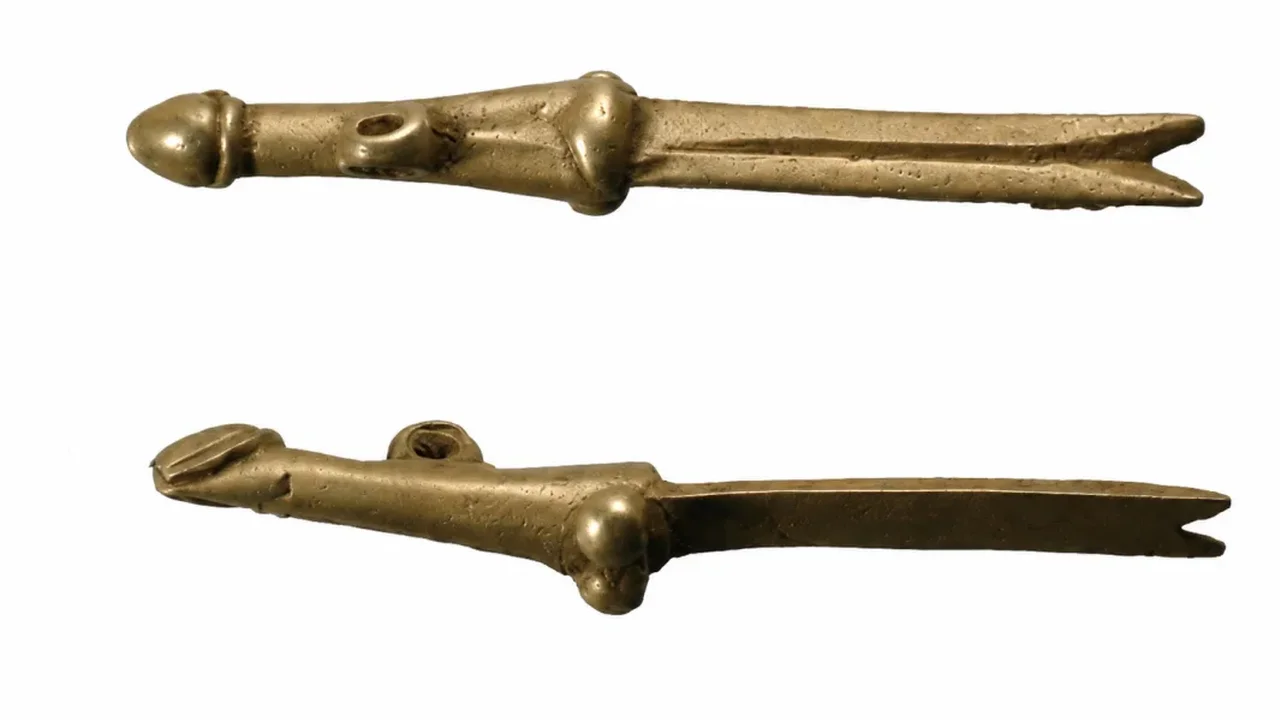
Archaeologists near Cheltenham in Gloucestershire have identified a late Roman personal-care object that blends everyday function with symbolic design. The copper-alloy tool, dated to around 300 to 400 CE, was made for cleaning dirt from beneath the fingernails.
What makes it unusual is its form: the handle is shaped like a penis. In Roman Britain, such imagery often carried protective meanings, linked to luck, fertility, and warding off misfortune. The object also includes a suspension loop, suggesting it may have been worn or carried as part of a portable grooming set.
A Personal Object From the Roman World
The piece features a cylindrical handle, a two-pronged cleaning end, and a loop for hanging. Researchers note that similar late Roman examples have been recorded in parts of England, but this discovery may be among the most refined examples known.
For Roman users, the design would likely have felt familiar rather than shocking. Across the empire, phallic motifs appeared on jewelry, household items, and personal accessories as symbols of protection and good fortune.
Clues From a Busy Landscape
The nail cleaner was recovered alongside another late Roman metal find: a copper-alloy buckle and plate from roughly 300 to 450 CE. Together with ditches, pits, postholes, trackways, and domestic debris, the discoveries point to a landscape shaped by settlement, farming, and craft activity over time.
The wider excavation has also produced coins spanning multiple eras, from Iron Age to medieval and modern periods, reinforcing the site's long history of use and movement.
Finds like this show how archaeology can turn a small object into a vivid window on daily life, belief, and identity in Roman Britain. Such discoveries may help future research map the human stories hidden beneath modern infrastructure.