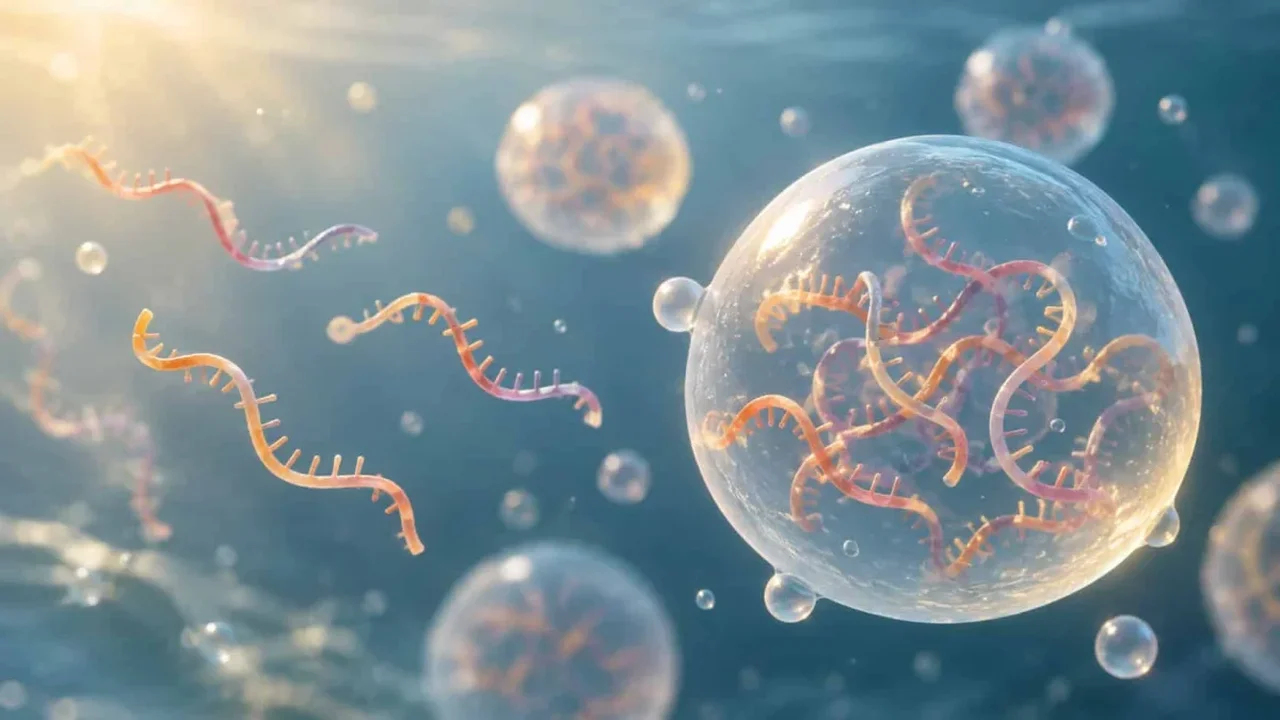
A subtle chemical feature may have given RNA a major advantage on the early Earth. Researchers found that RNA can gather into dense, liquid-like droplets more easily than similar strands of DNA, potentially offering a route for key molecules to organize before the first cells emerged.
A molecular difference with large-scale effects
RNA and DNA share many structural traits, yet RNA carries an additional oxygen-containing hydroxyl group on its sugar backbone. This small distinction, known as the 2′-OH group, appears to strongly influence how the molecules behave in water.
In experiments comparing closely matched RNA and single-stranded DNA, RNA formed biomolecular condensates at temperatures about 10°C lower than DNA. These condensates are concentrated droplets that arise without a surrounding membrane, creating localized environments where molecules can interact more often.
The work builds on earlier findings from the University at Buffalo, where researchers observed RNA droplets forming in magnesium-rich solutions as temperatures increased. Rather than simply dissolving, RNA strands separated from the surrounding liquid and clustered into a denser phase.
From droplets to early chemical systems
Using molecular simulations and structural measurements, the team found that RNA more readily releases water molecules around its surface as conditions change. Magnesium ions can then help bring RNA strands together. The resulting droplets may also develop into interconnected, gel-like networks, a behavior seen far less readily in DNA.
This property is especially relevant to the RNA world hypothesis, which proposes that RNA may once have stored genetic information while also supporting chemical reactions. Before cell membranes existed, freely dispersed molecules would have faced difficulty meeting often enough to sustain complex chemistry.
RNA condensates could have created temporary, membrane-free microenvironments where molecular interactions became more efficient. The findings do not prove how life began, but they identify a realistic physical mechanism by which early chemical systems may have become more organized.
Published in Nature Communications, the research shows how a single oxygen atom can shape large, self-organizing structures. Exploring such molecular behavior may help science better understand how simple chemistry gradually developed the capacity for life.