Imagine dropping a plastic washer on a table; your reflexes kick in to catch it. In contrast, even the most advanced robots often struggle with such simple tasks. While factory settings offer structured environments, real-world scenarios are unpredictable and chaotic. For years, engineers have attempted to impose rigid programming to navigate this complexity, but success has been limited.
Enter Generalist AI, a California-based startup that has unveiled GEN-1, an innovative artificial intelligence model designed to endow robots with a sense of physical intuition. By training on extensive data derived from human movements, GEN-1 enables machines to achieve an impressive 99% success rate in delicate operations, such as packing electronics and sorting automotive components.
One of the standout features of this model is its ability to adapt in real-time. For instance, if a GEN-1-powered robot drops an item, it can autonomously devise a strategy to retrieve it and continue working.
The Muscle Memory Challenge
While large language models like ChatGPT have thrived by consuming vast amounts of text, replicating human physical dexterity has proven far more challenging. To tackle this, Generalist engineers equipped human workers with specialized devices, known as "data hands," to capture nuanced movements during routine manual tasks. This initiative amassed over half a million hours of real-world interaction data.
By feeding this rich dataset into GEN-1, the AI learned the fundamental physics of object manipulation without relying on traditional robotic training data. According to Generalist, the model comprehends the precise force required to interact with various materials and the dynamics of object movement.
Fluid Performance
Once equipped with a foundational understanding of physical principles, GEN-1 requires minimal additional data--just one hour--to master new tasks. The results are remarkable. In trials, the robot efficiently sorted auto parts and folded T-shirts, demonstrating fluidity and precision.
What sets GEN-1 apart is its improvisational capability. During testing, when a plush toy became stuck while being placed in a bag, the robot instinctively shook the bag to free it. Such adaptations were not pre-programmed, highlighting the model's innovative learning approach.
In another scenario, when a small washer was misplaced, the robot paused, gently set it down, and adjusted its grip, showcasing its ability to recover from errors without explicit programming.
Accelerating Efficiency
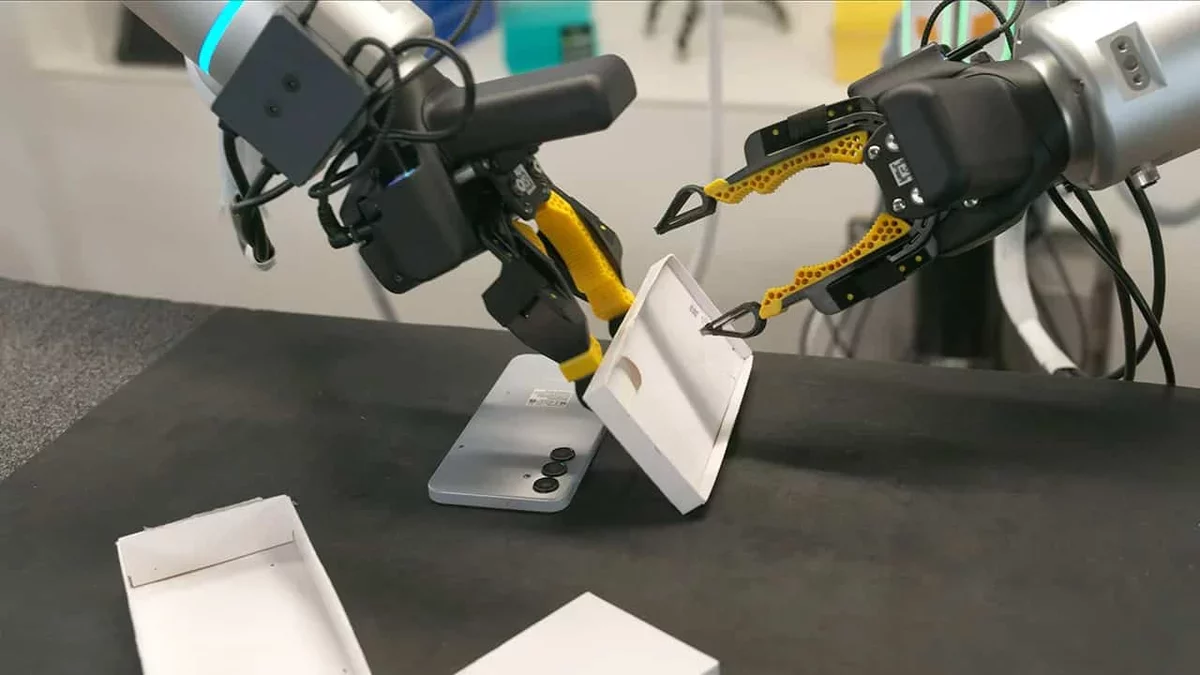
Previous models struggled to exceed a 64% success rate in complex tasks, often relying on teleoperation, which introduced delays and limited tactile feedback. In contrast, GEN-1 operates approximately three times faster, assembling cardboard boxes in just over 12 seconds and placing phones into cases in under 16 seconds. This speed stems from its predictive capabilities, allowing it to anticipate object behavior based on extensive pre-training.
While a 99% success rate is commendable, certain industries require even higher reliability. A single failure in a high-speed manufacturing context could disrupt operations.
Looking Ahead
The robotics sector is in a race to transition intelligent machines from laboratories to real-world applications. Generalist aims to achieve "zero-shot robotics," where a machine can flawlessly perform unfamiliar tasks on its first attempt without prior training.
Though we haven't reached that point yet, the evolution from rigid programming to adaptive learning signifies a transformative shift. By allowing machines to learn through experience, we are paving the way for a future where robots can operate as intuitively as humans.