In the quest for more efficient chemical reactions, chemists utilize catalysts--substances that lower the energy required for these processes. Traditionally, effective catalysts often incorporate metals, including rare and costly options.
Innovative Catalyst Transforms CO2 into Methanol
A team of researchers at ETH Zurich has achieved a significant milestone in catalyst design, unveiling a new system that dramatically reduces the energy necessary to synthesize methanol from carbon dioxide and hydrogen.
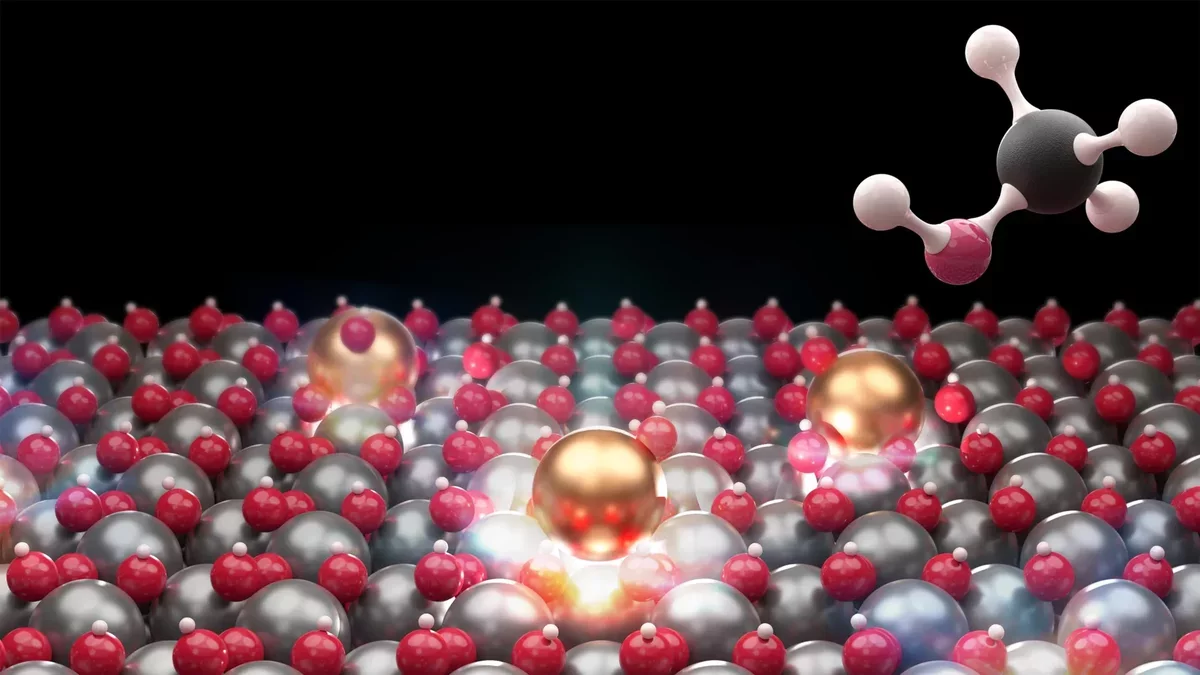
This innovative approach employs individual indium atoms as distinct active sites, marking a departure from conventional methods where metals are clustered in particles. This advancement not only enhances efficiency but also allows for greater precision in catalyst development, enabling scientists to observe and understand surface reactions more clearly.
Methanol: A Cornerstone of Sustainable Chemistry
"Methanol serves as a versatile precursor for a variety of chemicals and materials, akin to a Swiss army knife in the chemistry realm," remarks Javier Pérez-Ramírez, Professor of Catalysis Engineering at ETH Zurich.
As a critical component in the production of fuels and materials, methanol is increasingly pivotal in the transition away from fossil fuels. When generated using hydrogen and energy from renewable sources, methanol production has the potential to be climate neutral.
This method also offers a novel way to repurpose CO2, transforming it from a greenhouse gas into a valuable resource.
Single Atom Catalysts Enhance Efficiency
"Our catalyst features a single atom architecture where isolated active metal atoms are anchored on a specially designed support material," explains Pérez-Ramírez.
Unlike traditional catalysts that group metals into small particles--often containing numerous atoms that do not engage in the reaction--single atom catalysts optimize the use of scarce and expensive metals. This advancement can even make the use of precious metals feasible in industrial settings.
Working with isolated atoms can significantly alter catalyst behavior. "Indium has been utilized in this catalyst for over a decade," notes Pérez-Ramírez. "Our findings demonstrate that isolated indium atoms on hafnium oxide facilitate more efficient CO2-based methanol synthesis compared to conventional nanoparticles."
Engineering Robust Single Atom Catalysts
To accurately position individual indium atoms on hafnium oxide, the ETH team devised several new synthesis techniques in collaboration with various research groups. A key aspect was creating a support material that stabilizes the atoms while maintaining their reactivity.
One synthesis method involves igniting the starting materials in a flame at temperatures ranging from 2,000 to 3,000°C, followed by rapid cooling, ensuring that indium atoms remain on the surface and are securely embedded.
The resultant catalyst exhibits remarkable durability, capable of enduring high temperatures and pressures--essential for methanol production from CO2 and hydrogen, which typically necessitates conditions of up to 300°C and 50 times the standard atmospheric pressure.
Enhanced Understanding of Reaction Mechanisms
Traditional nanoparticle catalysts have posed challenges for analysis, as many signals originate from inactive atoms within the particles. This complicates the interpretation of reaction dynamics. Single atom catalysts minimize this issue, allowing scientists to study reaction mechanisms with significantly less interference, yielding clearer insights.
Pérez-Ramírez has been dedicated to enhancing CO2-based methanol production since 2010, collaborating closely with industry and holding multiple patents in this domain. He emphasizes that the success of this catalyst was made possible through strong interdisciplinary collaboration within Switzerland's research community: "The development of the methanol catalyst and the detailed analysis of the mechanism would not have been achievable without this collective expertise."