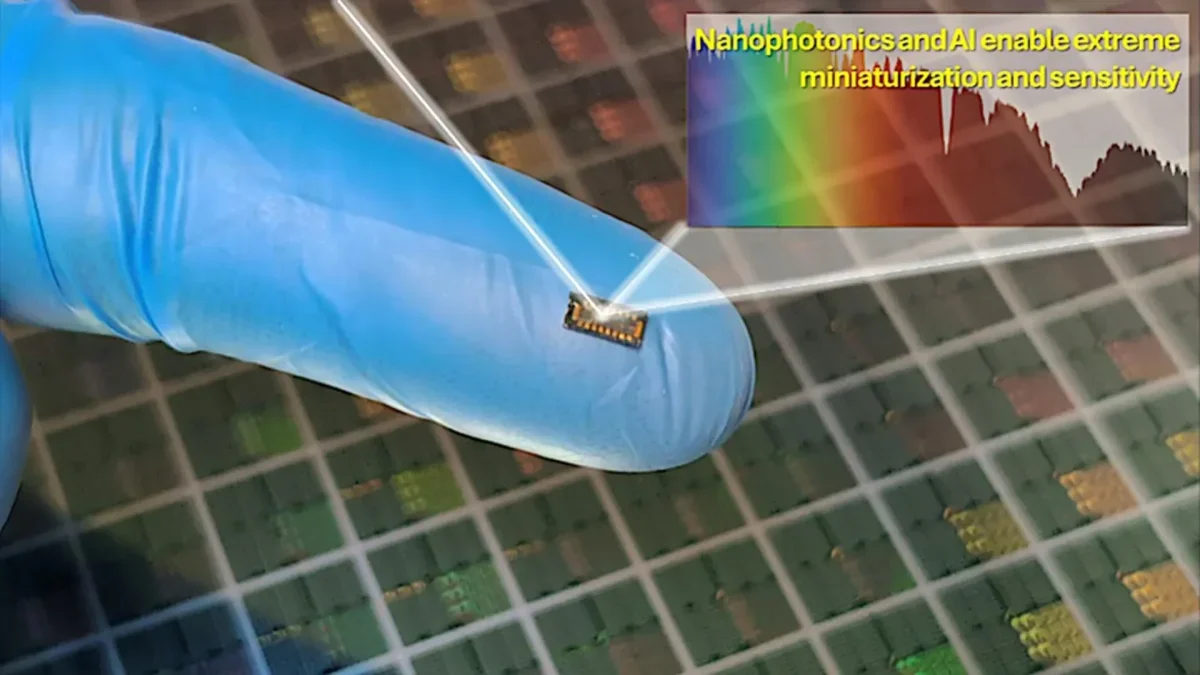
Researchers at the University of California Davis (UC Davis) have unveiled a groundbreaking alternative to traditional spectrometers, creating a device so compact it rivals the size of a grain of sand. Their findings, published in Advanced Photonics, detail a spectrometer-on-a-chip that leverages artificial intelligence (AI) along with a unique configuration of sensors to computationally reconstruct light spectra, eliminating the need for bulky optical components.
Innovative Use of AI
This new chip departs from conventional methods of dispersing light into its component colors. Instead, it employs 16 specialized silicon detectors, each calibrated to respond differently to incoming light. These detectors do not isolate individual colors; rather, they gather encoded signals that reveal hidden spectral information.
Visualize this system as a team of expert tasters, each sampling various elements of a complex mixture. While each detector captures only a portion of the overall picture, their combined data allows the AI to reconstruct the full light spectrum.
The second crucial element of this innovation is a fully connected neural network trained on thousands of data samples. Given that the detector signals can be noisy and complex, the AI adeptly learns the intricate relationship between these signals and the actual light spectrum. This approach addresses what researchers refer to as an "inverse problem," enabling the system to reproduce spectral data with an impressive resolution of approximately 8 nm, all without the need for large optical hardware.
Broadening Silicon's Capabilities
A significant advancement was achieved by enhancing standard silicon photodiodes with specialized photon-trapping surface textures (PTSTs). While silicon is effective for detecting visible light, it traditionally struggles with near-infrared (NIR) light detection, which is crucial for applications like biomedical imaging due to its deeper tissue penetration.
The PTST surfaces alter how light interacts within the chip. Instead of allowing NIR photons to pass through the silicon layer, the textured surface causes repeated scattering, significantly increasing the chances of absorption. Consequently, the chip gains sensitivity across a much broader spectral range compared to typical silicon sensors.
Advanced Detection Capabilities
This innovative architecture does not merely enhance color detection; it also incorporates high-speed sensors capable of measuring photon lifetime with remarkable temporal precision. This feature enables the device to identify ultrafast interactions between light and matter, phenomena that conventional spectrometers might overlook.
Researchers believe this capability could revolutionize sensing and imaging technologies that previously required larger, more costly systems.
Compact Design with Vast Potential
The entire system occupies a mere 0.4 square mm while ensuring high sensitivity and robust resistance to electrical noise--a common hurdle for portable, cost-effective electronics. Even in challenging environments, the AI-enhanced design maintains clear signal quality.
By merging machine learning with advanced silicon light detection, this technology holds promise for the development of compact, real-time hyperspectral sensing devices. Potential applications range from portable medical diagnostics and wearable health monitors to environmental remote sensing and food quality assessment.