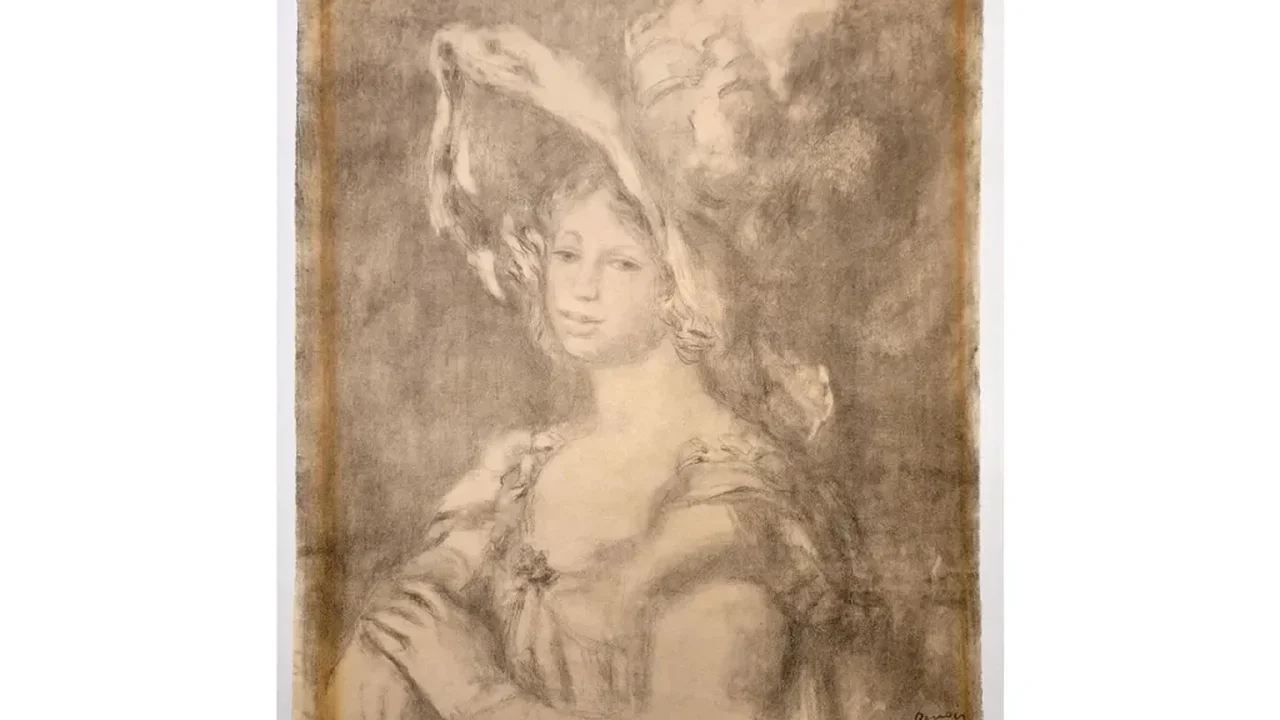
Art historian Henry Keazor has reattributed a print once considered a forgery to French artist Pierre-Auguste Renoir. Research with students at the University of Heidelberg indicates the work is a rare, hand-signed test print dating to around 1899.
The print came to Keazor in 2023 during a household clearance. Its previous owner had inherited it in the 1970s; at the time, a New York gallery had classified it as a fake and described it as a pencil drawing.
Keazor recognized that the work was a print, prompting further study through paper and microscopic analysis. Researchers identified the paper as consistent with an autotype print and found that the signature had been added by hand in black grease chalk.
The image depicts actor and singer Amelie Diéterle and corresponds to a work Renoir made for Germinal, an art portfolio that also featured artists including Degas, Vincent van Gogh and Toulouse-Lautrec. The portfolio was published in an edition of 100, with signatures printed as part of the works.
Keazor's explanation is that the newly identified piece was a test print made using one of the two printing stones. Because the signature was on a separate stone, Renoir added it by hand, making the proof a valid work. Such test prints are considered rare in art history.
The print is scheduled to go on view at Heidelberg's Kurpfälzisches Museum from November 26 to March 21 in the exhibition "Riddle around Renoir." The museum and the former owner will decide on its future home afterward. The case shows how close material analysis can deepen understanding of artists' working processes and the history of printmaking.