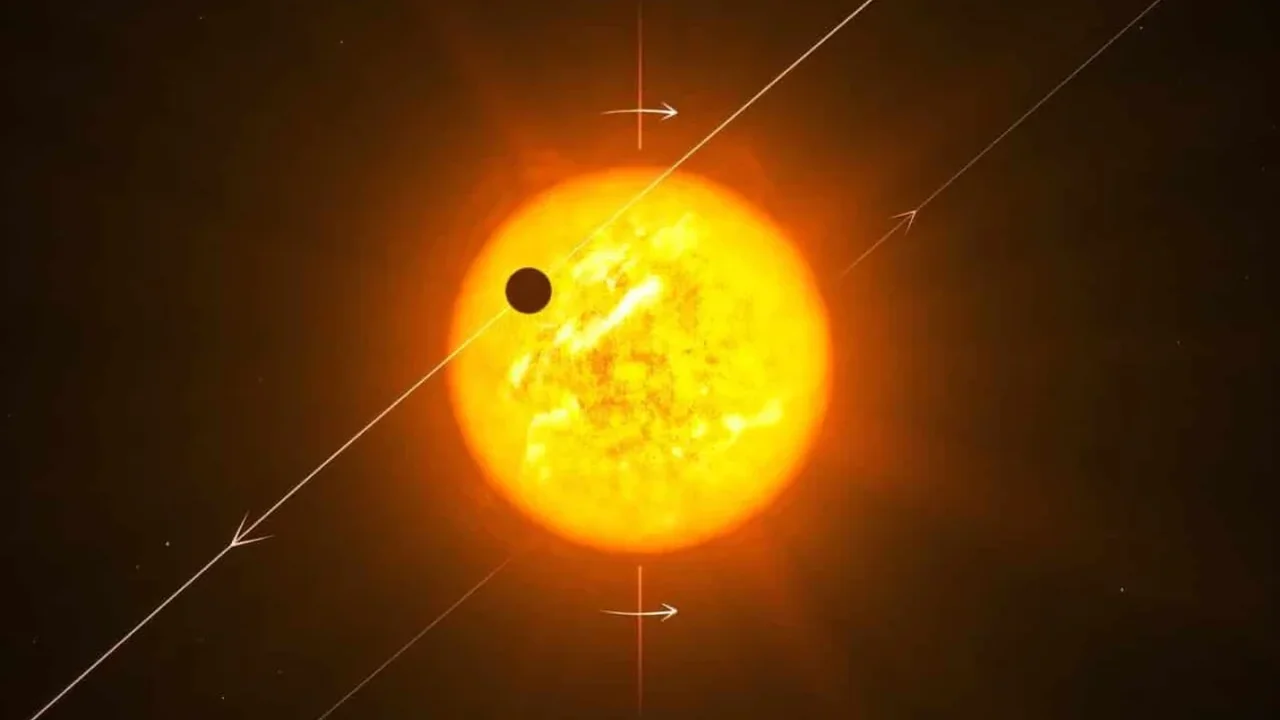
Astronomers have identified an unusual planetary system around the red dwarf GJ 3090, located about 72 light-years from Earth. Its known world, GJ 3090 b, follows a sharply tilted orbit that moves in the opposite direction to the star's rotation.
Most planets form within a rotating disk of gas and dust surrounding a young star. This shared origin generally causes planets to orbit in the same direction as their host star. GJ 3090 b challenges that familiar pattern: its orbital orientation is measured at roughly 136 degrees relative to the star's spin axis, confirming a retrograde path.
The planet is classified as a sub-Neptune, with a radius around 2.2 times that of Earth and a mass about 4.5 times greater. It completes one orbit every 2.85 days, passing regularly in front of its star from Earth's perspective.
A rare orbit around a small star
An international research team examined six planetary transits using the NIRPS and HARPS instruments at La Silla Observatory in Chile. By measuring subtle changes in starlight as the planet crossed different regions of the rotating star, the scientists mapped the alignment between the star's rotation and the planet's orbit.
The result makes GJ 3090 b the first confirmed planet on a retrograde orbit around a red dwarf. The research was led by astronomers at the University of Geneva and adds an important new case to the study of how planetary systems evolve.
Rethinking how planetary systems form
Highly tilted or backwards orbits are often associated with the gravitational influence of a massive outer planet or companion star. Yet observations of GJ 3090 have not revealed a large nearby object capable of forcing GJ 3090 b into its current trajectory.
Researchers are now exploring another possibility: the planet may have formed in a second, misaligned disk of gas that was captured by the young star. If that material rotated in a different direction, planets developing within it could naturally inherit an unconventional orbit.
Further observations of the system's other planet may help distinguish between these scenarios. GJ 3090 b shows that planetary systems around smaller stars may emerge through more diverse pathways than previously expected, broadening the search for the many ways worlds can form and evolve.