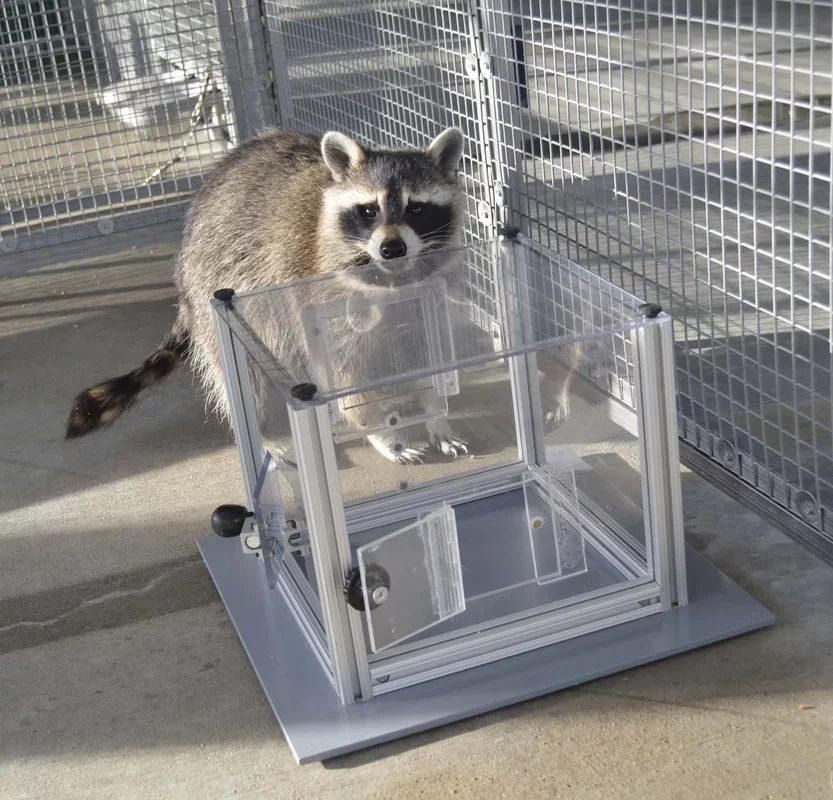
Even after enjoying their marshmallow reward, raccoons continue to engage with puzzle boxes, showcasing a fascinating behavior known as information foraging. This phenomenon suggests that these clever creatures are not solely motivated by immediate rewards but are also driven by the desire to acquire valuable knowledge for future encounters.
Researchers from the University of British Columbia, led by Hannah Griebling and Sarah Benson-Amram, conducted an intriguing experiment involving 16 adult raccoons at a research facility in Colorado. The raccoons were presented with a transparent puzzle box that could be opened in nine different ways, categorized into easy, medium, and hard challenges. Some openings required simple actions, while others necessitated a series of steps.
Prior to the trials, the team determined that marshmallows were the raccoons' preferred treat. During each session, a single marshmallow was placed inside the box, and the animals were allowed up to 20 minutes to explore. Surprisingly, the raccoons demonstrated a remarkable ability to solve all three challenges, even in the absence of a marshmallow reward.
A Mind Adapted for Urban Living
The study reinforces the notion of raccoons as intelligent and resourceful animals. Previous research has indicated that raccoons can remember solutions, adapt to new challenges, and innovate when faced with obstacles. Their dexterous forepaws, equipped with heightened sensitivity, enable them to gather tactile information effectively as they manipulate various objects.
In the latest study, the raccoons displayed notable behavioral flexibility. When faced with easier puzzles, they explored different openings and varied their approach. Conversely, as the puzzles became more complex, they reverted to previously successful methods, showcasing a strategic decision-making process akin to that of humans when choosing between familiar and novel options.
This adaptive intelligence is particularly advantageous in urban environments. Cities often present a wealth of easily accessible food, albeit concealed behind various barriers. Raccoons that actively seek information about their surroundings gain a significant advantage in navigating these urban challenges.
The findings also shed light on the ongoing interactions between raccoons and humans, illustrating a cycle of adaptation. As humans implement new designs to deter raccoons, these animals return to assess and learn from the changes, perpetuating a dynamic relationship.
While the study involved captive raccoons, and their behaviors may differ from their wild counterparts, it highlights the cognitive capabilities of these animals. Dr. Benson-Amram noted that while raccoons have been featured in folklore for their intelligence, empirical research on their cognitive abilities remains limited. This study contributes valuable insights to our understanding of raccoon behavior and cognition.
As urban landscapes continue to evolve, the ability of raccoons to adapt and learn from their environments suggests a future where these creatures will thrive alongside human developments, further enriching our understanding of wildlife in urban settings.