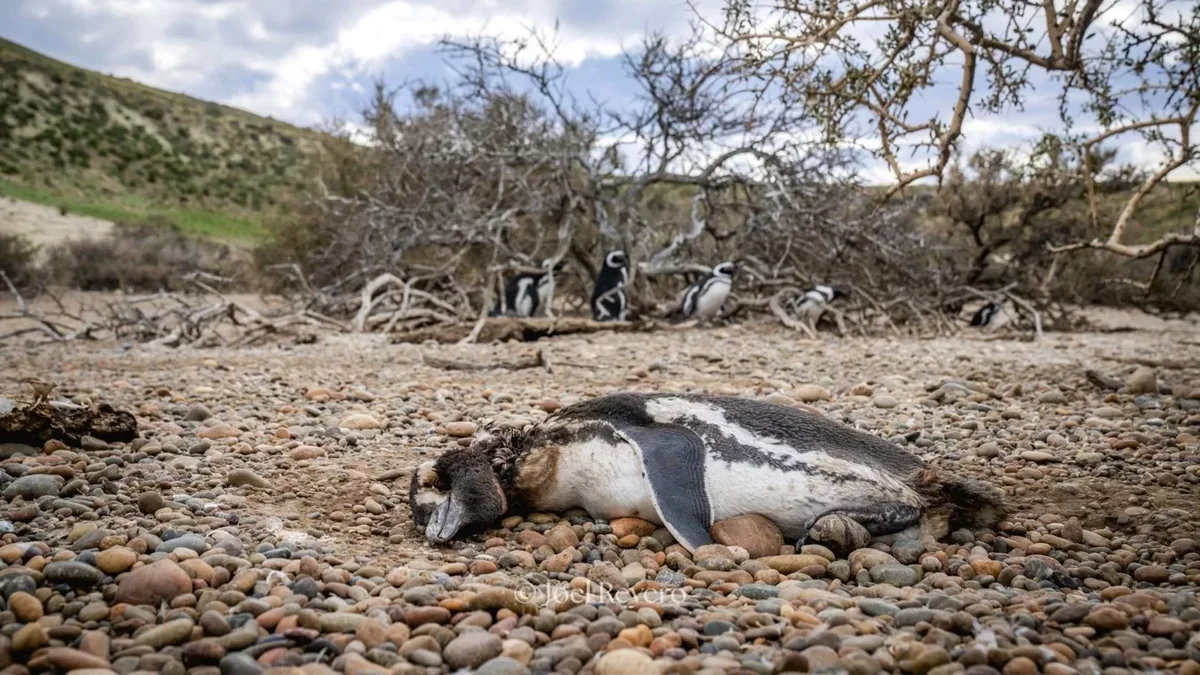
The recent developments in Patagonia underscore the intricate process of restoring ecosystems that have faced long-term alterations and are now rapidly evolving.
Pumas Resurface, Penguins Confront New Dangers
Following the cessation of cattle ranching in southern Argentina in 1990, pumas (Puma concolor) have gradually reclaimed their historic territories. This resurgence has introduced them to the Magellanic penguins (Spheniscus magellanicus) for the first time in contemporary history.
Previously, these penguins relocated from offshore islands to the mainland, benefiting from the absence of land-based predators. However, with the arrival of pumas, they became vulnerable due to their limited defenses against large carnivores. Until recently, the impact of this new predator-prey interaction on penguin populations was not well understood.
Long-Term Observations in Monte Leon National Park
Since its establishment in 2004, Monte Leon National Park has been the focus of extensive research on penguin colonies, with scientists from the Centro de Investigaciones de Puerto Deseado at Universidad Nacional de la Patagonia Austral collaborating with park rangers. Between 2007 and 2010, they documented penguin carcasses linked to puma predation.
In a recent study, the research team teamed up with experts from Oxford University's Wildlife Conservation Research Unit (WildCRU) to analyze the findings and evaluate the long-term effects on the penguin colony.
Significant Penguin Losses
The study revealed that over 7,000 adult penguins were killed during the four-year observation period. Many carcasses showed signs of being only partially consumed or left uneaten, suggesting that the killings were not solely for sustenance. This accounts for approximately 7.6% of the adult penguin population, which is around 93,000 individuals.
Lead author Melisa Lera, a postgraduate student at WildCRU, Oxford University, stated: "The number of carcasses exhibiting signs of predation we encountered is staggering. The fact that many were left uneaten indicates that pumas were killing more penguins than they needed for food, a phenomenon known as 'surplus killing.' This behavior is similar to that observed in domestic cats when prey is abundant and easy to catch, prompting them to hunt more than they consume. We aimed to determine if this behavior could threaten the penguin colony's survival."
Insights from Population Models
Population modeling conducted by the research team indicated that puma predation alone is unlikely to lead to the extinction of the Monte Leon penguin colony. Instead, the models highlighted other critical factors, particularly the success of breeding and the survival rates of juvenile penguins.
Extinction was only projected in hypothetical scenarios where juvenile survival rates were extremely low, with around 20% not reaching adulthood, coupled with very poor reproduction rates of no more than one chick per pair. In these scenarios, high levels of puma predation exacerbated the situation but were not the primary cause of decline.
Co-author Dr. Jorgelina Marino (WildCRU, Oxford University) remarked: "This research highlights a new conservation challenge, where recovering carnivores are encountering unfamiliar prey. Understanding how these dietary changes impact both predators and their prey is vital for effective conservation efforts."
Impact of Climate Change and Other Pressures
Given the significant role of breeding success and juvenile mortality in population stability, the researchers stress the importance of understanding how environmental factors affect penguin reproduction. Elements such as nutrient availability, food resources, and temperature, all influenced by climate change, could profoundly affect the future of the colony.
Similar challenges are arising globally as land predators extend their reach into coastal habitats. Coastal seabird colonies and other marine species may face increasing threats. For instance, non-native feral hogs are now significant predators of loggerhead sea turtle eggs along the Georgia coast, while coyotes in eastern North America are encroaching on coastal barrier islands, disrupting local ecosystems.
The Importance of Ongoing Monitoring
The authors emphasize that continuous monitoring is crucial for detecting early signs of population decline and for making informed management decisions to prevent severe ecological damage. At Monte Leon National Park, authorities are diligently tracking both puma and penguin populations as they navigate the complex repercussions of ecosystem recovery.