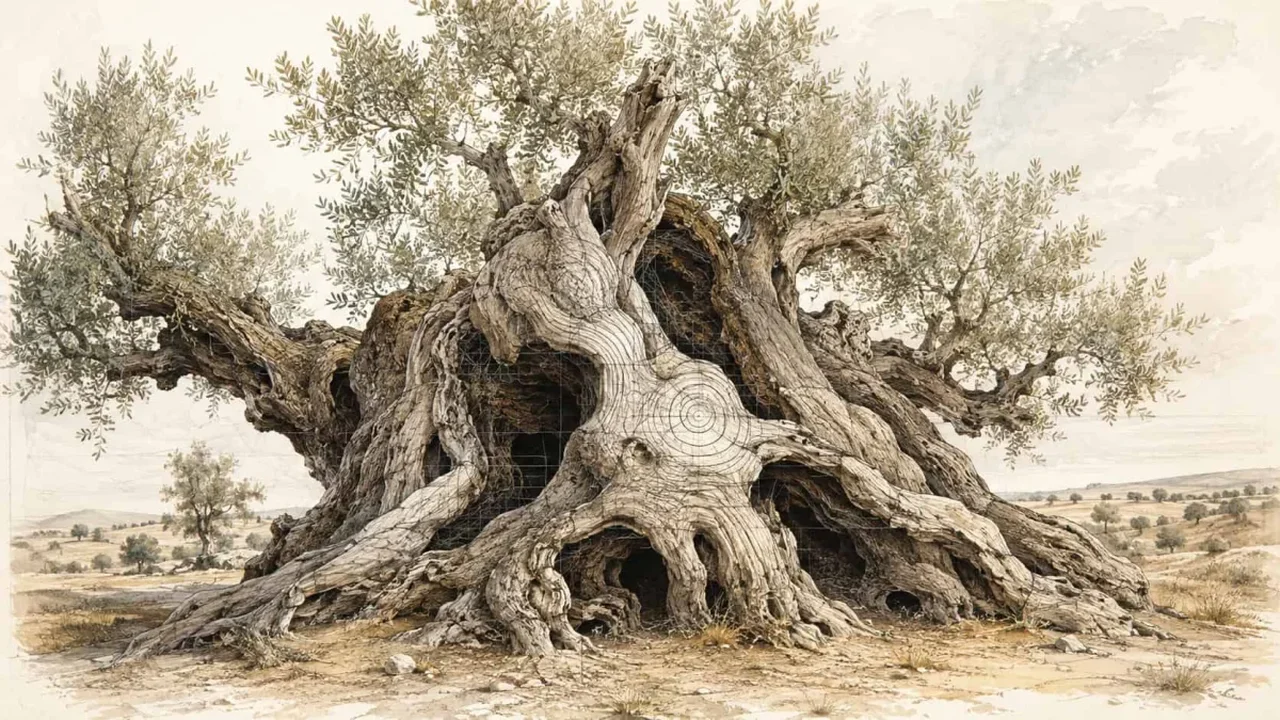
In southern Portugal's Alentejo region, a remarkable olive tree known as Oliveira do Peso is estimated to have taken root around 1700 BCE, placing its origin deep in the Bronze Age. If the current estimate is accurate, the tree would be about 3,712 years old, making it the oldest olive tree dated in Portugal so far.
What makes this specimen especially fascinating is that it is still alive and productive. Standing about six meters tall with a trunk circumference of roughly 10 meters, the tree continues to bear olives despite its extraordinary age.
How scientists estimate the age
Dating ancient olive trees is notoriously complex. Their trunks often become hollow over time, and the oldest wood may disappear entirely. Olive trees also do not always form clean, easy-to-read growth rings, which makes traditional ring counting unreliable.
To address this, researchers at the University of Trás-os-Montes and Alto Douro developed a non-destructive method that uses trunk measurements such as diameter, height and circumference. These dimensions are then compared with a mathematical model to estimate age without harming the tree.
The method has been applied to hundreds of ancient olives in Portugal and beyond, including other trees estimated to be more than 2,000 years old. It was also used to date Oliveira do Mouchão, another famous Portuguese olive tree, at around 3,350 years old.
A living symbol of resilience
Olive trees have a rare ability to renew themselves. Even when parts of the trunk age or decay, new shoots can emerge and keep the organism alive. Their adaptation to hot, dry Mediterranean conditions also helps them endure for millennia.
While the exact age of Oliveira do Peso cannot be confirmed with absolute precision, the estimate highlights something extraordinary: a living tree that has persisted since ancient times and still contributes fruit today. In the years ahead, methods like this may deepen our understanding of longevity in nature and inspire new approaches to preserving living heritage.