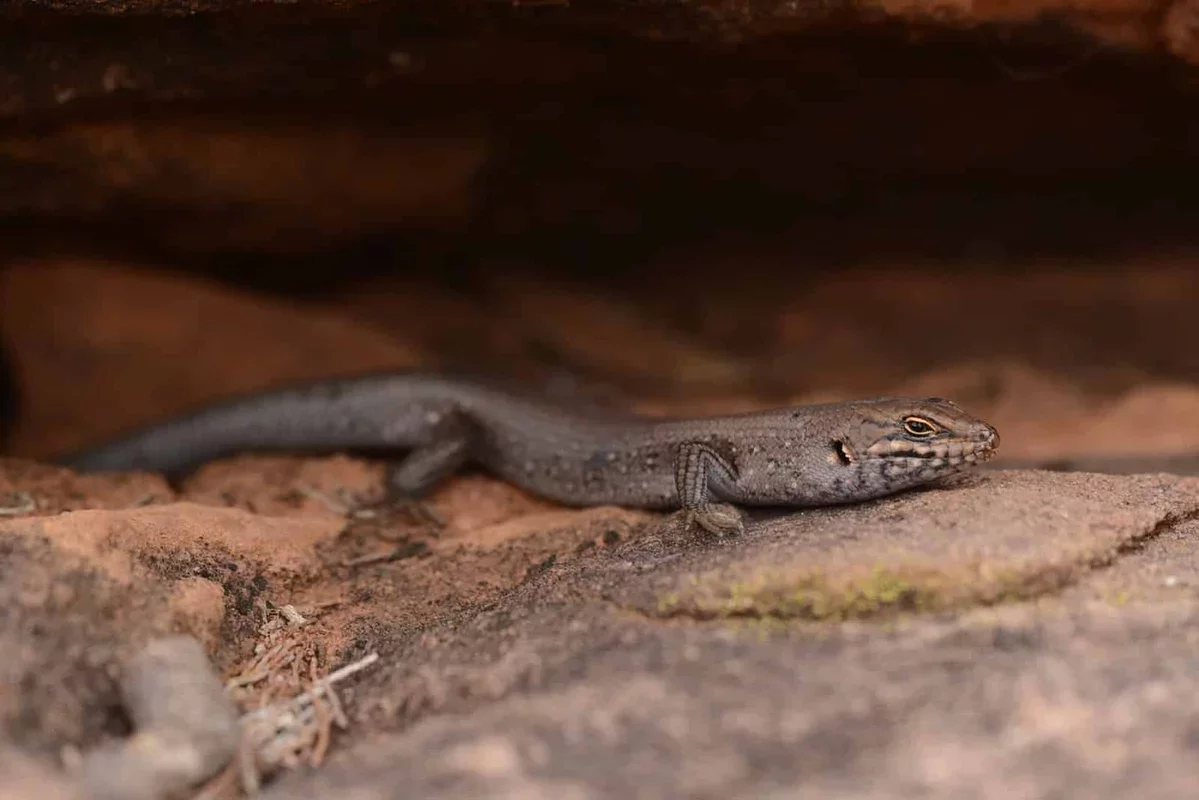
In a remarkable breakthrough, scientists have identified a new species of skink, potentially one of Australia's most endangered reptiles, through collaboration with Indigenous knowledge. This newly recognized skink, named Liopholis mutawintji, is found exclusively in a secluded gorge within Mutawintji National Park, New South Wales, where its population is estimated to be fewer than 20 individuals.
The common name, Kungaka, translates to "the Hidden One" in the language of the Wiimpatja Aboriginal Owners, reflecting the skink's tendency to conceal itself in crevices and burrows. Researchers from the Australian Museum Research Institute (AMRI) worked alongside the Wiimpatja community and the New South Wales National Parks & Wildlife Service to classify the Kungaka as a distinct species.
According to Thomas Parkin, the study's lead author, the Kungaka was initially believed to be a remnant population of White's skink (L. whitii), which is widely found in southeastern Australia. However, given that Mutawintji is situated approximately 500 kilometers from the nearest White's skink population, the team revisited its classification. Through DNA analysis and physical trait comparison, they discovered that White's skink comprises three genetically distinct lineages: the southern White's skink, northern White's skink (L. compressicauda), and the newly identified Kungaka.
Parkin noted that the Kungaka can be distinguished by its unique features, including dark-tipped scales on its limbs, a longer tail, and specific body proportions. Alex Slavenko, a member of the IUCN Skink Specialist Group, praised the research team's integration of genetics, morphology, and Indigenous ecological knowledge to resolve longstanding taxonomic questions.
Monitoring efforts over the past 25 years have indicated that the Kungaka may already be critically endangered, facing threats from habitat degradation due to feral goats, drought, and predation by introduced species like feral cats. The formal recognition of the Kungaka as a distinct species is a pivotal step toward its inclusion in state and federal threatened species lists, which will aid in developing effective conservation strategies.
Efforts are already underway to mitigate these threats, with considerations for captive breeding and genetic management. Warlpa Thompson, a co-author from the Mutawintji Board of Management, expressed pride in the recognition of the Kungaka, emphasizing the importance of Indigenous stewardship in conserving this unique species.
This discovery not only highlights the significance of Indigenous knowledge in scientific research but also underscores the potential for collaborative efforts to safeguard biodiversity. As the Kungaka gains recognition, it could inspire further conservation initiatives, paving the way for a more sustainable future for Australia's unique wildlife.