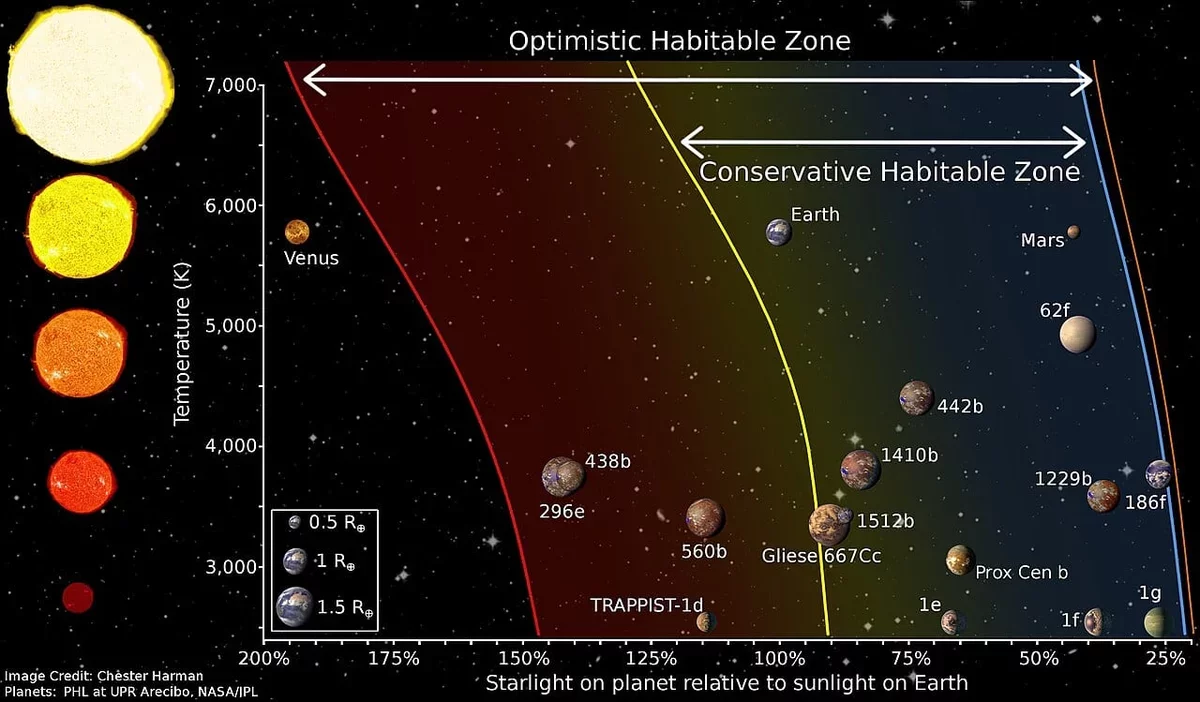
For life as we understand it, the presence of liquid water is essential. Traditionally, this has been linked to the "habitable zone," often referred to as the "Goldilocks zone," which is determined by a planet's distance from its star and the star's size.
However, recent findings challenge this conventional wisdom.
A study published in The Astrophysical Journal by astrophysicist Amri Wandel from the Hebrew University of Jerusalem suggests that liquid water might exist on many planets previously considered uninhabitable, extending well beyond the Goldilocks zone.
This implies that the potential for habitable planets could be much broader than previously thought.
Tidally Locked Planets
The traditional habitable zone concept was based on Earth, a rapidly rotating planet receiving even warmth from a sun-like star. Yet, many of the exoplanets discovered so far orbit smaller, cooler stars, known as M-dwarfs.
This leads to many planets being "tidally locked" to their stars, meaning one side experiences perpetual daylight while the other remains in constant darkness.
Initially, this arrangement appeared unfriendly to life, with a scorching day side and a frigid night side. However, Wandel's research reveals a more optimistic scenario. By employing a new climate model, he investigated heat distribution on these locked worlds and found that even moderate atmospheric heat transfer could keep parts of the night side above freezing. Thus, liquid water could potentially survive even on planets much closer to their stars than previously believed.
Supporting this theory are recent discoveries from the James Webb Space Telescope, which has identified water vapor and other volatile compounds around several M-dwarf orbiting planets, challenging earlier assumptions about their capacity to retain such elements.
Life Under Ice
This study expands the definition of the habitable zone in both directions.
On the outer limits, where planets receive minimal starlight, one might expect surface water to freeze. However, Wandel argues that liquid water can exist without sunlight. Beneath thick ice, geothermal heat could melt the ice from below, creating subglacial lakes.
This concept finds parallels in our solar system, where Jupiter's moon Europa and Saturn's moon Enceladus harbor oceans beneath their icy surfaces. Mars may also contain liquid water trapped beneath its polar ice caps.
Wandel's findings indicate that similar conditions could exist on rocky exoplanets located far outside the conventional habitable zone. While water may not be visible, it could still be present, facilitating the chemical processes necessary for life.
This broadened perspective on habitability encourages astronomers to reassess which worlds merit further study. Instead of a narrow band, habitability now encompasses a wider range defined by atmospheric conditions, heat distribution, and internal energy, alongside the distance from their stars.
It is important to note that this research does not assert that these environments are teeming with life or are suitable for life as we know it. Numerous uncertainties remain, including atmospheric stability and the chemistry of subsurface oceans. Nonetheless, by relaxing stringent assumptions, this study opens up new avenues for exploration.
In a galaxy predominantly filled with small, cool stars, this expansion is significant, suggesting that the essential components for liquid water--and potentially life--may be more prevalent than previously imagined.