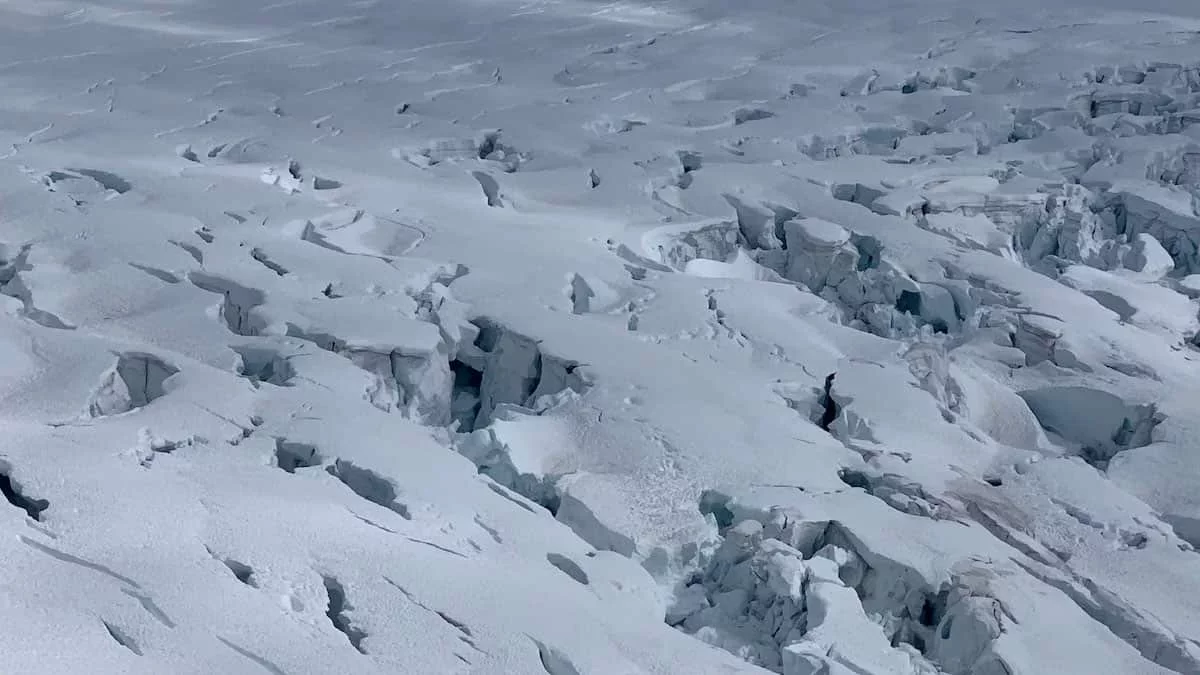
Recent research has unveiled a potential oversight in the modeling of glacial flow that could significantly alter our understanding of sea level rise. Traditionally, scientists have relied on a standard equation to estimate ice viscosity, a crucial factor in predicting how glaciers behave under stress. This equation incorporates a variable known as the stress exponent, denoted as n.
For many years, glaciologists have used a default value of 3 for n, but new findings suggest that a value of 4 may more accurately reflect the dynamics of Earth's ice sheets. This adjustment could lead to a more precise understanding of glacial retreat and its implications for sea level changes.
In a study led by researchers including Martin et al., a model was developed to simulate the behavior of the rapidly retreating Pine Island Glacier in West Antarctica. By running projections with both n values of 3 and 4, the team was able to identify significant discrepancies in predictions related to glacial flow and sea level contributions.
Over a simulation period of 100 years, the model revealed that using n = 3 underestimated glacial retreat by 18% and the contributions to sea level change by 21% under moderate melting scenarios. In extreme melting scenarios, the underestimation rose to a staggering 35%.
These findings highlight the importance of accurately representing physical processes in ice sheet models. The researchers also noted that incorrect values for n could lead to misinterpretations of other physical phenomena affecting ice sheets.
The implications of this research extend far beyond theoretical models. As scientists continue to refine their understanding of glacial dynamics, the potential for more accurate predictions of sea level rise becomes increasingly attainable. This advancement not only enhances our comprehension of climate change but also informs global policy and preparedness strategies.
Ultimately, this pivotal research could reshape our approach to climate science, encouraging further exploration into the factors influencing glacial behavior and their broader impacts on our planet's future.