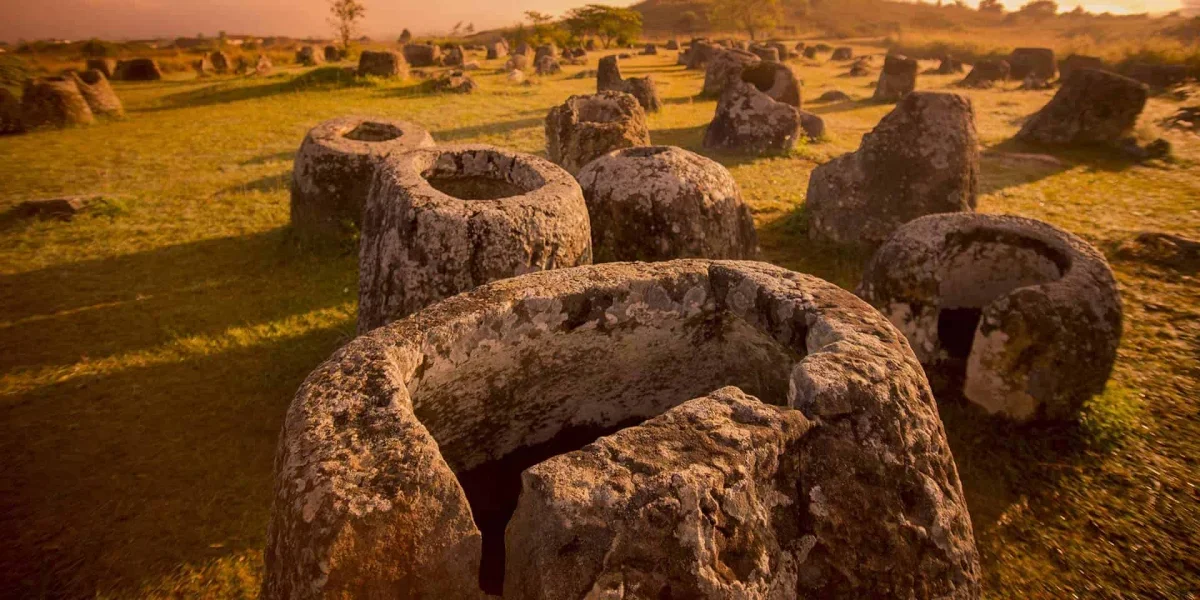
For centuries, the Plain of Jars in northern Laos has intrigued archaeologists and historians alike, with its monumental stone jars standing silently across the landscape. Recent excavations at one of these sites have uncovered significant findings that may shed light on their purpose and the culture that created them.
Archaeologists have discovered bones and teeth from at least 37 individuals within one of the jars, suggesting that these structures were used for burial practices over a span of approximately 270 years. The presence of glass beads alongside the remains indicates that this ancient community maintained trade links with regions as far-reaching as India and Mesopotamia.
The Purpose of the Jars
Located about 70 kilometers northeast of Phonsavan, the excavation site, known as Jar 1, revealed a large stone vessel measuring 1.3 meters in height and over 2 meters in diameter. Led by Nicholas Skopal from James Cook University and the Australian National University, the research team uncovered disarticulated bones, artifacts such as an iron knife and a copper-based bell, and numerous glass beads.
This recent excavation provides compelling evidence supporting the idea that the jars served a funerary function, a theory proposed as early as the 1930s by French archaeologist Madeleine Colani. The arrangement of the bones suggests a practice known as "secondary burial," where remains are moved to a new site after decomposition, indicating that Jar 1 functioned as an ossuary rather than a traditional grave.
A Cultural Connection
The analysis of the glass beads reveals a fascinating glimpse into the extensive trade networks of the time. Most beads are linked to South Asian glass-making traditions, while others may have connections to the Middle East and Southeast Asia. This evidence suggests that the highlands of Laos were not isolated; rather, they were part of a vibrant trade system that connected diverse cultures.
Future Research Directions
Despite these exciting discoveries, many questions remain unanswered. The exact origins of the jars, the methods used to transport them, and the reasons for their eventual abandonment continue to puzzle researchers. Ongoing studies aim to further investigate the identities and health of the individuals buried within the jars, as well as their dietary habits and possible familial connections.
Published in the journal Antiquity, these findings not only enhance our understanding of the cultural practices in ancient Laos but also highlight the interconnectedness of early civilizations. As research progresses, we may gain deeper insights into how these ancient communities lived and interacted with one another, shaping our understanding of history.