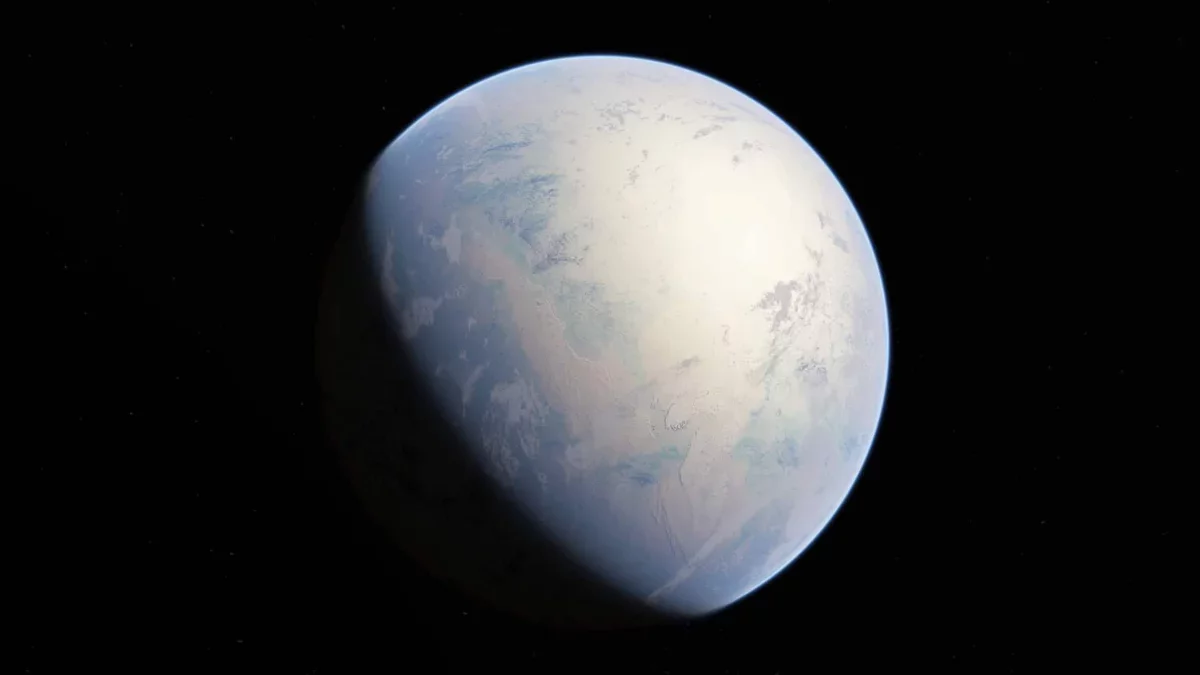
While today's Earth appears as a vibrant blue planet from space, 700 million years ago, it resembled a dazzling white snowball. Surprisingly, this icy environment may have harbored life, as recent findings indicate that pockets of ice-free areas existed, providing refuge for early complex organisms.
During the Cryogenian period (720 to 635 million years ago), massive ice sheets enveloped the planet, extending from the poles to the tropics, with surface temperatures plummeting to -50°C. The reflective nature of the ice, known as the albedo effect, contributed to this prolonged frigid state, termed "Snowball Earth."
Traditionally, scientists believed that such extensive ice cover would stifle climate variability, limiting interactions between the atmosphere and oceans. However, recent research challenges this notion. By analyzing ancient rock formations, researchers found that climate conditions during this period were more dynamic than previously thought. The findings suggest oscillations in climate patterns resembling those we experience today.
Understanding Climate Cycles
The breakthrough came from the Garvellach Islands off Scotland's west coast, where rocks formed during the Sturtian glaciation (720-660 million years ago) provided a unique archive of Snowball Earth. These laminated sedimentary rocks, or varves, act as natural data loggers, capturing historical environmental conditions.
Analysis of approximately 2,600 varves revealed non-uniform layers, indicating predictable climate cycles over years to centuries. Remarkably, these sediments preserved a comprehensive array of climate rhythms, including annual seasons and phenomena like El Niño, which typically occurs every two to seven years.
Hints of an Ice-Free Ocean
The findings raise intriguing questions about the ocean's state during Snowball Earth. Computer simulations indicate that even a small fraction of the ocean being ice-free--around 15%--could facilitate interactions between the atmosphere and oceans, potentially leading to climate oscillations.
These ancient sediments likely document a tropical oasis, providing a haven for life amid widespread glaciation. This aligns with other evidence suggesting that parts of the ocean remained partially ice-free during this era. Such oases may have been critical for the survival of life, allowing it to thrive despite the harsh conditions.
Interestingly, the Snowball Earth phenomenon coincided with a significant biological revolution, as multicellular life began to flourish, driven by nutrients released from glacial activity. This study proposes that if tropical oceans contained open water, they could have functioned as refuges for life, ensuring biodiversity during extreme climatic conditions.
Ultimately, this research paints a picture of an oscillating Earth, where thin cracks in ice or patches of open water created habitats that nurtured early life, paving the way for the diverse ecosystems we see today.