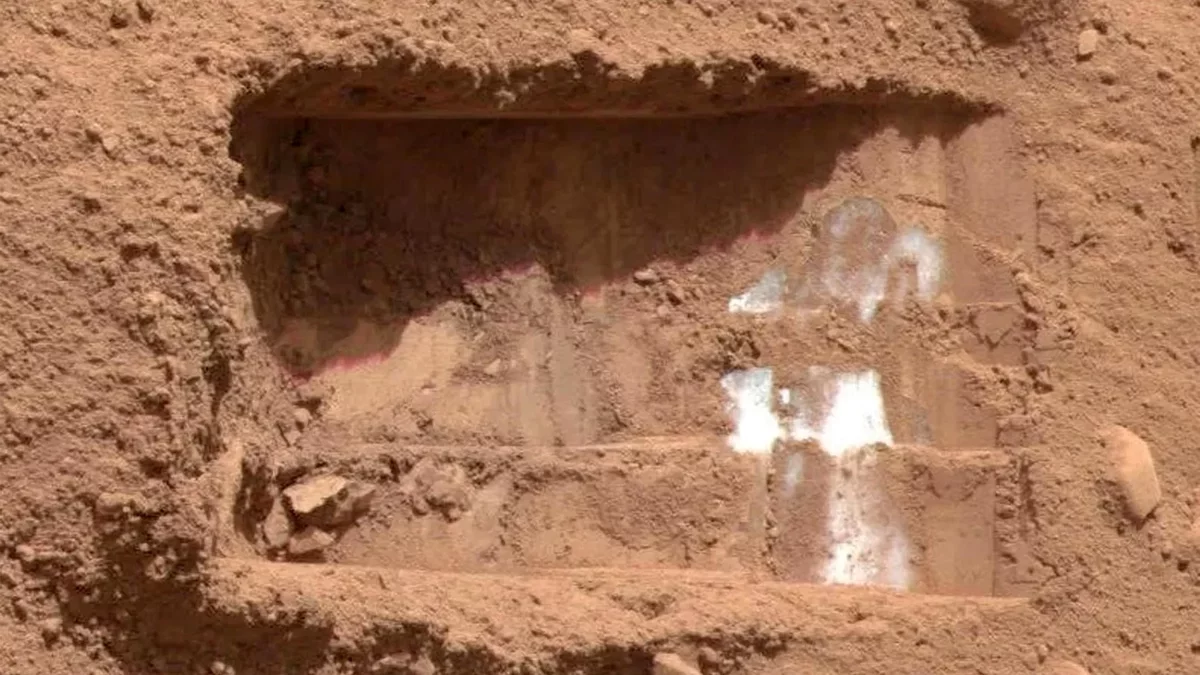
Scientists at NASA's Goddard Space Flight Center, in collaboration with Penn State University, have conducted groundbreaking research that suggests ancient life forms could persist for over 50 million years within Martian ice. Their experiments recreated Martian conditions in a laboratory setting, focusing on the survival of amino acids from E. coli bacteria when encased in permafrost or ice caps on Mars. The results, recently published in Astrobiology, indicate that future missions aiming to discover life on Mars should prioritize exploring pure ice or ice-rich permafrost rather than primarily examining rocks, clay, or soil.
Co-author Christopher House, a professor of geosciences at Penn State, highlighted the significance of the findings, noting that many current surface ice deposits on Mars are less than two million years old. This suggests that if bacteria exist near the Martian surface, they could be detected in future explorations.
Laboratory Simulations of Martian Conditions
The study, led by Alexander Pavlov, a space scientist at NASA Goddard, involved sealing E. coli bacteria within test tubes filled with pure water ice. Some samples were mixed with materials typical of Martian sediment, including silicate-based rocks and clay. The frozen samples underwent exposure to gamma radiation, simulating 20 million years of cosmic ray bombardment, before being vacuum sealed and sent back to NASA for amino acid analysis.
The findings were remarkable: over 10 percent of the amino acids in pure water ice survived the full 50 million-year simulation, while samples mixed with Martian-like sediment deteriorated ten times faster.
Insights into Organic Molecule Preservation
Previous research from 2022 indicated that amino acids in a mixture of water ice and Martian soil were destroyed more rapidly than those in pure ice. Pavlov expressed surprise at the new results, which showed that organic materials in pure water ice remained intact longer than expected. This suggests that the unique properties of solid ice may shield organic compounds from radiation damage.
Broader Implications for Space Exploration
The research also examined organic materials at temperatures mimicking those found on Europa and Enceladus, icy moons of Jupiter and Saturn, respectively. At these lower temperatures, the breakdown of organic material slowed even further, offering promising insights for NASA's upcoming Europa Clipper mission, set to explore Europa's ice shell and subsurface ocean.
Future Mars Missions and Ice Access
Accessing buried ice on Mars will require advanced technology. The 2008 NASA Mars Phoenix mission was the first to successfully excavate and photograph Martian ice. House emphasized the necessity for future missions to utilize sufficiently powerful drilling equipment to reach the ice, which lies just beneath the Martian surface.
The research team included several experts from Penn State and NASA Goddard, with funding provided by NASA's Planetary Science Division.