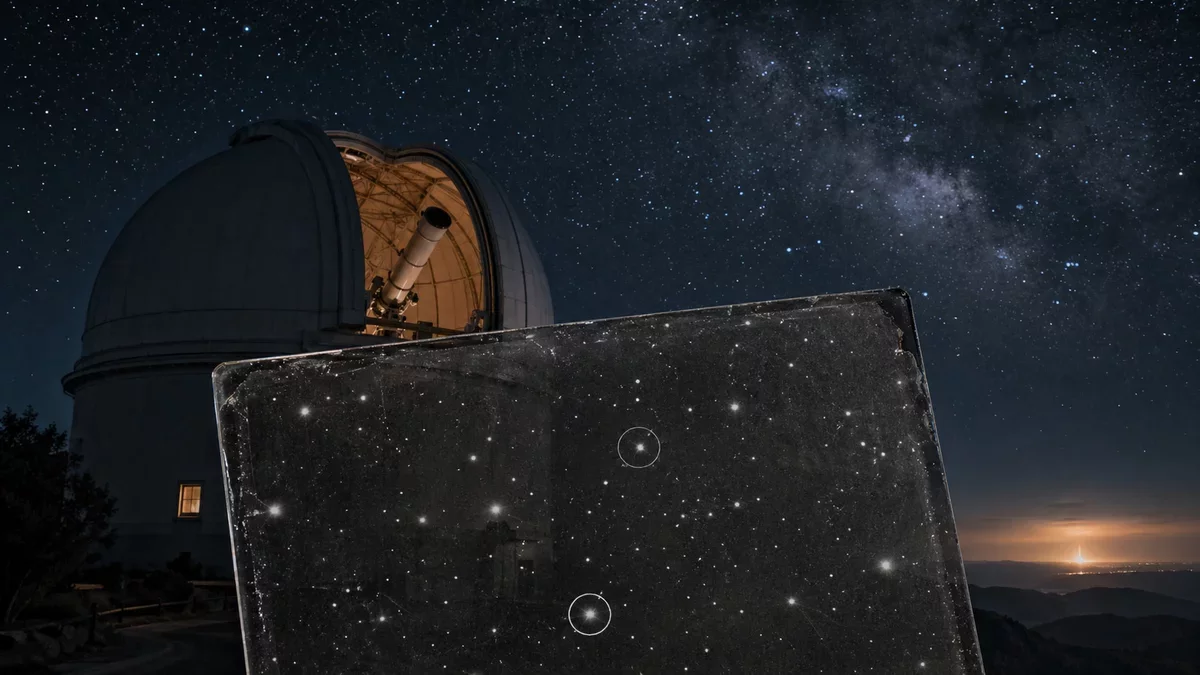
A fascinating discovery has emerged regarding flashes captured in the sky prior to the launch of the first satellite. Between 1949 and 1957, the Palomar Observatory documented thousands of fleeting, star-like points of light that appeared in one photograph and vanished in another. These anomalies do not correspond to any known stars or galaxies, and their existence predates the launch of Sputnik, making them difficult to attribute to conventional satellites or space debris.
Initially, many assumed these flashes were merely defects from aging photographs, such as dust or scratches. However, a recent study challenges this notion, suggesting that some of these flashes are indeed genuine phenomena. Researchers employed machine learning techniques to analyze over 107,000 candidate flashes from the Palomar Observatory Sky Survey, aiming to distinguish real objects from photographic imperfections.
The findings indicate that while most of the observed transients are likely artifacts, approximately 10% show a probability exceeding 80% of being real, unexplained occurrences. This reinforces the idea that some of the pre-Sputnik flashes merit further investigation.
Insights from the Palomar Observatory Sky Survey
The Palomar Observatory Sky Survey, initiated in the late 1940s, utilized large photographic plates to map the northern sky. This archive serves as a unique snapshot of the sky before the era of satellites, making it an invaluable resource for astronomers. With the advent of Sputnik in 1957, the sky became increasingly populated with artificial objects, complicating the interpretation of similar observations.
The transients observed are characterized as point-like sources, resembling stars rather than streaks, and they appear on one plate while disappearing from subsequent images. They do not match any known celestial objects cataloged in modern databases.
To address skepticism regarding these observations, researchers trained a machine-learning model on 250 image pairs from the survey, categorizing them as either likely real transients or defects. The model performed significantly better than chance at identifying genuine flashes.
Examining the Shadow Effect
One intriguing aspect of the analysis involved examining whether these flashes exhibited a shadow effect. Objects in orbit reflecting sunlight should dim or disappear when they pass into Earth's shadow. The study found a notable decrease in the number of observed transients within Earth's shadow, suggesting that the most convincing flashes may indeed be reflective objects.
Connections to Nuclear Tests
Moreover, the study revisits a provocative claim linking transient sightings to U.S. nuclear tests. The researchers noted a significant increase in transient counts around the dates of these tests, indicating a potential correlation that is difficult to dismiss.
While the exact nature of these flashes remains uncertain, the implications are profound. They could represent previously undetected atmospheric phenomena, or perhaps even hint at advanced technology predating our current understanding. This research opens the door to a deeper exploration of the historical astronomical record, suggesting that the skies of the 1950s were far more dynamic than previously imagined.
As we advance our understanding of these phenomena, the future may reveal even more about the universe's hidden complexities and the potential for undiscovered technologies.