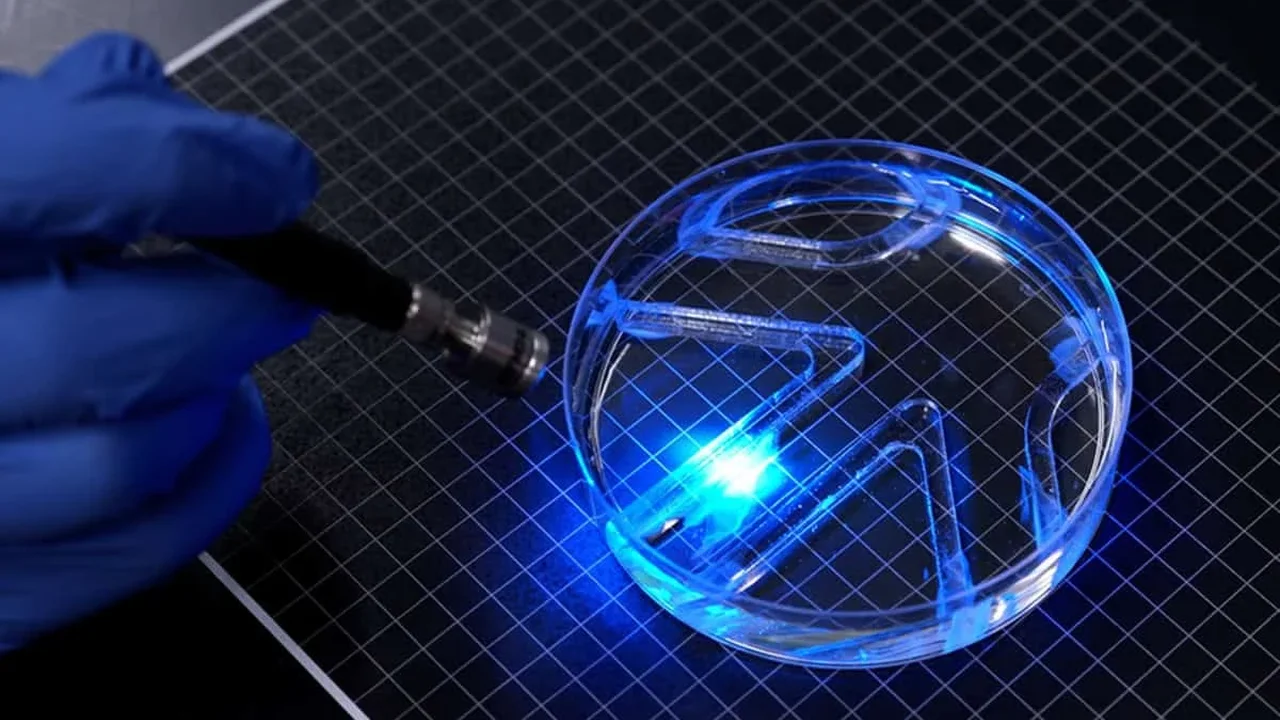
Engineers at MIT have developed an ultrathin biohybrid robot that moves through water using living muscle cells activated by light. Roughly the size of a small strip of gum, the soft swimmer requires no motor, battery or propeller.
The robot is built on a flexible gelatin methacrylate, or GelMA, structure measuring about half a millimeter thick. Its two fins are covered by sheets of mouse muscle cells thinner than 15 micrometers. When exposed to blue light, the cells contract, flexing the fins and producing forward motion.
A more efficient living actuator
To help the cells develop into coordinated muscle fibers, the MIT team created microscopic grooves across the gel surface. These channels guided muscle growth in the same direction, enabling the thin tissue layer to generate movement more effectively.
Reported in Advanced Functional Materials, the design produced around 20 times more force per muscle volume than earlier biohybrid robots based on bulkier three-dimensional muscle structures. The untethered muscle films also remained functional for more than 30 days.
The robot can travel at approximately four body lengths per minute and navigate a simple water maze. Researchers steer it by activating one fin or the other, while stimulating both fins enables rotation. Daily light-controlled contractions also strengthened its movement, increasing muscle stroke by about four times compared with untrained samples.
Soft robotics inspired by biology
Unlike traditional machines built around rigid components, this swimmer combines engineered materials with responsive living tissue. Its paper-thin design highlights how biological actuators could reduce material use while supporting delicate movement in compact robotic systems.
Future versions may integrate more advanced onboard control and refined body designs for specialized environments. Biohybrid robotics could help shape a new generation of soft, adaptive tools designed for precise exploration and interaction in sensitive settings.