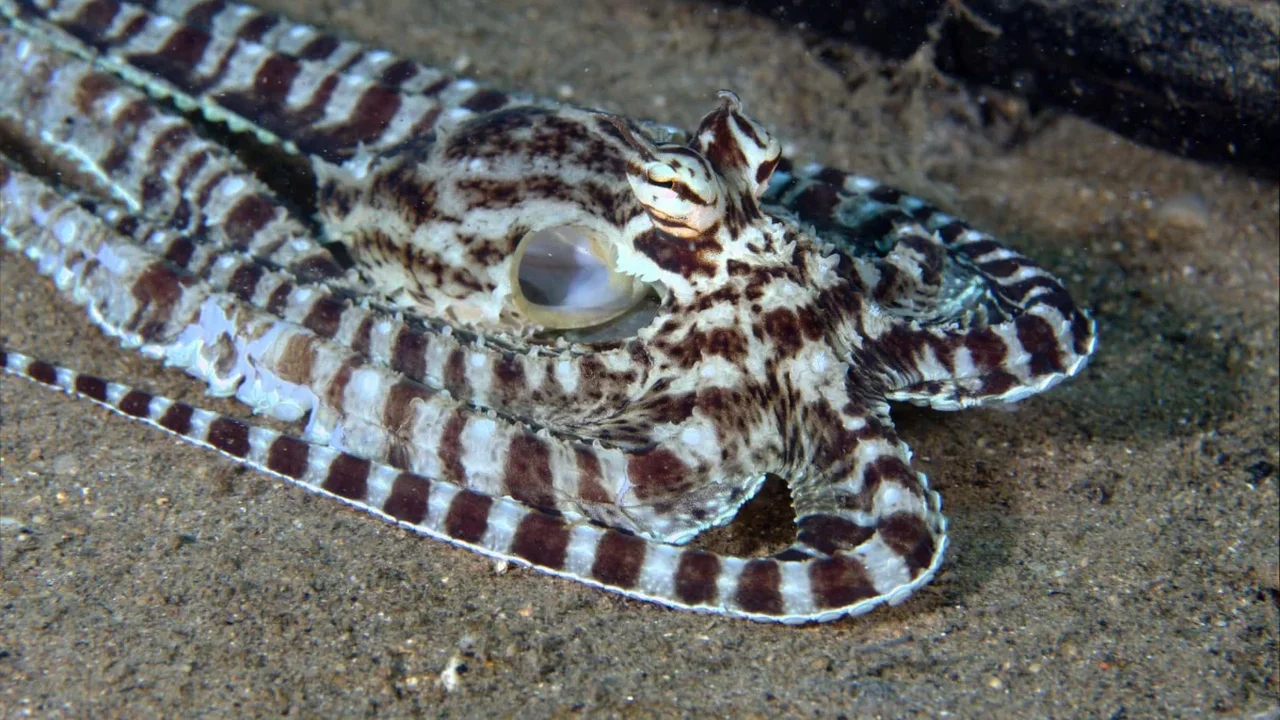
The mimic octopus (Thaumoctopus mimicus) can grow to about 60 centimetres and is marked with brown-and-white stripes and spots. Its most striking ability is changing its shape, colour and movement to resemble other marine animals.
A flexible underwater disguise
Among its documented imitations are flatfish and sea snakes, as well as lionfish. To look like a flatfish, the octopus flattens its body, brings its arms together and moves with a rippling motion. It may use this approach to cross open sandy seabeds, where simply blending into the background offers less protection.
Claims that the species imitates a fixed list of 15 animals are not well substantiated. Scientists are still examining which impersonations are reliably observed and how they help the octopus avoid predators. Its behavior is intriguing, but it does not by itself reveal what the animal understands or how much it learns through experience.
Range and behavior
The species inhabits muddy and sandy seabeds in shallow waters of the Indo-Pacific. In 2024, researchers reported the first documented sightings in Mozambique, based on observations made in 2020 and 2022 at the Vilanculos Coastal Wildlife Sanctuary. The records extended its known range into the southwestern Indian Ocean.
The mimic octopus feeds on small fish, worms and crustaceans. Its adaptable disguises and newly documented range show how much remains to be learned about marine life; further research may clarify how its behavior helps it navigate changing environments.