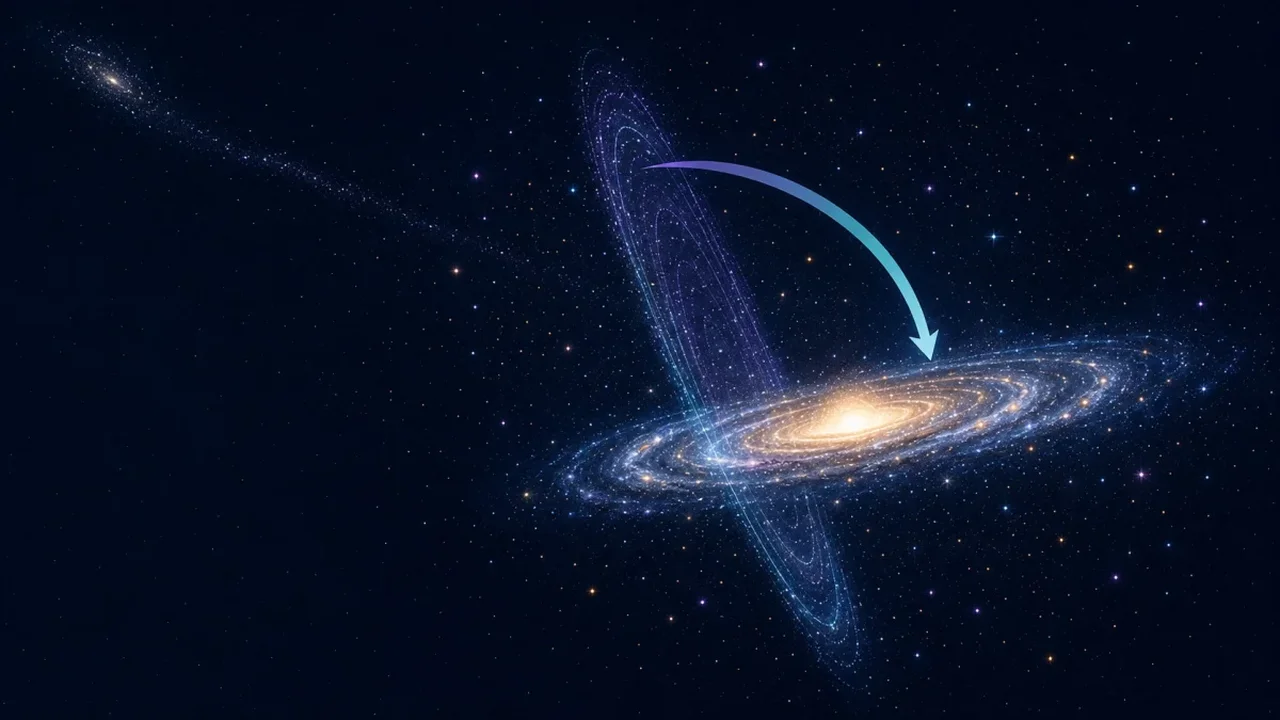
New research suggests the Milky Way may have undergone a dramatic reorientation in its early history, with its disc possibly shifting by more than 90 degrees during a long cosmic transformation.
The key evidence comes from the galaxy's stellar halo, a sparse population of ancient stars that rotates far more slowly than the main disc. While the disc moves at about 220 kilometres per second, the halo appears to spin at only 10 to 20 kilometres per second.
A cosmic fossil record
At the 2026 National Astronomy Meeting, Durham University researcher Kirill Batrakov presented a simulation-based explanation for this unusual behaviour. His team examined galaxy models built with the Auriga simulations and compared their rotation histories over billions of years.
The analysis points to a major merger with Gaia-Sausage-Enceladus, the remnant of a dwarf galaxy that joined the young Milky Way around 8 to 11 billion years ago. In astronomy, such mergers do not involve direct star-to-star impacts; instead, gravity reshapes orbits, strips material, and can gradually alter a galaxy's orientation.
According to the study, galaxies that experienced this kind of event often ended up with slower-rotating haloes. In some cases, the disc also flipped as the system settled into a new alignment. The process would have taken a very long time, possibly from 150 million years to as much as 1 to 2 billion years.
Earlier work using Gaia and the Sloan Digital Sky Survey had already hinted that the halo rotates in the same general direction as the disc, but much more slowly than expected. Other recent studies have also suggested that the Milky Way's outer dark-matter halo may be oriented differently from the visible disc.
The new findings are still awaiting peer review, but they add a compelling layer to the story of how our galaxy assembled itself. Future observations may help map the remaining traces of this ancient reshaping and reveal how common such flips are across the universe. In the years ahead, this line of research could deepen our understanding of how galaxies evolve and reorganize over cosmic time.