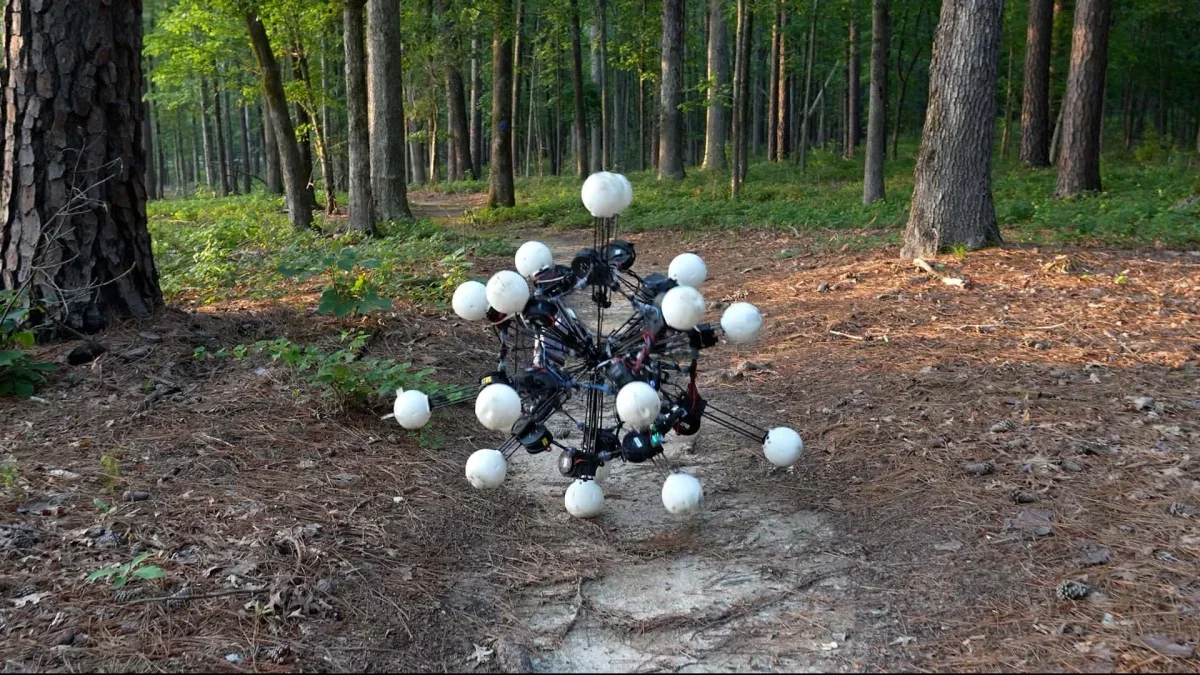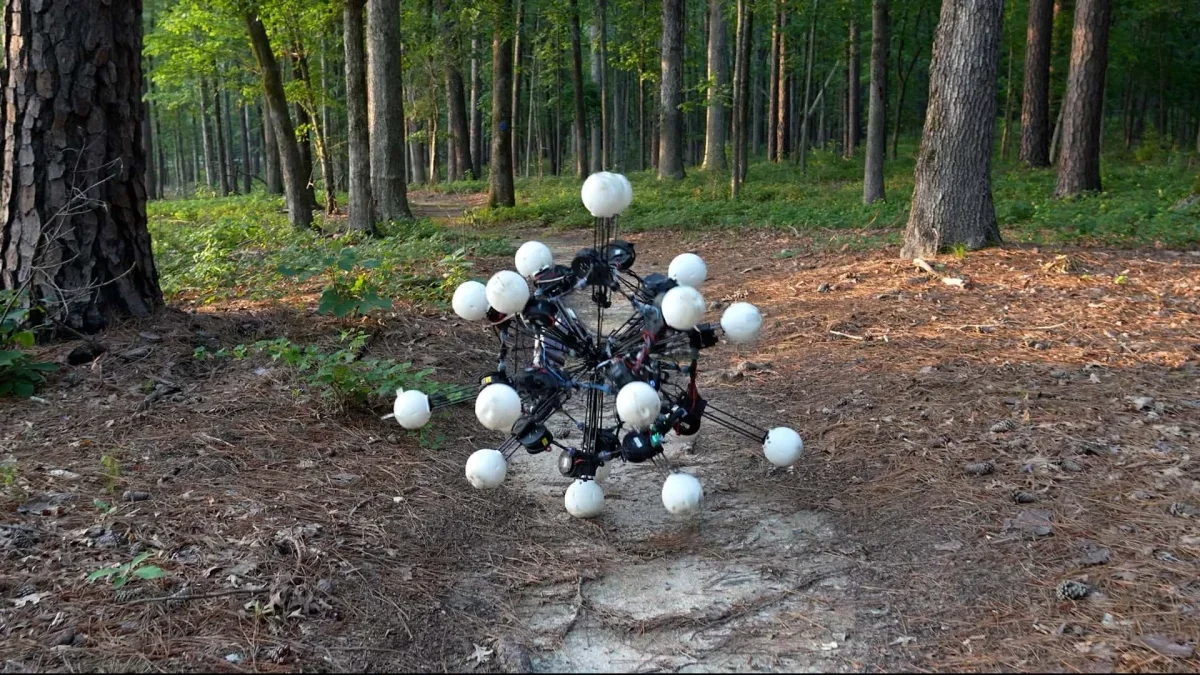
Introducing Argus, a groundbreaking robot that defies traditional design norms with its unique structure. Unlike conventional robots that mimic the movement of animals, Argus features an unconventional spherical shape equipped with 20 telescoping legs, each fitted with depth cameras. This design allows it to navigate diverse terrains, from grass to wet ground, without a defined front or back.
The inspiration for its name comes from Greek mythology, referencing Argus Panoptes, the many-eyed giant. This aptly reflects the robot's ability to observe its surroundings from multiple angles, enhancing its adaptability and functionality.
Researchers at Duke University have developed Argus as part of a study that challenges the conventional approach in robotics. Instead of focusing on mimicking biological forms, they propose a new paradigm where robots are designed based on their ability to move efficiently in all directions. This concept, termed dynamic isotropy, measures how uniformly a robot can accelerate its center of mass, with Argus achieving an impressive score of 0.91.
Jiaxun Liu, a doctoral student involved in the project, expressed excitement over Argus's capabilities, stating, "Watching Argus move is unlike any other robot we've worked with." Its design allows it to traverse obstacles and maintain stability even when several legs are disabled, showcasing resilience and versatility.
Rethinking Robot Design
Traditionally, robotics has drawn inspiration from biological entities--humanoid robots emulate human limbs, while quadrupeds resemble animals. However, the Duke team shifted the focus to a design that prioritizes movement efficiency. By conducting over 1,500 simulations, they identified an optimal configuration for Argus, which features legs radiating from a central frame, reminiscent of a sea urchin.
Argus's ability to maintain balance and maneuver across various surfaces, including concrete and soft sand, demonstrates its potential for real-world applications. It can carry payloads while navigating uneven terrain and even perform complex tasks like pushing objects without needing to orient itself in a specific direction.
Despite its promising capabilities, Argus is still in the developmental phase. Challenges remain, particularly in real-world testing where performance can diverge from simulations, largely due to issues with its depth cameras. Nevertheless, the researchers are optimistic about the future.
"Argus serves as evidence that designing for dynamic symmetry is more than just a theoretical concept," noted Boxi Xia, a postdoctoral researcher. "It showcases the potential for robots to operate effectively in unpredictable environments."
As robotics technology continues to evolve, designs like Argus pave the way for machines that can adapt to diverse challenges, from disaster response to extraterrestrial exploration. This innovative approach may redefine the future of robotics, moving away from human-like forms to designs that leverage mathematical and physical principles for enhanced functionality.