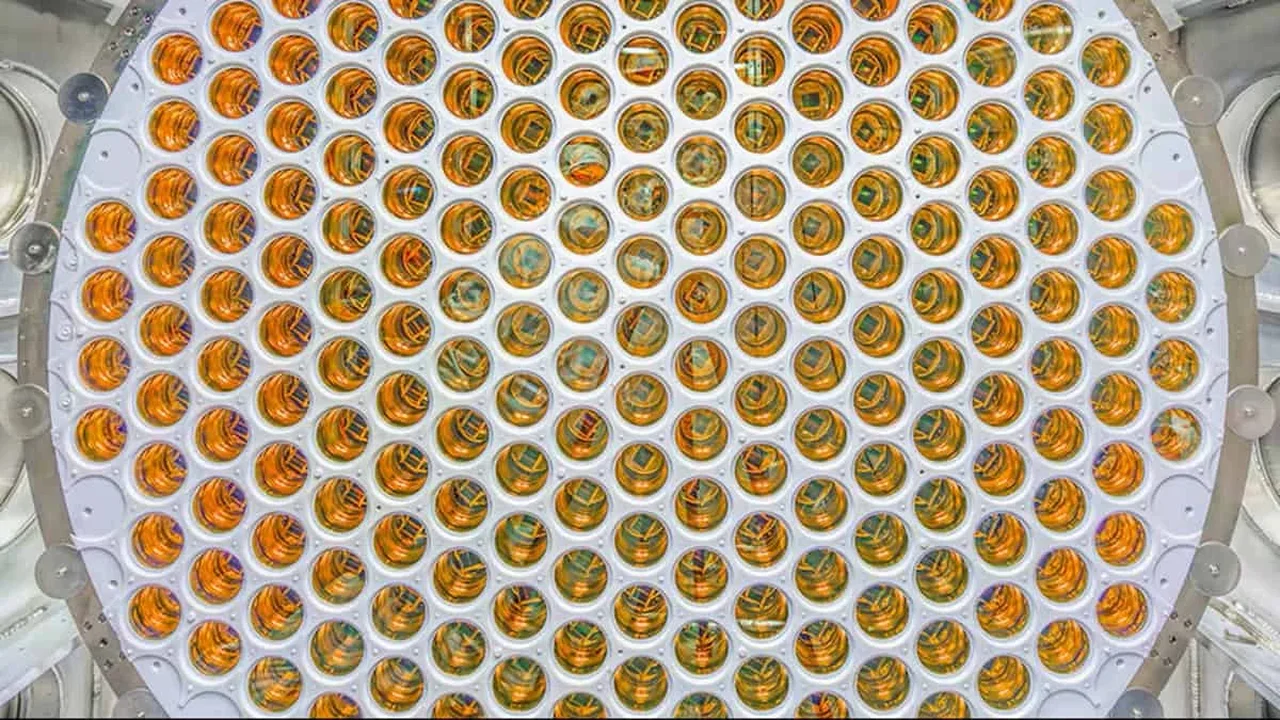
One of the world's most sensitive dark matter experiments has captured a rare event that is drawing attention across physics. The LUX-ZEPLIN detector, buried deep underground in South Dakota, recorded a single high-energy collision on June 16, 2023 that researchers have not yet been able to explain with confidence.
Dark matter remains invisible because it does not interact with light in the usual way. Scientists infer its presence through gravity, which shapes the motion of galaxies and galaxy clusters. Although it is believed to make up a major share of the universe's matter, its true nature is still unknown.
A single event, but a notable one
LUX-ZEPLIN, or LZ, uses seven tonnes of liquid xenon to detect tiny flashes produced when particles strike xenon atoms. In 220 days of data, the team found one unusually energetic recoil, measured at about 248 kiloelectronvolts. After checking possible explanations such as neutrons, neutrinos, radioactivity, cosmic particles, and detector effects, the researchers say none fully accounts for the signal.
The result carries a statistical significance of 2.6 sigma, which is intriguing but far below the 5 sigma threshold physicists usually require for a discovery. That means the event could still be a rare background fluctuation rather than evidence of dark matter.
Even so, the finding is scientifically valuable because it gives researchers a fresh direction. If the signal is real, it may point to a more complex version of dark matter than the classic WIMP model predicts. Future data from LZ, along with independent checks from experiments such as XENONnT and PandaX, will help clarify whether this is a breakthrough or a statistical surprise.
For now, the result adds a new clue to one of science's biggest mysteries, and it may shape the next generation of dark matter searches in the years ahead.