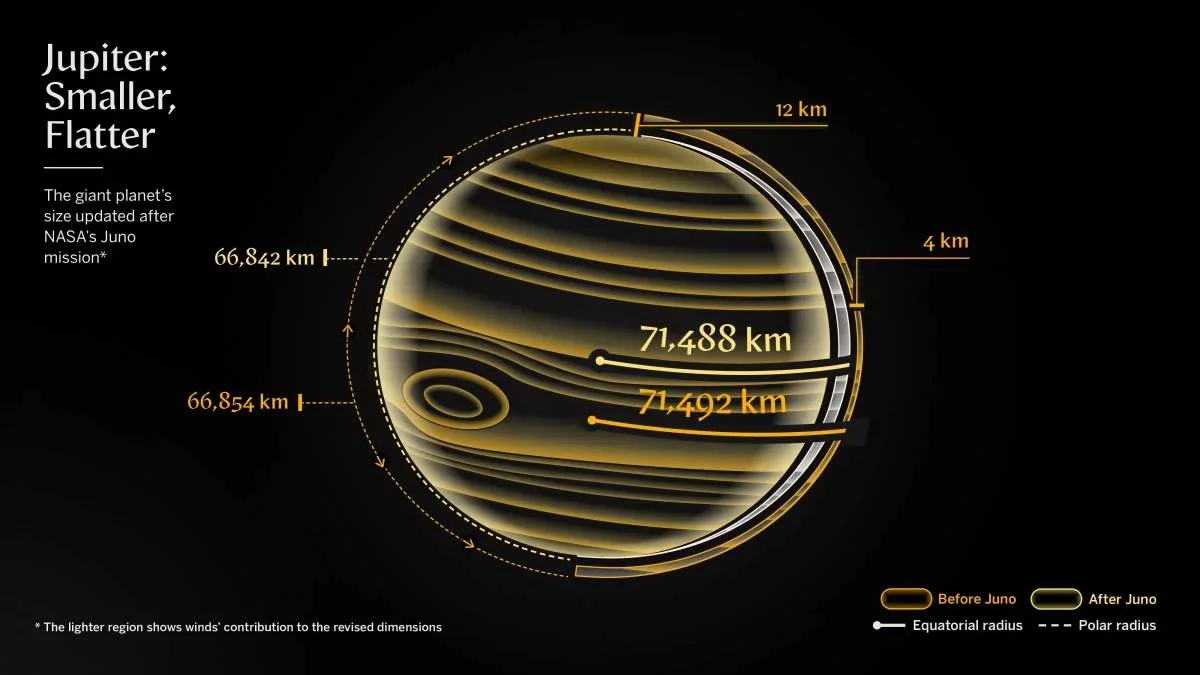
Recent findings indicate that Jupiter is now considered "smaller" than earlier measurements suggested. However, this doesn't imply that the planet has physically shrunk; rather, advancements from the Juno spacecraft have provided us with a more precise understanding of its dimensions.
At the critical pressure level of 1-bar, which represents the "surface" of this gas giant, new measurements reveal that Jupiter's polar radius is 12 kilometers shorter than previously estimated, while its equatorial bulge is now 4 kilometers slimmer. In total, its mean radius has decreased by 8 kilometers. Although these changes may seem minimal for a planet boasting a radius exceeding 70,000 kilometers, they are significant for scientists engaged in planetary research.
"Textbooks will need to be revised," remarked Yohai Kaspi, the lead author of the study and an astronomer at the Weizmann Institute of Science.
Understanding the Previous Miscalculations
For almost fifty years, our comprehension of Jupiter's dimensions was based on a limited number of measurements taken by the Voyager and Pioneer missions in the late 1970s. These pioneering spacecraft relied on how radio signals bent while traversing Jupiter's atmosphere.
While this method has proven reliable, it was based on just six data points, making it challenging to create a detailed map. Moreover, scientists at that time overlooked the impact of winds within Jupiter's atmosphere.
Jupiter is renowned for its rapid rotation, completing a full spin every 9 hours and 55 minutes, which contributes to its significant equatorial bulge. The planet resembles a basketball under pressure. However, the dynamic atmosphere, characterized by intense jets of wind, complicates this picture. These winds create centrifugal forces that affect the atmosphere at various latitudes.
Previous estimates treated Jupiter as a static object, but the latest study, led by Eli Galanti and Yohai Kaspi, utilized 24 high-precision measurements from Juno, incorporating the effects of these winds to establish a more accurate model.
Reassessing Jupiter's Size
Jupiter's equatorial measurement stands at 71,488 kilometers, while its polar measurement is 66,842 kilometers.
The adjustments made are less than the distance between Manhattan and Brooklyn. While they may appear trivial, they are crucial for researchers. Galanti noted, "A slight adjustment in radius allows our models of Jupiter's interior to align better with both gravitational data and atmospheric observations."
"By slightly reducing the equatorial radius by 14 kilometers to account for wind effects in static models, the mathematics aligns perfectly," explained Maayan Ziv, a PhD student in Kaspi's group.
"We were in a unique position to utilize advanced models for Jupiter's interior density structure, demonstrating that this refined shape helps reconcile models with actual measurements," Ziv added.
This research holds broader implications as Jupiter serves as a reference point for modeling exoplanets in distant star systems. The improved understanding of its shape will aid astronomers in more accurately determining the size and composition of far-off worlds.
Jupiter remains the magnificent, swirling giant it has always been, but now we possess a clearer perspective of it. It was indeed time for this update.
The study has been published in Nature Astronomy.