Throughout human history, our gaze has been drawn to the cosmos. Among the myriad myths surrounding stars and constellations, a groundbreaking hypothesis suggests that one particular tale may stretch back an astonishing 100,000 years.
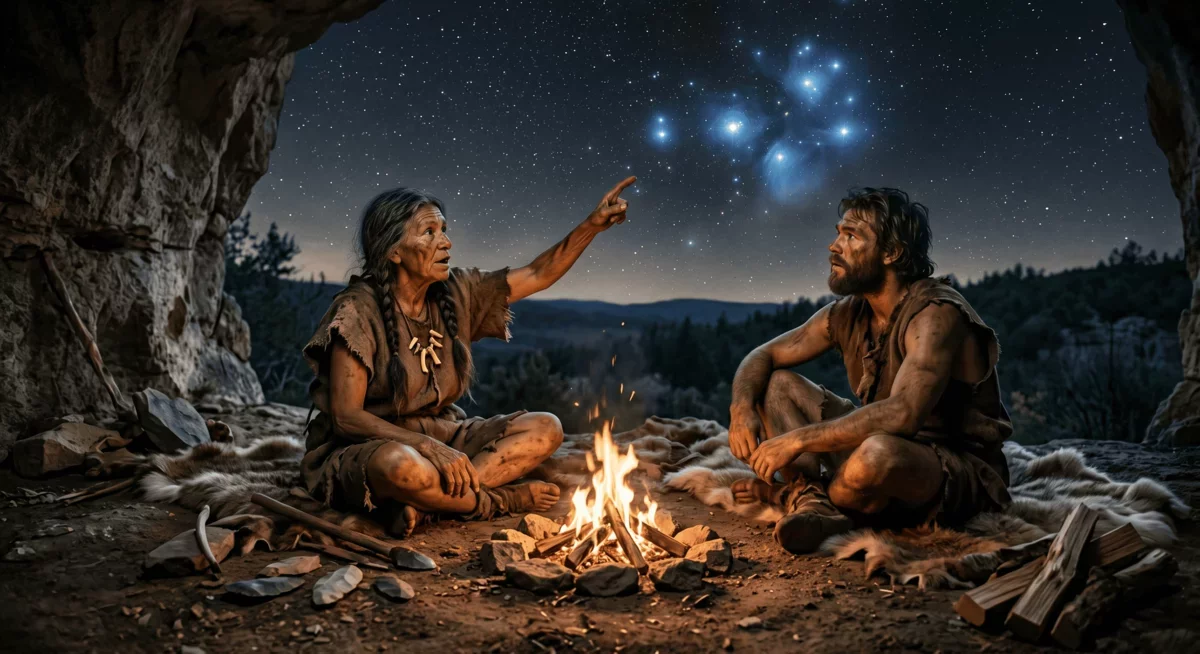
This legend revolves around the Pleiades, often referred to as the "Seven Sisters." Interestingly, while only six stars are visible to the naked eye today, the ancient night sky may have revealed a seventh star.
Research indicates that 100,000 years ago, two stars in this cluster, Atlas and Pleione, were sufficiently spaced apart to be seen as distinct entities. This revelation leads scientists to propose that the name "Seven Sisters" and its associated legends could date back to that era.
The Lost Sister
This theory stands on surprisingly robust foundations. Stars are not static; they move through space at varying velocities--a phenomenon known as proper motion. By studying contemporary star movements, researchers can trace their positions back through time.
Ray and Barnaby Norris, utilizing data from the Gaia space telescope, aimed to recreate how the Pleiades appeared to early Homo sapiens. Their findings reveal that the two stars currently too close to distinguish were once clearly visible, potentially leading to the formation of the "Seven Sisters" myth.
Legends and Stars
The Pleiades are deeply embedded in various cultural narratives. In Greek mythology, they are depicted as the daughters of Atlas pursued by Orion. Hindu traditions associate them with the wives of the Seven Sages, while Berber communities refer to them as the "daughters of the night." This cluster has inspired stories across cultures, including in the Talmud, Arabic folklore, Celtic mythology, and even among Aboriginal Australians, where the narratives closely mirror the Greek ones.
This widespread recognition of seven sisters across diverse cultures raises intriguing questions about a shared origin. The idea that these stories could have emerged around 100,000 years ago would provide a compelling explanation for their similarities, especially considering the isolation of many Aboriginal cultures for millennia.
The implications of this hypothesis are profound. If the tale has been passed down through generations--approximately 4,000 times--this challenges prior beliefs about the longevity of oral traditions. Historians previously thought stories faded after a few millennia, but this suggests that cultural narratives can endure far longer than anticipated.
Can Stories Really Survive That Long?
While some skeptics caution against overinterpreting coincidences, there are mechanisms through which cultures can preserve stories over time. Many indigenous societies utilize rhythm and song as mnemonic devices, ensuring that narratives are told accurately. The significance of storytelling often elevates its status in cultural practices, reinforcing the importance of preserving these tales.
Though the researchers presented their hypothesis in a book, they acknowledge the speculative nature of their claims. The absence of definitive proof leaves us pondering the possibility that ancient humans carried these narratives across continents, from Africa to Australia, Europe, and beyond.
This tantalizing prospect invites us to consider how interconnected our stories may be, transcending both time and geography.