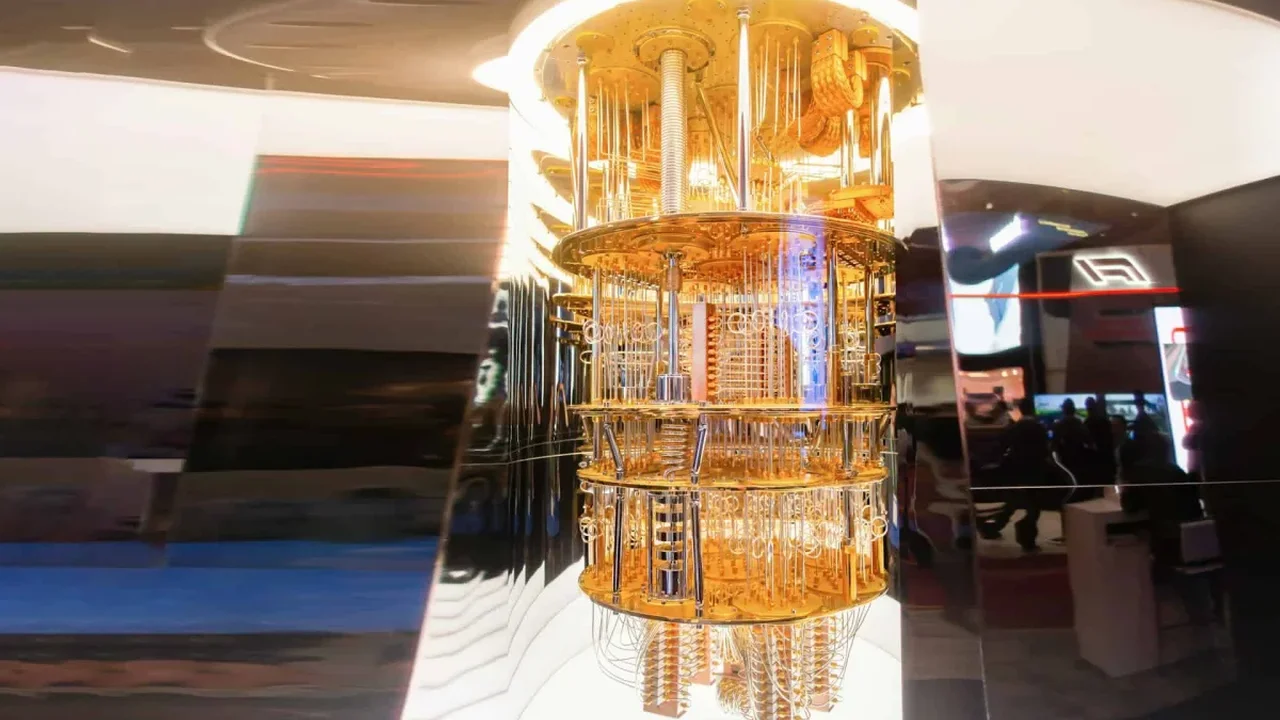
Quantum computing holds the promise of revolutionizing areas such as drug discovery and data encryption by tackling complex problems that traditional computers cannot address. Yet, progress has been hampered by a significant hurdle known as decoherence, which occurs when quantum bits, or qubits, lose their information due to environmental interactions. Even minimal electromagnetic noise can disrupt the delicate quantum states necessary for computation.
According to Lei Du, a postdoctoral researcher in applied quantum technology at Chalmers University, "Quantum systems are extraordinarily powerful but also extremely fragile. The key to making them useful is learning how to control their interaction with the surrounding environment."
Du leads a groundbreaking study that introduces a new quantum system centered around giant superatoms. These innovative structures merge various essential features, significantly reducing decoherence while maintaining stability and operating as a cohesive unit made up of interconnected "atoms."
Defining Giant Superatoms
Giant superatoms integrate two previously distinct concepts in quantum physics: giant atoms and superatoms. While both have been individually explored, this research marks the first instance of their combination into a unified system. These engineered structures mimic atomic behavior but do not exist naturally.
The concept of giant atoms was pioneered by Chalmers researchers over a decade ago. These specialized qubits connect with light or sound waves at multiple, spatially separated points, enabling them to interact with their environment in various locations simultaneously, thereby preserving quantum information.
Anton Frisk Kockum, Associate Professor of Applied Quantum Physics at Chalmers and co-author of the study, elaborates, "Waves that leave one connection point can travel through the environment and return to affect the atom at another point--similar to hearing an echo of your own voice before you've finished speaking. This self-interaction leads to highly beneficial quantum effects and reduces decoherence."
Enhancing Entanglement Across Distances
While giant atoms have advanced our understanding of quantum behavior, they faced limitations in terms of entanglement--the phenomenon that allows multiple qubits to share a single quantum state. To address this, the research team fused giant atoms with superatoms, which consist of several natural atoms sharing the same quantum state and behaving collectively.
This innovative combination is anticipated to facilitate the creation of complex quantum states essential for quantum communication, networks, and highly sensitive measurement systems. "A giant superatom may be envisaged as multiple giant atoms working together as a single entity," explains Du.
Towards Scalable Quantum Systems
This research paves the way for developing quantum systems that are both scalable and reliable. The team aims to transition from theoretical designs to actual constructions, potentially integrating these systems with other quantum technologies.
As Anton Frisk Kockum notes, "Smart design can reduce the need for increasingly complex hardware, and giant superatoms are bringing us closer to practical quantum technology." This advancement opens up new avenues for controlling quantum information flow and enhancing entanglement, setting the stage for a future where quantum computing becomes more accessible and effective.