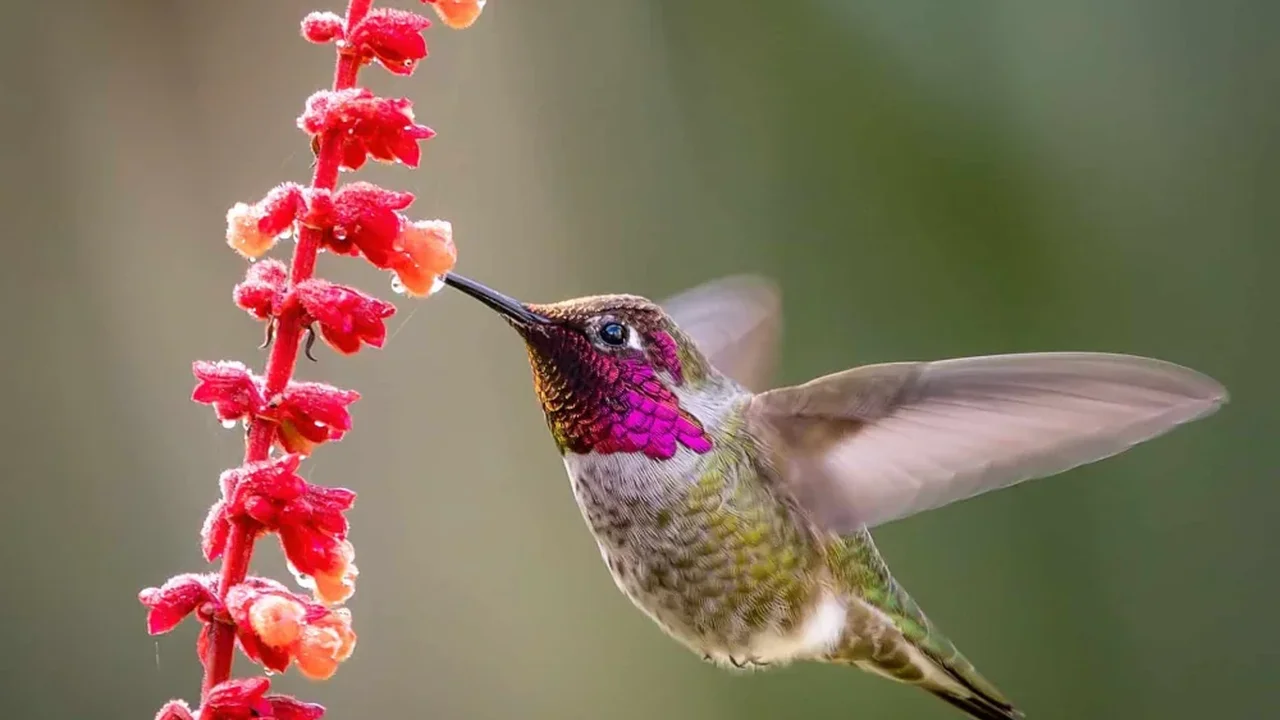
Anna's hummingbird males can flash brilliant magenta from their crowns and throats, even though the color is not produced by a magenta pigment. The effect comes from feather structures that reflect red and blue light together, creating a color with no single wavelength in the visible spectrum.
Layers that shape the light
Researchers from Yonsei University and Ghent University examined the feathers' microscopic structure. They found melanosomes--melanin-containing structures--arranged in layers inside tiny feather branches. The newly identified intermediate layer, around 189 nanometers thick, sits between smaller surface structures and larger ones deeper in the feather.
Light reflecting from the different layers interacts in ways that strengthen some wavelengths and reduce others. Measurements showed a strong red reflection near 632 nanometers, while the combined structural effect also produces a blue peak. Together, these reflections appear magenta to human eyes.
Computer simulations indicated that the surface and intermediate layers work together to generate the blue component. In experiments, gradually removing the surface layer weakened that reflection and shifted the feathers' appearance from magenta toward orange.
A natural design with wider potential
The findings, published in the Journal of the Royal Society Interface, offer a closer look at how structural color can create vivid hues without relying on conventional pigments. Hummingbirds also perceive color differently from humans, so their experience of the feathers' appearance may include visual information we cannot directly see.
Understanding these finely tuned natural reflectors could help guide the design of color-producing coatings and materials. Such research may bring future technologies closer to creating durable, complex colors through structure rather than dyes.