Researchers have identified a previously unseen alloy grain in material recovered from Hiroshima Bay, offering a rare glimpse into how extreme heat can reorganize matter at the atomic level.
A Tiny Grain With a Remarkable Structure
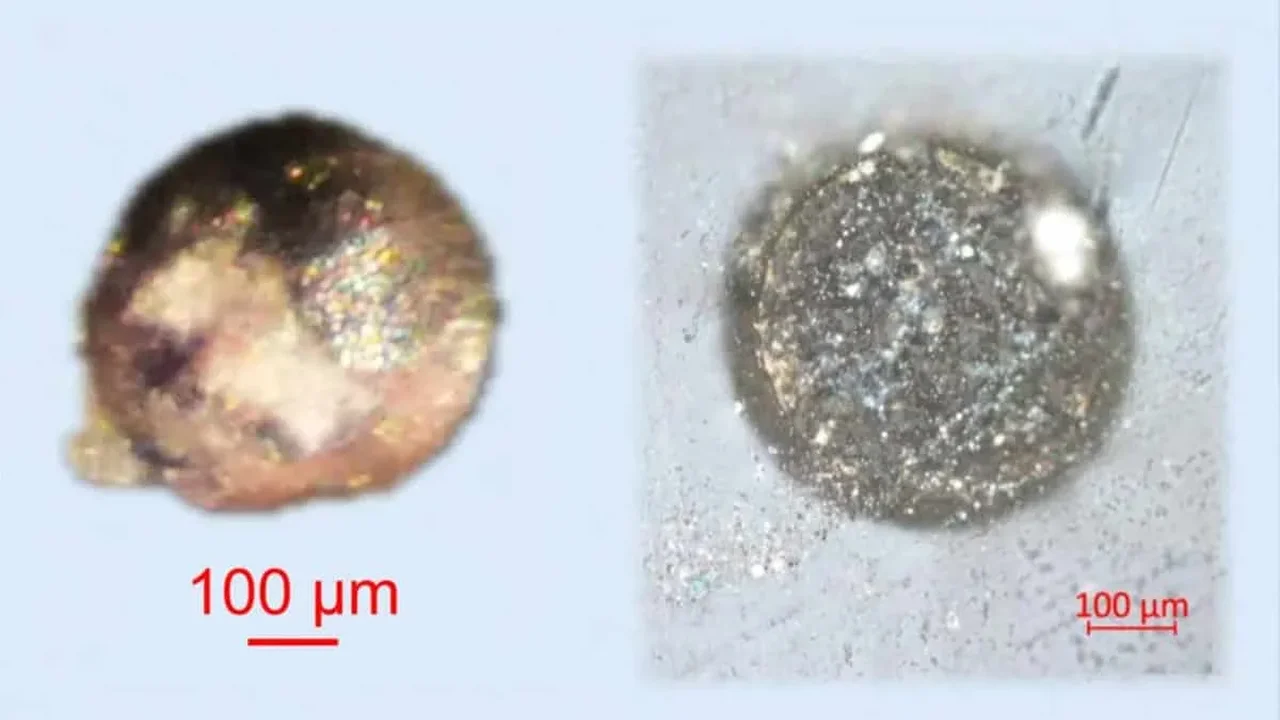
The particle, smaller than a red blood cell, was found inside a glassy droplet collected from beach sands in Hiroshima. It contains an unusual mix of iron, chromium, nickel, manganese, molybdenum, silicon and aluminum, likely drawn from urban materials vaporized during the 6 August 1945 explosion.
In a study published in Science Advances, Luca Bindi and colleagues at the University of Florence examined 34 of these so-called hiroshimaites. While three grains matched familiar iron-chromium alloys, one stood out for its distinct chemistry and structure.
Using single-crystal X-ray diffraction, the team found that the grain follows an ordered cubic pattern known as the AlAu4 type, a structure not previously reported for this kind of iron- and silicon-rich mixture. Rather than forming a disordered alloy, the atoms settled into a highly organized lattice after rapid cooling locked them in place.
Why It Matters for Materials Science
The discovery adds to growing evidence that extreme events can create exotic microscopic materials in seconds. Similar studies have already identified unusual crystals and glassy residues in nuclear-test debris, turning these particles into natural archives of temperature, pressure and cooling history.
Beyond its historical significance, the grain may also inspire new ideas in materials research. Alloys with iron, chromium and nickel are central to corrosion-resistant metals, and understanding how ordered structures emerge could support future work in rapid solidification, powder processing and additive manufacturing.
For now, the sample remains a single, tiny example -- but it shows how scientific analysis can uncover unexpected order inside the most intense moments of history. Such findings may guide future advances in advanced alloys and microscopic material design.