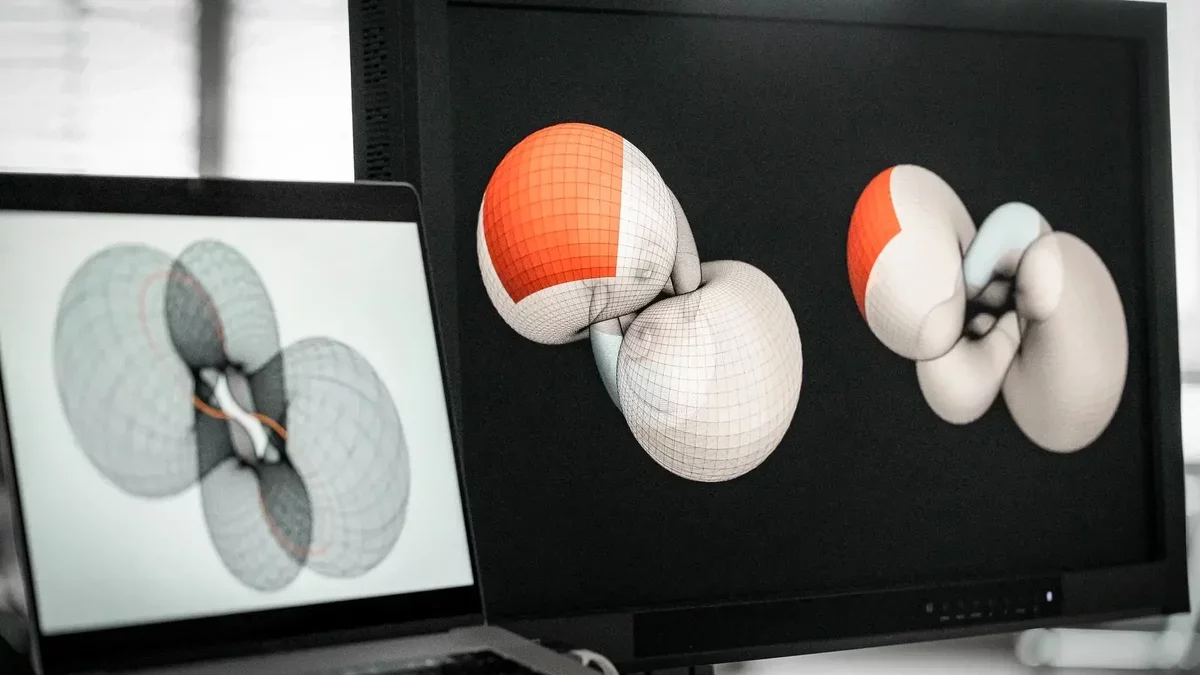
In a remarkable advancement that challenges long-held mathematical beliefs, researchers have successfully constructed two distinct, compact surfaces resembling doughnuts, known as tori. These surfaces exhibit identical values for both metric and mean curvature, yet they differ in overall structure. This groundbreaking example had eluded mathematicians for decades until now.
The metric of a surface quantifies the distances between points, while mean curvature reflects how the surface bends in space, indicating its inward or outward curvature and to what extent.
Revisiting Bonnet's Rule in Surface Geometry
Historically, mathematicians recognized that Bonnet's rule does not universally apply. Exceptions typically involve non-compact surfaces, such as flat planes that extend infinitely or those with edges. Compact surfaces, like spheres, were presumed to adhere strictly to this rule, where the metric and mean curvature completely define their shape.
Previous research indicated that for toroidal surfaces, a single set of metric and mean curvature values could relate to multiple shapes. However, a tangible example demonstrating this phenomenon had never been established.
A Pioneering Counterexample Unveiled
This new research bridges that gap. By crafting a pair of tori that align in local measurements but differ on a global scale, the team has presented the first explicit instance of this intriguing phenomenon.
"After years of dedicated research, we have finally discovered a concrete case that illustrates that even for closed, doughnut-like surfaces, local measurement data do not necessarily dictate a single global shape," explains Tim Hoffmann, Professor of Applied and Computational Topology at the TUM School of Computation, Information and Technology. "This achievement allows us to resolve a long-standing issue in differential geometry concerning surfaces."
This discovery not only answers a pivotal question in geometry but also reveals a profound insight: even with complete local information, the entire shape of a surface cannot always be uniquely identified.