In 1935, Albert Einstein and Nathan Rosen proposed a concept known as a "bridge," which mathematically linked two identical copies of spacetime. This notion was not initially intended as a travel conduit but aimed to ensure consistency between the realms of gravity and quantum physics. Over time, these Einstein-Rosen bridges became popularly associated with wormholes, despite diverging from their original purpose.
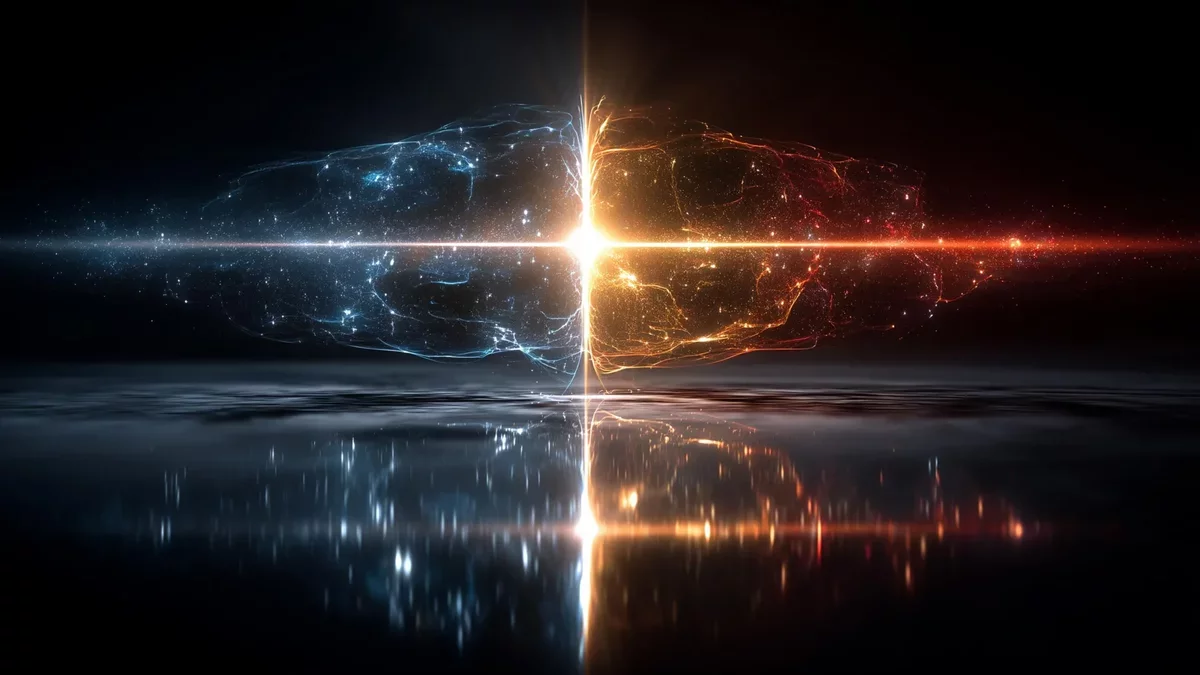
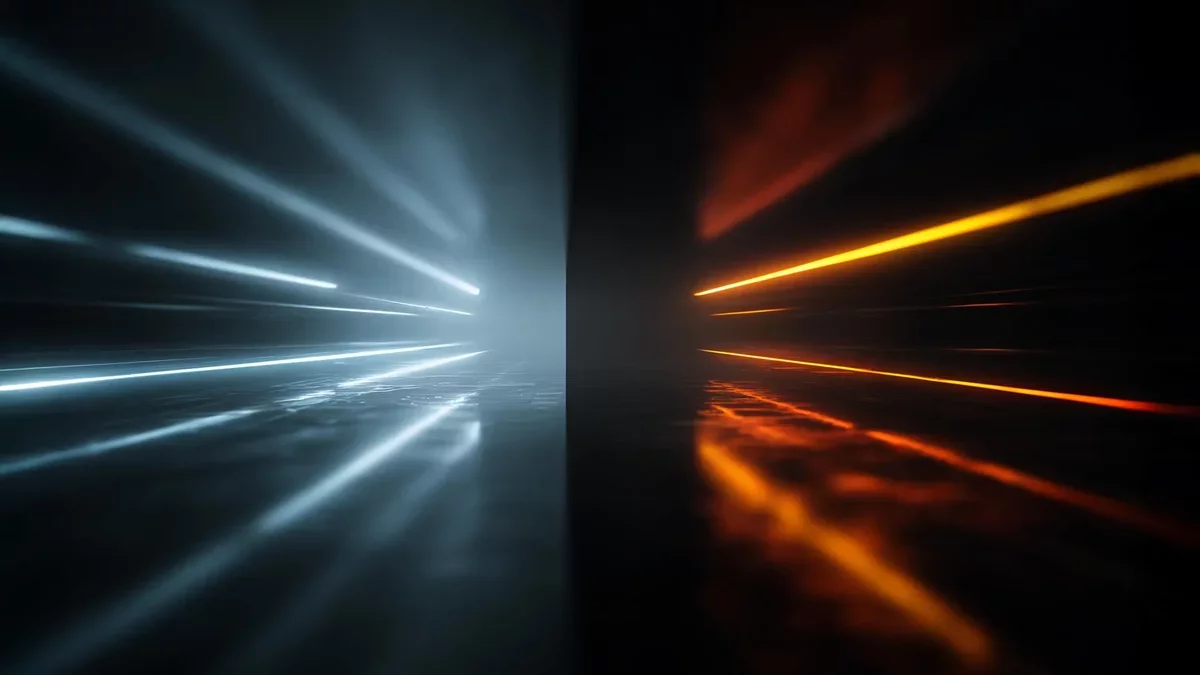
Recent research conducted by a team of physicists, including myself, indicates that the original Einstein-Rosen bridge may point to something more profound than a mere wormhole. This interpretation suggests that the bridge serves as a mirror in spacetime, connecting two microscopic arrows of time.
Quantum mechanics governs the behavior of particles at the smallest scales, while Einstein's theory of general relativity describes gravity and spacetime. The challenge of reconciling these two frameworks has long puzzled scientists, and our new perspective may provide a promising avenue for resolution.
A Misunderstood Legacy
The concept of wormholes gained traction decades after the work of Einstein and Rosen, particularly in the late 1980s when physicists speculated about traversing spacetime. However, these explorations indicated that such journeys are theoretically impossible within general relativity, as the bridge collapses faster than light can traverse it, rendering it non-traversable.
Despite this, the metaphor of wormholes has thrived in popular culture and speculative physics, inspiring numerous theories, books, and films. Nevertheless, there remains a lack of observational evidence for macroscopic wormholes, and speculative extensions to support their existence have yet to be validated.
Two Arrows of Time
Our recent findings revisit the Einstein-Rosen bridge using a modern quantum interpretation of time, building on concepts proposed by researchers like Sravan Kumar and João Marto. Fundamental laws of physics do not differentiate between past and future, which leads to a new understanding of the bridge as two complementary components of a quantum state, where time flows in both directions.
This duality is crucial for a complete physical description, especially near black holes or in dynamic cosmic environments. Here, both time directions must be considered for a coherent quantum framework, allowing the Einstein-Rosen bridges to emerge naturally.
Solving the Information Paradox
At the quantum level, the bridge facilitates the passage of information across what appears to be an event horizon, challenging the notion that information is lost in black holes. This perspective offers a resolution to the black hole information paradox, suggesting that information evolves along a reversed temporal direction rather than disappearing entirely.
Our understanding of time is often limited by our macroscopic experiences, yet quantum mechanics reveals a more complex reality. Interestingly, evidence for this hidden structure may exist in the cosmic microwave background, which hints at a preference for certain spatial orientations.
Echoes of a Prior Universe?
This new interpretation leads to a fascinating possibility: the Big Bang may not have been the absolute beginning but rather a transition between two time-reversed phases of cosmic evolution. In this model, black holes could serve as bridges between different cosmic epochs, suggesting our universe may have originated from a previous collapsed state.
This perspective enriches our understanding of the universe, suggesting that the Big Bang was not a singular start but a gateway to a more complex cosmic history. By embracing this duality of time, we may uncover deeper truths about the fabric of reality itself.