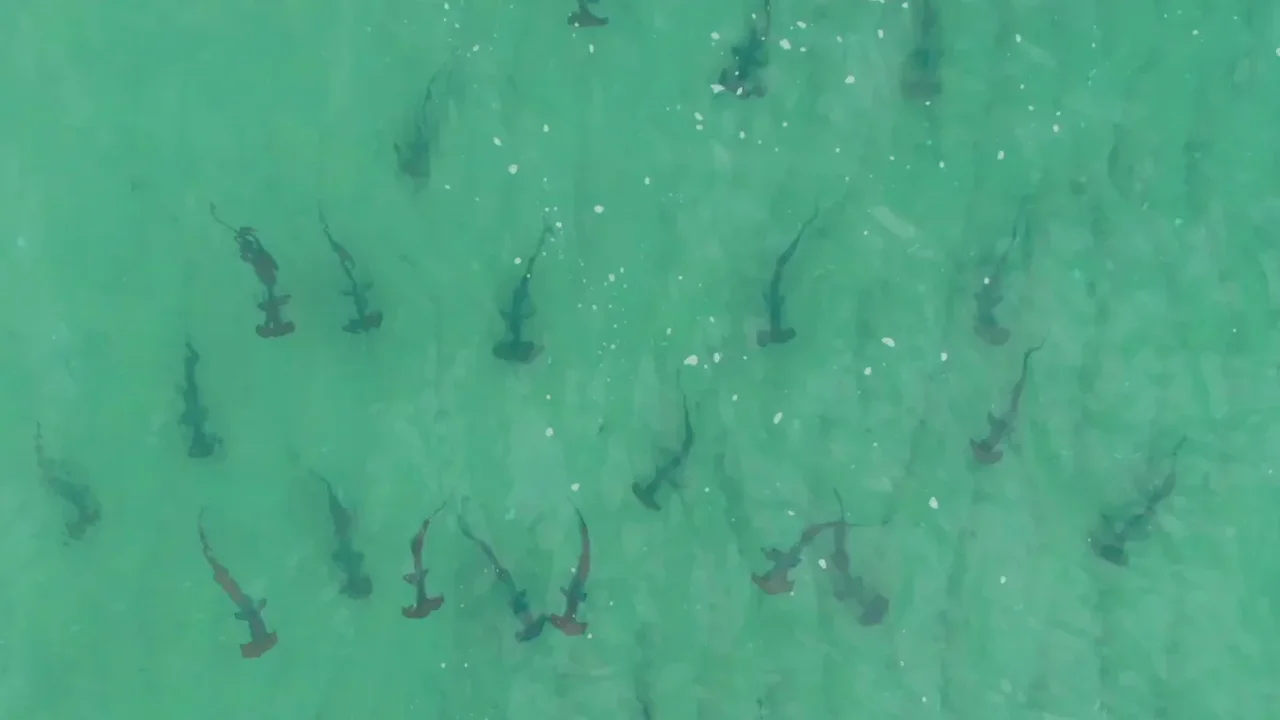
Drone monitoring along southeast Queensland's coast has revealed groups of young scalloped hammerhead sharks gathering in shallow waters near popular beaches. The findings suggest these coastal areas could play a role in the species' early life, although researchers have not confirmed them as nurseries.
Researchers analyzed observations collected through Queensland's SharkSmart drone program at nine beaches between September 2020 and December 2024. They recorded 84 scalloped hammerhead sightings among 2,696 shark observations. Because the same sharks may have appeared more than once, the total does not represent a count of individual animals.
The largest groups were recorded at Noosa Main Beach, where researchers estimated up to 100 sharks, and Burleigh Beach, where groups reached 80. Most were juveniles, averaging about 1.1 metres long. Gatherings were most frequent from April to June, and at Burleigh, sharks were repeatedly observed near a rocky headland.
Potential habitat for young sharks
Food and shelter near reefs and headlands may help explain why juveniles gather in these areas, but the study did not determine the cause. The researchers also note that sightings varied with conditions such as water clarity, location and time of day. A lack of observations does not necessarily mean sharks were absent.
Published in Marine Biology, the research highlights how drone surveys can reveal patterns that conventional monitoring may miss, while observing sharks in shallow water without capture or tagging. Repeated sightings point to possible habitat importance, but researchers say more evidence is needed to establish how long individual sharks stay and whether the sites meet scientific definitions of nurseries.
Continued monitoring could help clarify the role of Queensland's coastal waters and guide future conservation planning for this critically endangered species. Better knowledge of where young hammerheads gather may help shape more informed protection of marine habitats.