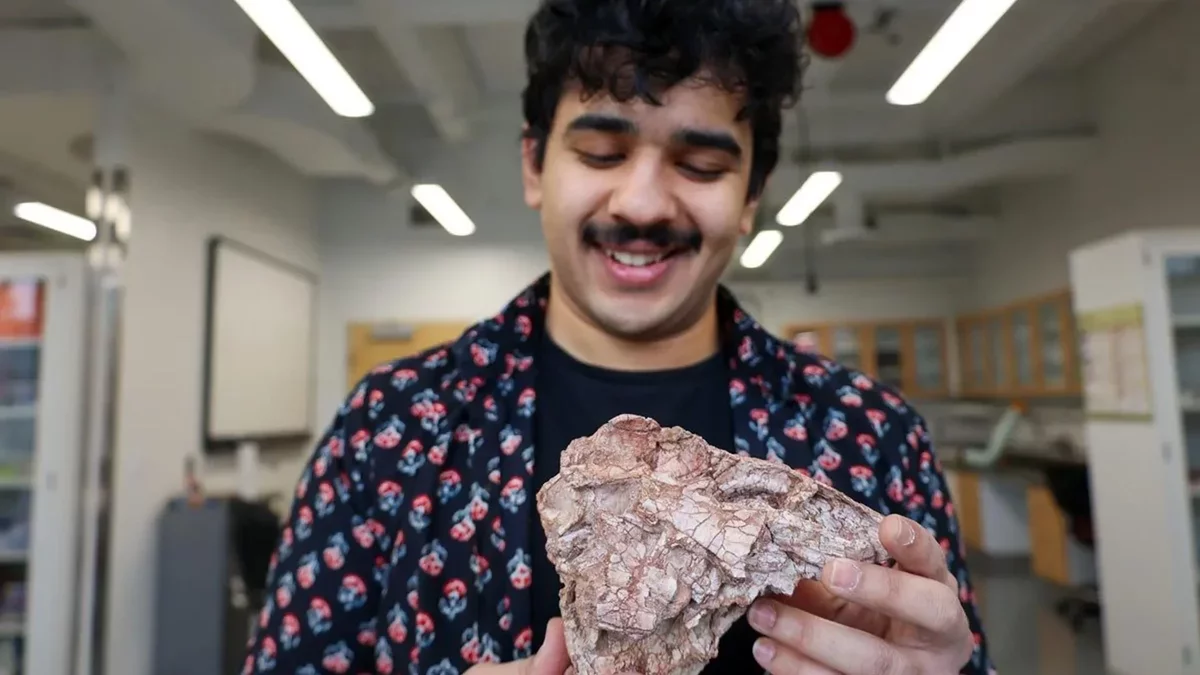
Within the paleobiology lab at Virginia Tech, an undergraduate student held up a remarkably damaged dinosaur skull, a testament to the mysteries of evolution. Despite its poor condition, Srivastava, a senior majoring in geosciences, dedicated two years to meticulously reconstructing this fossil, ultimately publishing his findings in Papers in Palaeontology. His research sheds light on the rise of dinosaurs during the Jurassic period.
Typically, such intricate studies are reserved for seasoned scientists, but geobiologists Sterling Nesbitt and Michelle Stocker welcomed Srivastava to the project as a first-year student. "We aim to immerse undergraduate researchers in the full spectrum of paleontological research at Virginia Tech," Nesbitt stated. "Simba took charge of the project with enthusiasm."
Unraveling a Rare Dinosaur Skull
This fossil has a fascinating backstory. Initially unearthed in 1982 by a team from the Carnegie Museum of Natural History at Ghost Ranch, New Mexico, it was rediscovered by Nesbitt over three decades later and brought to Virginia Tech for further analysis.
Employing computed tomography scanning, Srivastava digitally isolated the fragmented bones and produced a 3D-printed reconstruction of the skull. This specimen belonged to a carnivorous dinosaur species that existed more than three times earlier than the famed Tyrannosaurus Rex. These creatures thrived towards the end of the Triassic period, competing for survival alongside early crocodilian and mammalian relatives.
The Ascendancy of Dinosaurs
Following a significant mass extinction event, the competitive landscape shifted dramatically, enabling dinosaurs to emerge as the dominant terrestrial animals. "Dinosaurs transitioned from supporting roles to becoming the main attraction," remarked Srivastava.
Fossils from this pivotal transitional phase are scarce, particularly well-preserved specimens from the late Triassic, making this damaged skull exceptionally valuable. Notably, no other specimens have been documented that resemble it, providing unique insights into early dinosaur evolution.
Even in its compromised state, the fossil revealed remarkable anatomical features. It exhibited large cheekbones, a broad braincase, and a likely short, deep snout--characteristics previously unobserved in early dinosaurs, indicating a more complex evolutionary trajectory than previously recognized.
A New Species with Distinctive Features
Based on its peculiar appearance, Srivastava named the new species Ptychotherates bucculentus, translating to "folded hunter with full cheeks" in Latin. A paleo-artist humorously described it as resembling a "murder muppet."
After extensive analysis, the team concluded that this dinosaur belonged to Herrerasauria, one of the earliest carnivorous dinosaur groups, and appeared to be among the last representatives of this lineage.
Reassessing the End-Triassic Extinction
The fossil prompted an unexpected revelation. Ptychotherates was discovered in rock layers that may date just before the Triassic mass extinction, suggesting that this lineage might have faced extinction as a direct consequence of that event. "This compels us to reevaluate the end-Triassic extinction's impact on not just dinosaur competitors but also long-established dinosaur groups," Srivastava noted.
Given that no herrerasaurians have been found dating to such a late point in the Triassic, scientists surmise that the American Southwest may have served as their last refuge.
One Fossil, an Entire Lost Lineage
Srivastava's "folded hunter" may represent the final evidence of this dinosaur group. "This specimen fits in my hands, yet it encapsulates the existence of countless individuals throughout time," he reflected. "It is the sole proof of their survival and evolution into this unique skull shape."