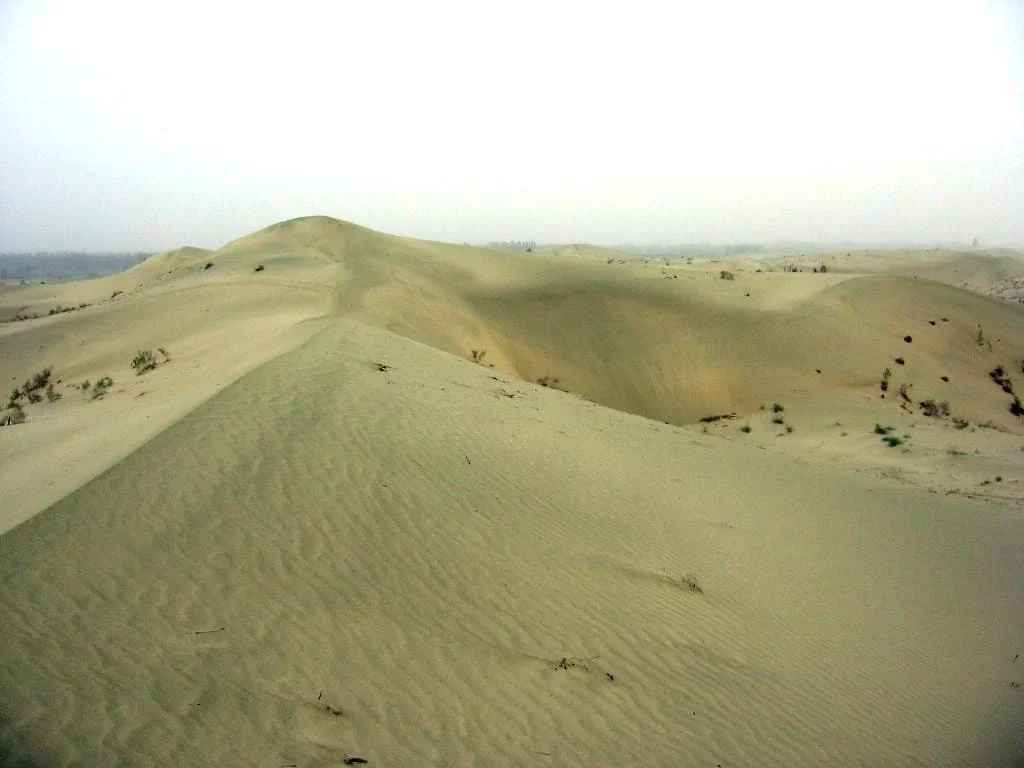
The Taklamakan Desert, known for its harsh conditions and vast stretches of sand, has undergone a remarkable transformation. Once labeled as "The Place of No Return," this expansive area in western China, spanning 130,000 square miles, was long seen as a barren wasteland until a groundbreaking initiative began in 1978.
China's ambitious Three-North Shelterbelt Program aimed to create a "Great Green Wall" by planting billions of trees to combat the advancing Gobi and Taklamakan deserts. Against considerable odds, this initiative is showing promising results, with vegetation gradually reclaiming the desert's perimeter and converting it into a functional carbon sink.
The Glow of Success
Despite facing criticism regarding the survival rates of trees in arid regions, the project has yielded positive outcomes. Researchers have noted that while these forests can be water-intensive, leading to concerns about exacerbating desertification, the overall impact appears to be beneficial.
Using Solar-Induced Fluorescence (SIF), researchers led by Salma Noor discovered that the Taklamakan emits a faint glow during photosynthesis, indicating that carbon absorption is happening. While the scale of carbon sequestration may be modest, the consistent drawdown of CO2 is a noteworthy achievement.
"This isn't a rainforest," explains UCR atmospheric physicist King-Fai Li. "It resembles shrubland, but its ability to capture CO2 is a measurable success."
Challenges Ahead
The success of the Taklamakan project can be attributed to its unique geographical features, surrounded by towering mountains. As climate change accelerates glacier melting, a temporary influx of water nourishes the irrigation systems sustaining the "Great Green Wall." However, this reliance on water resources poses a significant risk. If glacial runoff diminishes, the green wall could revert to a barren state.
Implementing similar projects in other deserts, such as the Sahara, would encounter substantial challenges due to the lack of high-altitude runoff. Replicating this success would require innovative solutions, including large-scale desalination or accessing ancient aquifers.
Additionally, the ecological impact of converting bright deserts into darker vegetation is a concern. The absorption of solar radiation could inadvertently raise local temperatures, complicating the environmental balance.
Why This Matters
Current studies suggest that the carbon sequestration benefits in the Taklamakan outweigh the potential heating effects. Increased vegetation promotes "evapotranspiration," leading to localized cooling and potentially enhanced rainfall.
"Planting trees alone won't resolve the climate crisis," Li emphasizes. "However, understanding the conditions under which CO2 can be effectively captured is crucial."
The Taklamakan initiative exemplifies how human intervention can combat desertification and foster sustainable carbon sinks in challenging environments. It serves as a reminder that with strategic planning and dedication, even the most desolate landscapes can be revitalized.