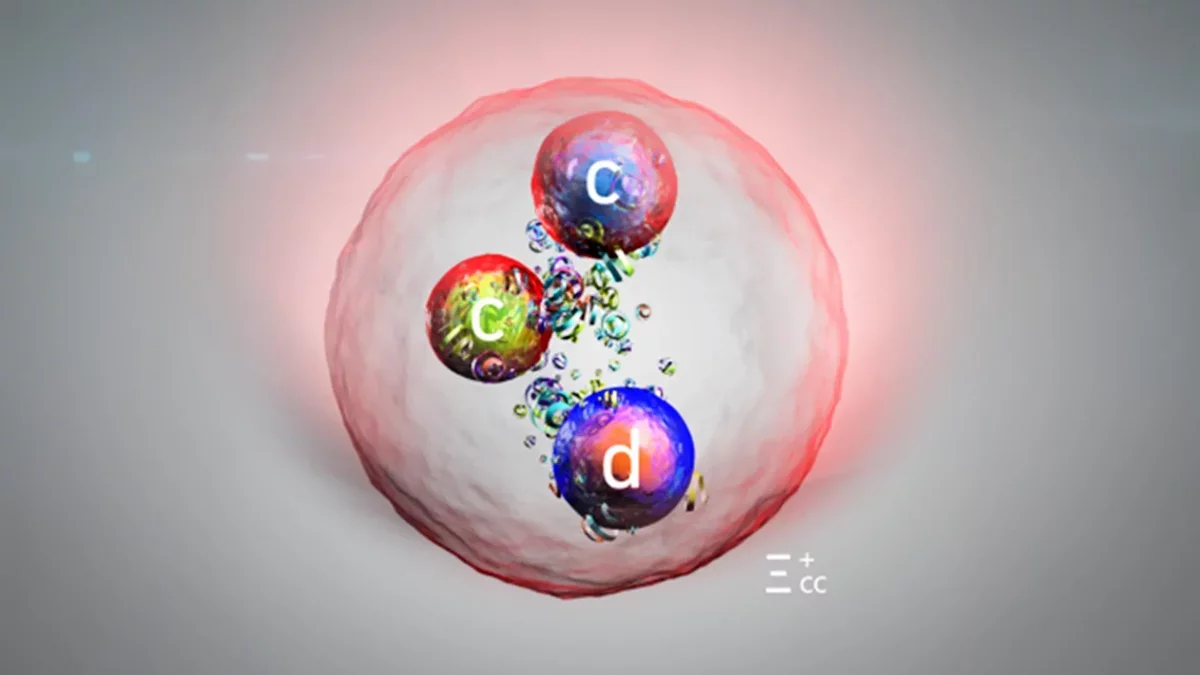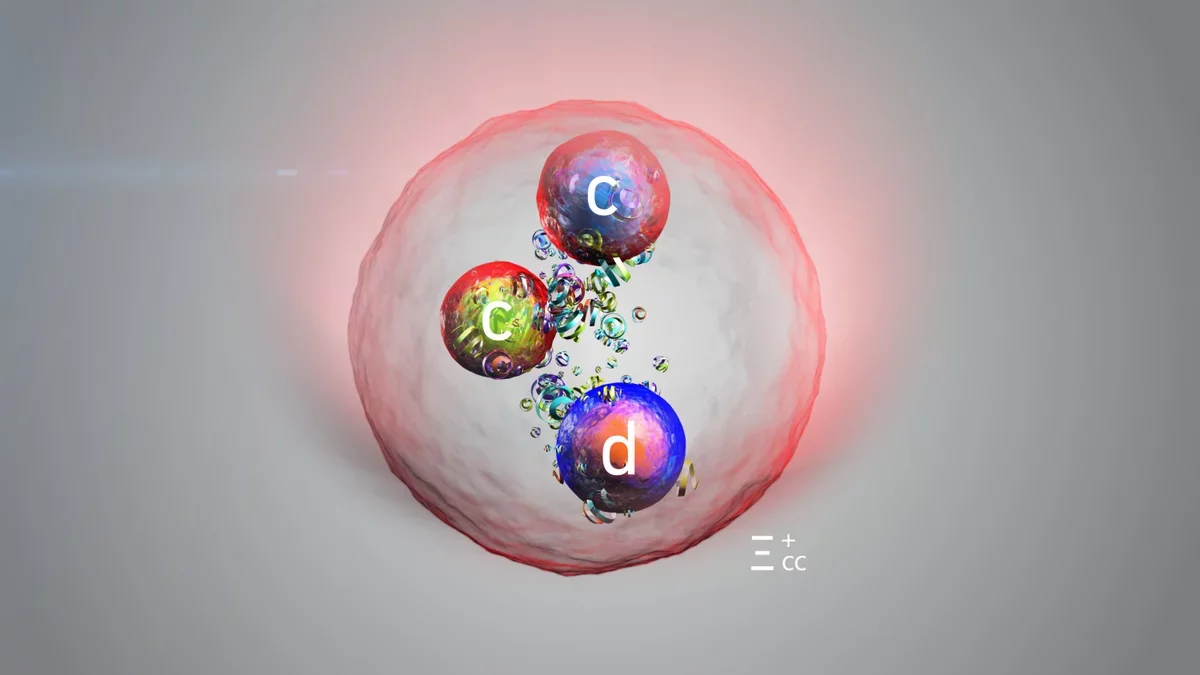
After two decades of searching, CERN has successfully identified a rare heavy relative of the proton, known as Ξcc⁺. Pronounced "Zye," this particle has eluded detection for years, but its recent observation marks a significant achievement in particle physics.
This discovery highlights the effectiveness of CERN's upgraded detectors, providing a fresh perspective on the "strong force," the fundamental interaction that binds all atoms together. The Ξcc⁺ belongs to the same family as protons and neutrons, which are the building blocks of atomic nuclei.
A Unique Particle in the Proton Family
While a proton consists of two up quarks and one down quark, the Ξcc⁺ is composed of one down quark and two charm quarks, making it a heavier and exceedingly rare counterpart. Understanding such particles is crucial, as they provide insights into the fundamental forces that govern matter.
A Prolonged Search
Physicists have long theorized the existence of the Ξcc⁺. In 2017, a closely related particle, Ξcc⁺⁺, was discovered, which contained charm quarks paired with an up quark. The absence of the Ξcc⁺ had left scientists puzzled, but advancements in detector technology have now provided the clarity needed to confirm its existence.
"This discovery is just the beginning of what we can learn with the new LHCb detector," remarked Prof. Tim Gershon from the University of Warwick. The improved capabilities allowed scientists to detect the particle in just one year, a feat that previously required a decade of data collection.
The Broader Significance
The existence of the Ξcc⁺ is significant beyond the realm of particle physics. It enhances our understanding of the four fundamental forces of nature: gravity, electromagnetism, the strong nuclear force, and the weak nuclear force. The strong force, which binds protons and neutrons within atomic nuclei, operates over very short distances, making it challenging to study.
Rare particles like the Ξcc⁺ provide researchers with new avenues to test theories of quantum chromodynamics, the framework describing how quarks interact. LHCb spokesperson Vincenzo Vagnoni emphasized that confirming more particle types enriches our understanding of matter and the universe.
This breakthrough not only closes a long-standing gap in particle physics but also opens new pathways for exploration into the fundamental nature of matter, potentially reshaping our comprehension of the universe.