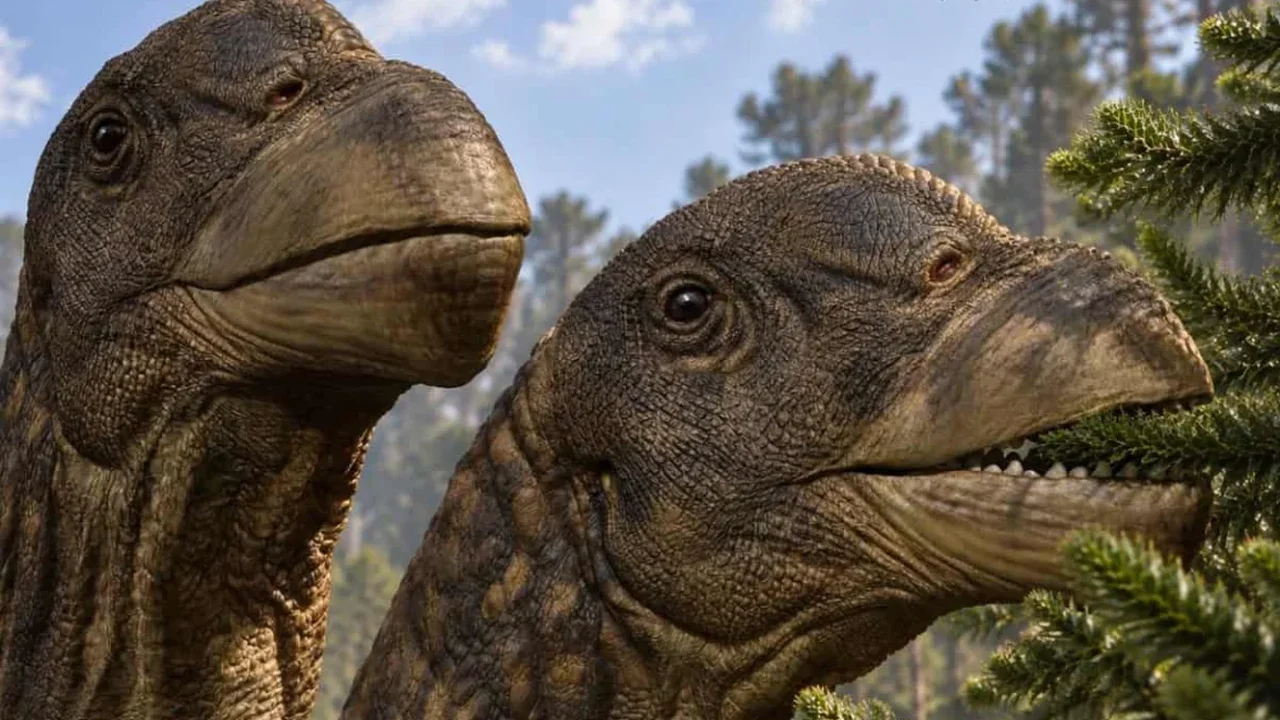
Long-necked sauropods are often imagined with skin drawn tightly over their delicate skulls. New research suggests that image may need a major update: Camarasaurus may have had a broad, keratin-rich mouth covering resembling a turtle-like beak while retaining its full set of teeth.
The proposed structure, called an odontoscutum, would have covered and reinforced the outer surfaces of the upper and lower jaws. Rather than hiding the teeth entirely, the tissue may have supported their bases while leaving their tips exposed for feeding.
Clues in Ancient Bone
Researchers investigated tiny openings and grooves in the skull that once carried nerves and blood vessels. These patterns were compared with more than 300 living reptiles and birds, including animals with fleshy lips, visible teeth and keratinous beaks.
In these comparisons, Camarasaurus and two other sauropods showed anatomical signals closer to modern animals with hardened facial coverings. The findings support the possibility that this dinosaur's face was fuller and more structurally protected than traditional skeletal reconstructions suggest.
Living around 150 million years ago in what is now the western United States, Camarasaurus was a large Jurassic plant-eater with a short, tall skull and sturdy spoon-shaped teeth. Its dental anatomy was suited to processing relatively tough vegetation, making a reinforced jaw covering a plausible functional feature.
A New View of Sauropod Faces
The study builds on earlier research indicating that sauropod teeth may have been held in place by substantial soft tissue. Fossil teeth are sometimes preserved in organized rows even after much of the jaw bone has disappeared, suggesting that connective tissues played an important role in stabilizing the dentition.
The new analysis remains a preprint, meaning it has not yet completed peer review. Its fossil sample is also limited, so broader conclusions about all sauropods will require additional skulls and further anatomical testing.
Still, the research highlights how fossils can reveal more than bones alone. As paleontologists refine methods for reconstructing skin, muscles and keratin, dinosaurs such as Camarasaurus may emerge with far more distinctive and lifelike faces.
This approach could reshape future dinosaur reconstructions by bringing ancient animals closer to their true biological diversity.