Astronomers have identified radio emission that appears to originate directly from Beta Pictoris b, a young gas giant located about 64 light-years from Earth. The finding could represent the first time radio waves have been confidently traced to an exoplanet rather than its host star.
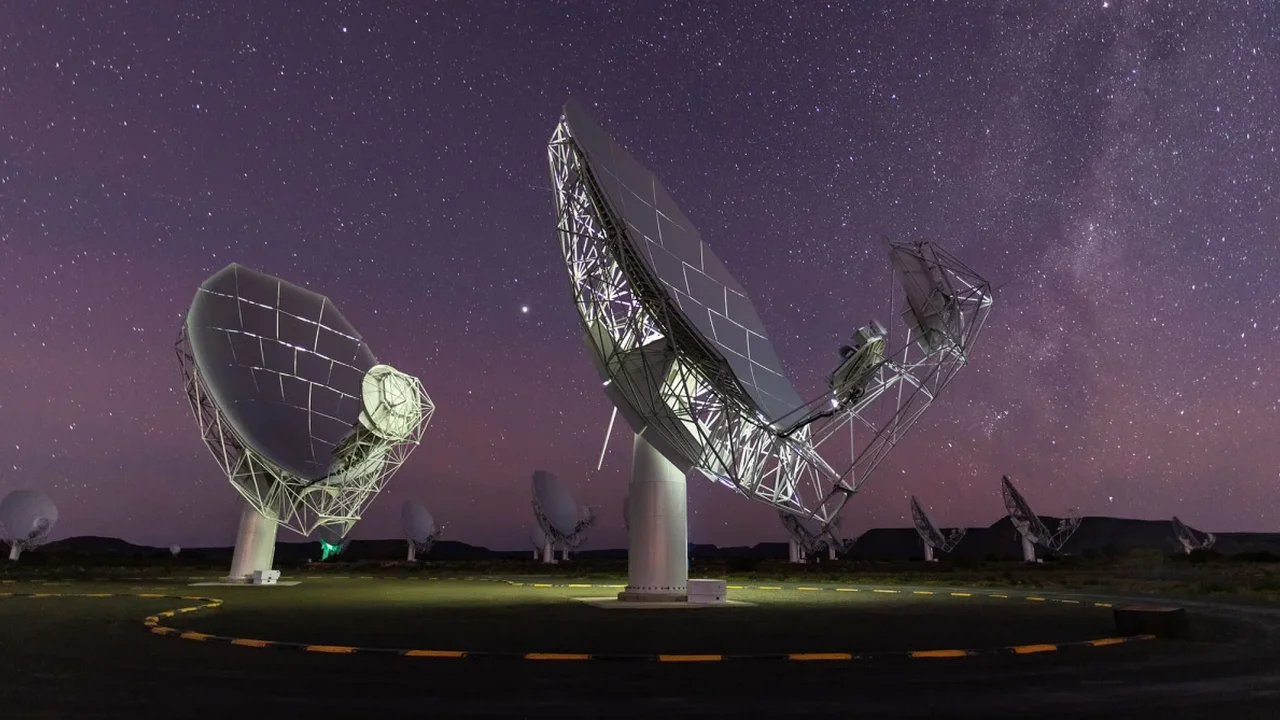
Observed with South Africa's MeerKAT radio telescope array, the signal was detected repeatedly during observations conducted in 2025 and 2026. Its short, variable bursts and strong circular polarization point to a natural auroral process, similar to the magnetic activity behind Earth's polar lights and Jupiter's powerful radio emissions.
A magnetic signature from a distant world
The proposed mechanism is known as electron cyclotron maser instability, in which energetic electrons moving through a magnetic field generate intense radio waves. By measuring the signal's upper frequency limit of 3.5 gigahertz, researchers estimate that the magnetic field at the emission site is at least 1,250 gauss.
That is vastly stronger than Earth's surface magnetic field and suggests that Beta Pictoris b is an exceptionally magnetically active world. The planet is roughly 12 times Jupiter's mass and completes a rotation in about eight to nine hours, a rapid spin that may help power its auroral activity.
To establish the source, the team compared the radio signal's position with highly precise celestial reference points, including measurements from Gaia. The emission aligned with Beta Pictoris b and could be distinguished from its host star and another known planet in the system.
A new tool for studying exoplanets
Magnetic fields play an important role in how planetary atmospheres interact with stellar winds and can reveal details about conditions deep within a planet. Until now, astronomers had identified promising radio activity in planetary systems, but separating a planet's signal from that of its star remained a major challenge.
The result is currently presented as a preprint and awaits peer review. If confirmed, the technique could help astronomers examine magnetic environments around other directly imaged giant planets.
This advance may open a new era in exoplanet research, enabling scientists to explore distant worlds not only through light and motion, but also through their magnetic voices.