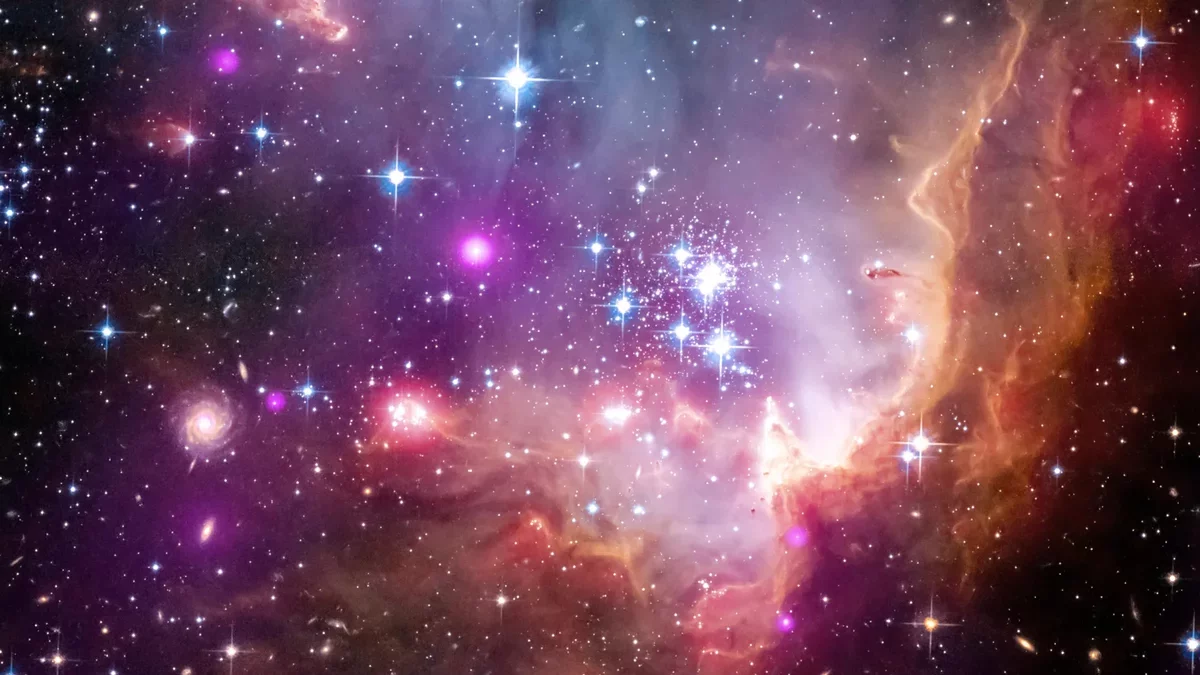
A captivating mystery in the cosmos has recently been unraveled, shedding light on the peculiar behavior of the Small Magellanic Cloud (SMC). Unlike typical galaxies, the stars in the SMC exhibit chaotic motion rather than orderly orbits, prompting scientists to seek an explanation.
Collision Reveals Stellar Secrets
New findings published in The Astrophysical Journal by researchers from the University of Arizona indicate that the SMC's unusual stellar dynamics are the result of a collision with the Large Magellanic Cloud (LMC). This discovery raises important questions about the SMC's utility as a benchmark for understanding galaxy formation and evolution.
"We are witnessing a galaxy undergo a transformation in real time," stated Himansh Rathore, a graduate student at Steward Observatory and the lead author of the study. "The SMC offers us a unique perspective on a critical process that shapes galaxies."
Gas Dynamics and Gravitational Forces
The SMC is predominantly composed of gas rather than stars. Under normal circumstances, this gas would cool and form a rotating disk due to gravitational forces, similar to the formation of our solar system. However, previous observations from the Hubble Space Telescope and the European Space Agency's Gaia satellite revealed that the SMC's stars were not conforming to this expected behavior.
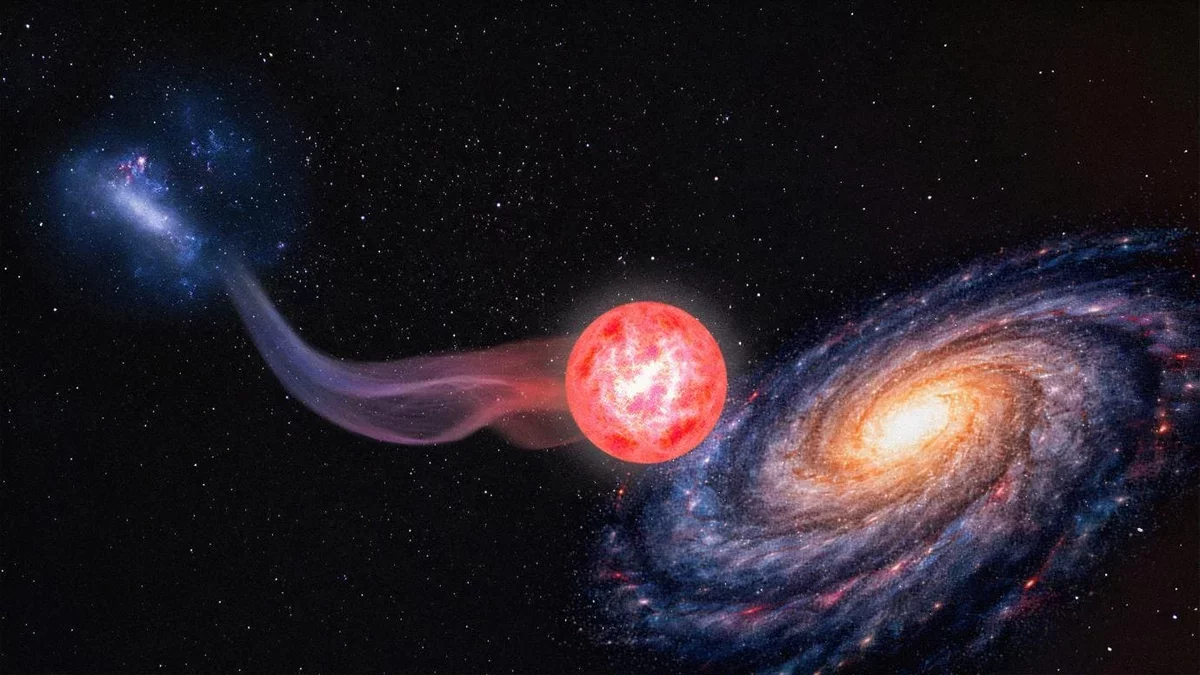
According to Rathore, a collision that took place several hundred million years ago likely caused this disruption. During this event, the SMC passed through the LMC's dense disk, leading to a scattering of its stars and a loss of rotational motion. The gravitational interactions also stripped the SMC's gas of its orderly rotation.
"It's akin to droplets of water being blown off your hand as you move it through the air," Rathore explained. "The SMC's gas experienced similar forces during its passage through the LMC."
Debunking Long-Standing Myths
This research also addresses a long-held misconception regarding the SMC's gas. Observations had suggested that the gas was rotating, leading astronomers to assume that the stars would exhibit similar motion. However, the new analysis clarifies that the apparent rotation was an illusion created by the galaxy's stretched shape following the collision.
Reassessing a Cosmic Reference
Historically, the SMC has been a crucial reference point for studying star formation and galaxy evolution. The latest findings challenge its status as a reliable model.
"The SMC has undergone a significant transformation due to this collision, injecting a substantial amount of energy into the system," remarked Besla, another researcher involved in the study.
Using advanced computer simulations that accounted for the properties of both galaxies, the team explored the SMC's gas behavior within the LMC's dense environment. They developed innovative techniques to interpret the chaotic motions of stars post-collision.
Insights into Dark Matter
The impact may also yield new insights into dark matter. In a related study, the team noted that the collision left a distinct mark on the LMC, tilting its central bar-shaped structure--a feature linked to the interaction.
Rathore emphasized that this tilt could provide a new method for estimating dark matter, which remains elusive to direct observation. "Astronomy often captures a moment in time, but these two galaxies have transformed through their close encounter," he concluded.